


FSSAI State License vs Central License: Which One Does Your Food Business Actually Need?
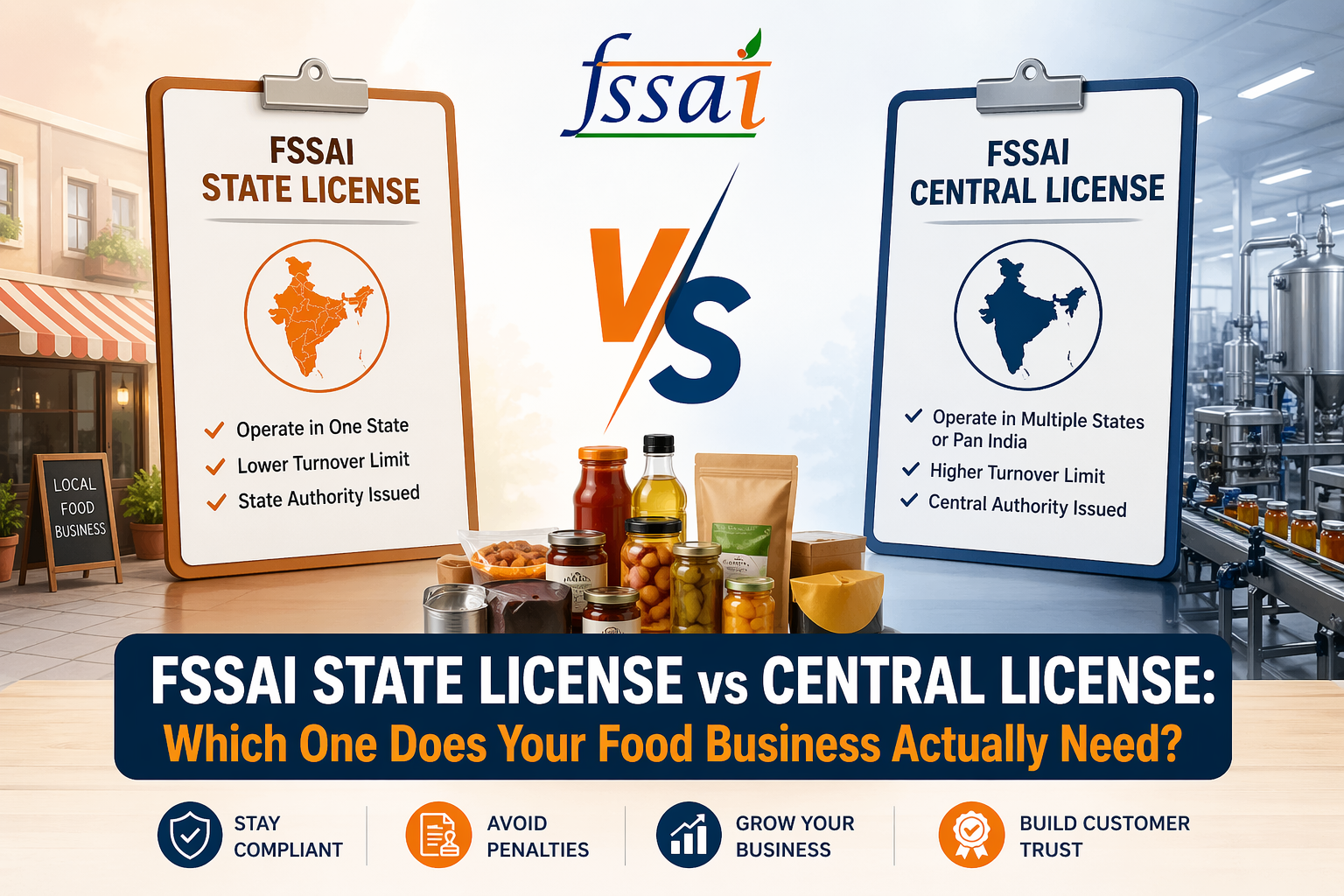
If you're starting a food business in India whether it's a cloud kitchen, a packaged snacks brand, a restaurant chain, or a food import company one of the first compliance questions you'll face is this:
Do I need an FSSAI State License or a Central License?
It sounds like a bureaucratic detail, but getting it wrong can mean delays, penalties, or even forced shutdowns. And yet, most resources on the internet either oversimplify the answer or drown you in legal jargon.
This guide cuts through the noise. By the end of it, you'll clearly understand which license applies to your business, why the distinction matters, and what the application process actually looks like explained by someone who has helped multiple food businesses navigate FSSAI license compliance from scratch.
What Is FSSAI, and Why Does It Issue Different Types of Licenses?
The Food Safety and Standards Authority of India (FSSAI) is the apex body responsible for regulating food safety across the country. Established under the Food Safety and Standards Act, 2006, it operates under the Ministry of Health and Family Welfare.
FSSAI doesn't issue a one-size-fits-all license. Instead, it has a three-tier registration and licensing system designed to match the regulatory burden with the scale of the business:
-
Basic Registration For very small food businesses with annual turnover below ₹12 lakh
-
State License For mid-sized businesses operating within a single state
-
Central License For large-scale businesses, those operating across multiple states, or those engaged in import/export
The logic is simple: a roadside dhaba and a multinational food company should not face identical regulatory requirements. The system scales oversight to match the potential risk to public health.
FSSAI State License
The FSSAI State License is issued by the State Food Safety Authority of the respective state government. It is applicable to food businesses that operate within the boundaries of a single state and have a certain scale of operations.
Eligibility Criteria for State License
You would typically apply for a State License if your business meets any of the following conditions:
-
Annual turnover is between ₹12 lakh and ₹20 crore
-
You operate a medium-scale manufacturing unit within one state
-
You run a restaurant, hotel, or food service outlet that isn't part of a national chain
-
You are a retailer, distributor, or wholesaler operating within a single state
-
You operate a storage unit (cold storage or warehouse) with a capacity of less than 50,000 MT
-
You run a petty food manufacturer with production capacity not exceeding 100 kg/litre per day (excluding milk and meat)
The key phrase here is within a single state. The moment your business crosses state borders for operations, not just sales the Central License becomes relevant.
Validity and Fee
A State License is typically issued for 1 to 5 years, with annual fees ranging from ₹2,000 to ₹5,000 depending on the category and state.
FSSAI Central License: Who Is It For?
The Central License is issued by the Central Licensing Authority specifically, the Designated Officer appointed by the FSSAI at the central level. It carries a higher degree of scrutiny and is mandatory for businesses with a wider operational footprint or higher risk profile.
Eligibility Criteria for Central License
You need a Central License if your food business falls into any of these categories:
-
Annual turnover exceeds ₹20 crore
-
You are a food importer or exporter
-
You operate in more than one state even if it's just a registered office in one state and a warehouse or manufacturing unit in another
-
You are a manufacturer supplying to government departments (defense, railways, etc.)
-
You operate a large food manufacturing unit (e.g., a dairy processing plant with over 50,000 litre/day capacity)
-
You run an e-commerce food business operating across states
-
You manage a central/head office of a food business that has branches in multiple states (the head office gets a Central License; each branch may need a State License in its respective state)
One important nuance that trips up many entrepreneurs: even if your sales happen nationally, what matters is where your operations are physically located. A single-state manufacturer selling pan-India via e-commerce may still qualify for a State License, while a business with warehouses in Mumbai and Delhi needs a Central License
The Core Difference Between FSSAI State and Central License
Let's break down the key differences clearly, so you can make a confident decision:
1. Issuing Authority
The most fundamental distinction is who issues the license:
-
State License → Issued by the State Food Safety Authority (state government body)
-
Central License → Issued by the Central Licensing Authority under FSSAI (central government body)
This matters because the jurisdiction of enforcement, inspection, and appeal also follows this division.
2. Turnover Threshold
-
State License: Annual turnover between ₹12 lakh and ₹20 crore
-
Central License: Annual turnover above ₹20 crore
However, turnover is not the only deciding factor it works in combination with the operational scope and business category.
3. Operational Geography
This is often the most decisive factor in practice:
-
State License: All operations (manufacturing, storage, distribution) within a single state
-
Central License: Operations spanning two or more states, or import/export activity
4. Business Categories Covered
Some business types are mandatorily covered under the Central License regardless of turnover these include food importers, exporters, and suppliers to certain government entities. No matter how small the operation, these categories must go to the central level.
5. Application Portal
Both licenses are applied for on the FoSCoS portal (Food Safety Compliance System the upgraded replacement for the older FLRS portal). The system automatically directs your application to the appropriate authority based on the information you provide.
6. Fee Structure
Central License fees are higher, ranging from ₹7,500 to ₹30,000 per year depending on the category, compared to State License fees of ₹2,000–₹5,000 per year.
7. Inspection and Compliance Rigor
Central License holders are subject to more frequent and thorough inspections by FSSAI-appointed officers. The documentation requirements including quality control records, food safety management systems, and product testing reports are also more extensive.
Head Office + Branch Model
Many growing food businesses get confused when they have a registered head office in one city and operating units (kitchens, warehouses, or outlets) in multiple cities across states.
Here's how FSSAI handles this:
-
The head office must obtain a Central License (since the business has a multi-state presence)
-
Each branch, outlet, or unit in a specific state must obtain a State License from that state's authority
So if you run a QSR chain with your head office in Bengaluru and outlets in Pune, Hyderabad, and Chennai, you'll need:
-
1 Central License for the head office
-
Separate State Licenses for each state where outlets operate (Maharashtra, Telangana, Tamil Nadu)
This is not duplication it's how the system is designed to ensure local food safety oversight while centralizing overall accountability.
Documents Required
While the core document set is similar, Central License applications typically require more detailed technical documentation.
Common Documents for Both
-
PAN card of the business/proprietor/partners/directors
-
Proof of business address (rent agreement + NOC, or ownership documents)
-
Identity and address proofs of proprietor/partners/directors
-
Passport-size photographs
-
Blueprint or layout plan of the food processing unit
-
List of food products to be manufactured or handled
-
Food Safety Management System (FSMS) plan
-
Bank account details
Additional Documents for Central License
-
IE Code (Import Export Code) mandatory for importers/exporters
-
NOC from local body/municipal corporation
-
Proof of turnover (audited financial statements)
-
Water testing report (for manufacturing units)
-
Details of technical personnel/food safety supervisor
-
Copy of recall plan (for manufacturers)
-
Pesticide residue report (for certain categories)
The Central License process is deliberately more rigorous because the businesses it covers have a wider potential impact on food safety across the country.
How to Apply
Both State and Central License applications are filed online through the FoSCoS portal at foscos.fssai.gov.in.
Step 1: Register on FoSCoS Create a login using your mobile number or email. This gives you access to the unified application dashboard.
Step 2: Select License Type The system will prompt you to answer a few questions about your business — turnover, number of states of operation, business category, etc. Based on your responses, it will guide you toward the appropriate license type.
Step 3: Fill the Application Form Complete Form B (for both State and Central Licenses). Be precise about your business activities, product categories, and production capacities. Errors here can lead to rejection.
Step 4: Upload Documents Attach all required documents in the prescribed format. File sizes and formats are specified on the portal.
Step 5: Pay the Fee Pay online through net banking, UPI, or debit/credit card. Keep the payment receipt.
Step 6: Inspection For manufacturing units especially, expect a physical inspection by a Food Safety Officer before the license is granted. Be prepared with your premises, equipment, and quality records.
Step 7: License Issuance Once verified, the license is issued digitally. It should be displayed prominently at your business premises.
Typical Timeline:
-
State License: 30–60 days
-
Central License: 60–90 days (can be longer if inspection is required)
Penalties for Operating Without the Correct License
This is where many food businesses underestimate the stakes. Operating without a valid FSSAI license or with the wrong category of license can attract significant consequences:
-
Fine of up to ₹5 lakh for manufacturing or selling food without a license (Section 63, FSS Act)
-
Imprisonment up to 6 months in cases of persistent violations
-
Product seizure and destruction if food is found unsafe or mislabeled
-
Business closure orders from food safety authorities
Beyond legal penalties, an FSSAI license is increasingly required by:
-
Retail chains and supermarkets before onboarding suppliers
-
E-commerce platforms (Amazon, Flipkart, Swiggy, Zomato) for listing food products
-
Export partners and international buyers
Conclusion
The distinction between an FSSAI State License and a Central License isn't just paperwork it reflects the scale of your accountability in the food safety ecosystem. Getting the right license from the start keeps your business compliant, builds trust with buyers and partners, and protects you from regulatory action down the line.

