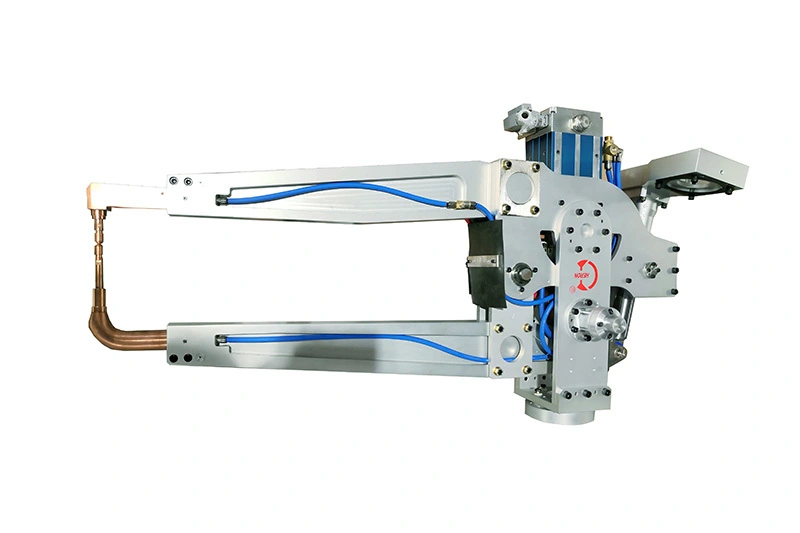
In today’s lightweight manufacturing landscape, the demand for efficient, precise, and high-strength aluminum joining has increased dramatically across automotive, aerospace, EV battery systems, and industrial fabrication. Among the most reliable solutions, the aluminum spot welder plays a critical role in delivering repeatable weld quality while supporting high-volume production environments.
However, welding aluminum is not as straightforward as steel. Its high conductivity, oxide layer, and thermal behavior require specialized equipment and process control. This is where advanced resistance welding systems like those developed by Heron Welder become essential for consistent industrial performance.
What is an Aluminum Spot Welder?
An aluminum spot welder is a resistance welding machine designed to join aluminum sheets or components by passing a high electrical current through clamped materials under pressure. The heat generated at the interface melts the metal locally, forming a weld nugget that solidifies under electrode force.
Unlike steel welding, aluminum requires:
- Higher current density
- Precise pulse control
- Shorter welding cycles
- Strong electrode force
These requirements are essential due to aluminum’s high thermal conductivity and low electrical resistance, which rapidly dissipate heat from the weld zone.
Why Aluminum Spot Welding is Technically Challenging
Aluminum is widely used in lightweight structures, but it presents several welding challenges:
1. High Thermal Conductivity
Heat spreads quickly away from the weld zone, making it difficult to maintain a stable molten nugget.
2. Oxide Layer Formation
Aluminum naturally forms a strong oxide layer that melts at a much higher temperature than aluminum itself, increasing contact resistance inconsistency.
3. Electrode Wear
The interaction between aluminum and copper electrodes accelerates wear, affecting weld quality over time.
4. Process Sensitivity
Even small variations in pressure, current, or timing can significantly impact weld strength and consistency.
According to industrial studies, aluminum spot welding requires 2–3 times more current than steel welding, making advanced control systems essential for stable production.
How an Aluminum Spot Welder Works
The welding process typically follows a controlled three-stage cycle:
1. Squeeze Phase
Electrodes apply high force to ensure intimate contact and reduce resistance variation at the joint.
2. Welding Phase
A high current pulse is applied for milliseconds, generating heat at the interface and forming a molten weld nugget.
3. Forging & Cooling Phase
Pressure is maintained after current cutoff, allowing the weld to solidify under compression for maximum strength.
Modern systems, especially MFDC-based aluminum spot welders, provide precise current modulation and real-time feedback, ensuring stable nugget formation even under challenging conditions.
Key Technologies in Modern Aluminum Spot Welders
To overcome aluminum welding limitations, advanced industrial systems integrate several technologies:
MFDC (Medium Frequency Direct Current) Technology
MFDC is considered the industry standard for aluminum spot welding due to:
- Stable DC output without zero-crossing loss
- Higher thermal efficiency
- Improved weld consistency
- Reduced electrode wear
Adaptive Current Control
Automatically adjusts current based on material thickness and surface condition.
Multi-Pulse Welding Profiles
Preheating + welding + forging pulses improve nugget formation and reduce defects.
Electrode Monitoring Systems
Detect wear and contamination in real time to maintain consistent weld quality.
Industrial Applications of Aluminum Spot Welding
Aluminum spot welding is widely used in industries where lightweight strength and structural integrity are critical.
Automotive & EV Manufacturing
- Battery trays
- Body-in-white structures
- Lightweight chassis components
Aerospace Industry
- Fuselage panels
- Interior structural frames
- Lightweight support assemblies
Electrical & Energy Systems
- Busbars
- Power enclosures
- Heat-dissipation structures
Industrial Equipment Manufacturing
- Aluminum housings
- Machinery enclosures
- Structural panels
Aluminum Spot Welding vs Traditional Welding Methods
| Feature |
Aluminum Spot Welding |
MIG/TIG Welding |
| Speed |
Very high (mass production) |
Moderate to slow |
| Automation |
Fully automated |
Semi-manual |
| Consistency |
Excellent in production lines |
Operator dependent |
| Heat Input |
Localized |
Wider heat affected zone |
| Cost Efficiency |
High for mass production |
Higher labor cost |
For OEMs and high-volume manufacturers, aluminum spot welding provides a faster, more repeatable, and automation-friendly solution compared to arc welding methods.
Best Practices for High-Quality Aluminum Spot Welding
To achieve reliable weld quality, engineers should focus on:
1. Surface Preparation
Remove oxide layers using brushing or chemical cleaning before welding.
2. Electrode Maintenance
Regular dressing prevents contamination buildup and ensures consistent current flow.
3. Optimized Welding Parameters
Fine-tune:
- Current intensity
- Weld time
- Electrode force
- Pulse sequence
4. Proper Cooling Strategy
Controlled cooling prevents cracking and improves joint strength.
5. Machine Calibration
Regular calibration ensures stable output and reduces production variability.
Role of Automation in Aluminum Spot Welding
Modern manufacturing is increasingly shifting toward automated welding production lines. Automation improves:
- Production consistency
- Cycle time efficiency
- Quality traceability
- Operator safety
Heron Welder integrates aluminum spot welding into fully automated systems that combine:
- Robotic welding arms
- Intelligent controllers
- Real-time process monitoring
- High-duty cycle welding guns
This makes it ideal for large-scale production environments such as automotive OEM lines and EV battery manufacturing.
Why Choose Heron Welder for Aluminum Spot Welding Solutions
Heron Welder specializes in advanced resistance welding technologies, including:
- Aluminum spot welding machines (MFDC systems)
- Projection welding systems
- Seam welding solutions
- Clinching and FSPR riveting systems
- Automated welding production lines
Our solutions are engineered for:
- High-volume industrial production
- Precision-controlled welding quality
- Reduced operational downtime
- Long-term electrode durability
With decades of expertise in resistance welding innovation, Heron delivers systems designed for modern manufacturing efficiency and global OEM standards.
FAQs About Aluminum Spot Welders
1. Can aluminum be spot welded effectively?
Yes, but it requires high-current MFDC systems and precise control due to aluminum’s conductivity and oxide layer.
2. Why is aluminum harder to spot weld than steel?
Because it conducts heat and electricity rapidly and forms a stable oxide layer that interferes with consistent welding.
3. What industries use aluminum spot welding the most?
Automotive, EV battery production, aerospace, and industrial equipment manufacturing.
4. What type of machine is best for aluminum spot welding?
MFDC resistance spot welding machines are the most effective for stable and high-quality aluminum welds.
5. How can weld quality be improved?
By optimizing parameters, maintaining electrodes, and ensuring proper surface preparation.
Final Thoughts
The aluminum spot welder is a critical asset in modern manufacturing, enabling high-speed, high-strength joining of lightweight materials. However, achieving consistent weld quality requires advanced control systems, optimized parameters, and reliable industrial-grade equipment.
With growing demand for aluminum structures in EVs and aerospace applications, investing in a high-performance welding solution is no longer optional it is essential for competitiveness.
Get in Touch with Heron Welder
Looking for a reliable aluminum spot welding solution for your production line?
Heron Welder offers customized resistance welding machines and automated systems tailored to your manufacturing needs.
Contact our engineering team today to request a quote or consultation for your aluminum welding application.