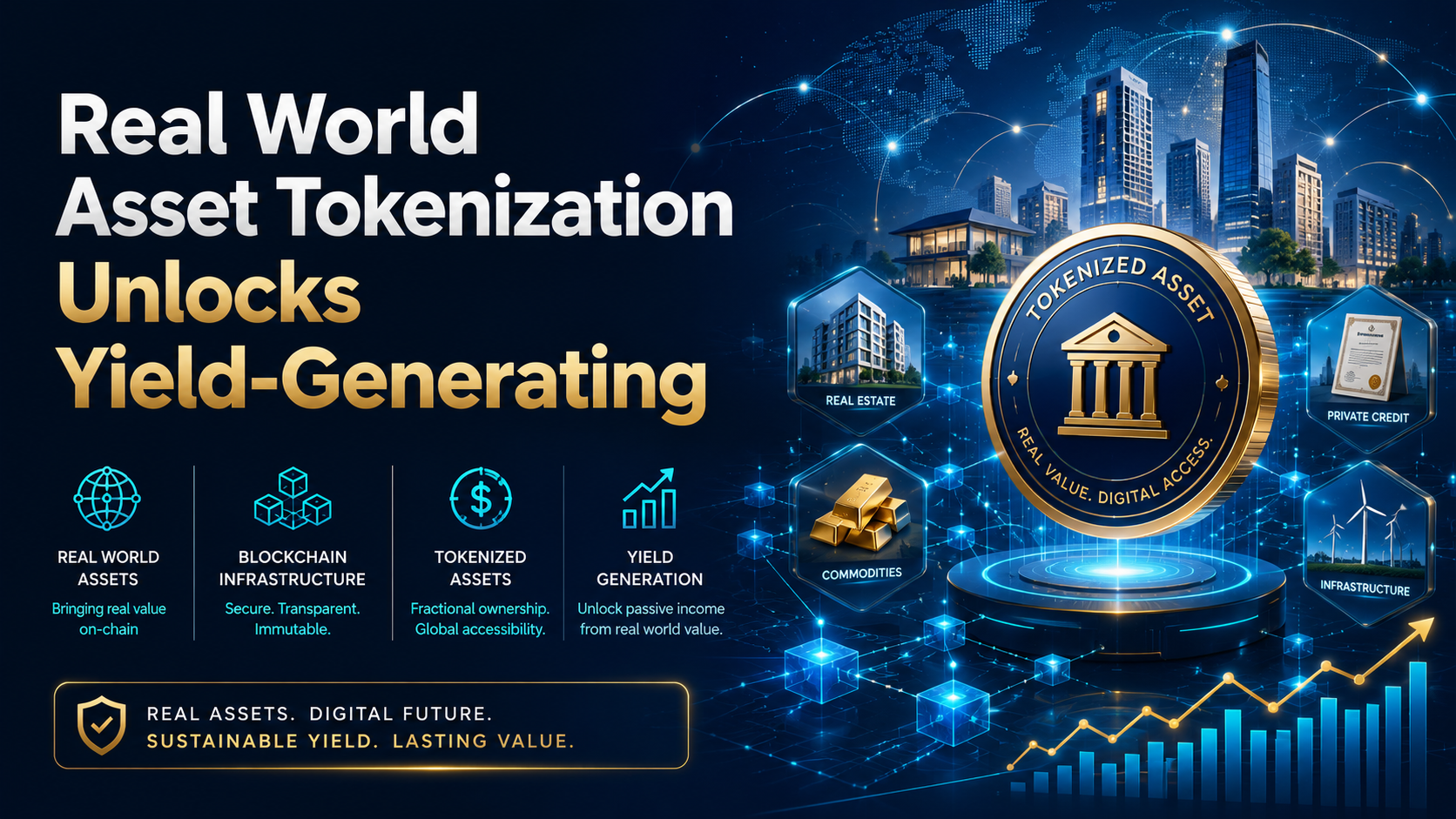
Real World Asset (RWA) tokenization is reshaping how income-generating assets are accessed, distributed, and managed. Instead of ownership being concentrated among institutions or high-net-worth investors, blockchain-based tokenization allows these assets to be fractionally owned, transparently tracked, and traded in near real time. This shift is not just about digitizing ownership records it is about unlocking continuous, programmable yield from assets that were traditionally slow, illiquid, and geographically restricted.
In 2026, the most important transformation brought by RWA tokenization is the ability to convert traditionally static assets into dynamic yield-generating instruments. Real estate rentals, government bonds, infrastructure projects, commodities storage, and even private credit portfolios are now being structured into tokenized systems that distribute returns automatically to investors.
Understanding Real World Asset Tokenization
Real World Asset tokenization is the process of converting physical or financial assets into digital tokens on a blockchain. Each token represents a fraction of ownership in an underlying asset, along with its associated rights such as income distribution, appreciation benefits, or governance participation.
For example:
- A commercial building generating rental income can be split into thousands of digital tokens.
- A government bond can be tokenized into programmable units that distribute coupon payments automatically.
- A private credit loan portfolio can be represented as yield-bearing tokens that reflect interest payments.
The key innovation is that these tokens are programmable. This means cash flows, ownership rights, and compliance rules can all be embedded directly into smart contracts.
The Core Mechanism Behind Yield Generation
Yield generation in tokenized RWAs comes from the real economic activity of the underlying asset. Unlike speculative cryptocurrencies, these instruments are backed by tangible or contractual cash flows.
The process generally follows three stages:
- Asset Origination
A real-world asset such as real estate, debt instruments, or infrastructure projects is identified and legally structured for tokenization.
- Token Creation and Fractionalization
The asset is divided into digital tokens representing proportional ownership. Each token carries rights to a share of income generated by the asset.
- Automated Yield Distribution
Smart contracts distribute income (rent, interest, revenue) directly to token holders based on predefined rules.
This structure removes intermediaries and reduces delays in payout cycles, allowing investors to receive yield more efficiently.
How Tokenization Unlocks Access to High-Yield Assets
Traditionally, high-yield investments were limited to institutional investors due to high capital requirements, legal complexity, and liquidity constraints. Tokenization changes this structure by breaking entry barriers.
1. Fractional Ownership of Income-Generating Assets
One of the most significant advantages is fractional ownership. Investors no longer need to purchase an entire asset to earn from it. Instead, they can buy a small portion of a high-value asset and still receive proportional income. For example, a commercial real estate building that generates monthly rental income can be split into thousands of tokens. Even a small investor can earn passive income proportional to their holdings.
2. Continuous Yield Distribution via Smart Contracts
Smart contracts automate the entire income distribution process. Instead of quarterly or annual payouts, yield can be distributed in real time or on a more frequent schedule depending on asset performance.
For instance:
- Rental income can be distributed monthly or daily
- Bond interest can be automatically credited as it accrues
- Infrastructure revenue can be streamed continuously
This creates a more efficient and transparent yield mechanism.
3. Global Investor Participation
RWA tokenization removes geographical barriers. Investors from different countries can access the same asset pool without needing traditional brokerage accounts or complex legal arrangements.
This global access increases demand for yield-generating assets and improves liquidity in markets that were previously fragmented.
Key Asset Classes Driving Tokenized Yield
Several asset categories are particularly well-suited for yield generation through tokenization.
Real Estate Income Assets
Real estate remains one of the most popular categories. Rental properties, commercial buildings, and hospitality assets generate consistent cash flow. Tokenization allows these properties to be divided into income-sharing units, making them accessible to a wider investor base.
Tokenized Debt Instruments
Debt markets are among the largest sources of yield in traditional finance. Tokenized bonds and private credit instruments allow investors to earn interest income with improved transparency and liquidity. These instruments often have predictable cash flows, making them ideal for blockchain-based yield systems.
Infrastructure and Energy Projects
Infrastructure assets such as toll roads, renewable energy plants, and utility networks generate long-term revenue streams. Tokenization allows these projects to raise capital from global investors while distributing operational revenue as yield.
Commodities and Revenue-Backed Assets
Certain commodities and revenue-linked contracts can also be tokenized. For example, storage-backed commodities or royalty-based assets provide ongoing income streams that can be distributed to token holders.
Role of Smart Contracts in Yield Automation
Smart contracts are the backbone of yield distribution in tokenized ecosystems. They ensure that rules are enforced without manual intervention.
A typical smart contract system handles:
- Income collection from real-world sources
- Conversion of revenue into digital assets or stable currencies
- Distribution of yield based on token holdings
- Enforcement of compliance rules (such as investor eligibility)
This automation significantly reduces operational costs and improves transparency.
Liquidity Enhancement and Secondary Markets
One of the historical problems with yield-generating assets is illiquidity. Investors often had to lock capital for long periods without exit options. Tokenization solves this through secondary trading markets.
Token holders can:
- Sell their fractional ownership anytime (subject to market liquidity)
- Trade yield-bearing tokens like financial instruments
- Participate in decentralized liquidity pools
This transforms traditionally illiquid assets into tradable financial products.
Risk Diversification Through Tokenized Portfolios
RWA tokenization also enables better diversification. Instead of investing in a single property or bond, investors can spread capital across multiple yield-generating assets.
For example, a portfolio might include:
- Tokenized real estate in different regions
- A mix of government and private debt instruments
- Infrastructure-backed revenue tokens
This reduces exposure to single-asset risk while maintaining consistent yield generation.
Transparency and Trust in Yield Distribution
Traditional investment systems often suffer from opacity in revenue reporting and payout structures. Blockchain-based tokenization introduces full transparency.
Every transaction is recorded on-chain, including:
- Revenue inflows
- Expense deductions
- Yield distribution events
This allows investors to independently verify performance and ensures trust in the system.
Integration with Decentralized Finance (DeFi)
Tokenized RWAs are increasingly being integrated into decentralized finance ecosystems. This creates additional yield opportunities beyond the underlying asset.
For example:
- Tokenized real estate can be used as collateral for loans
- Yield-bearing tokens can be staked for additional rewards
- Asset-backed tokens can be used in liquidity pools
This layering of yield mechanisms creates a more dynamic investment environment.
AI and Predictive Yield Optimization
Artificial intelligence is increasingly being used to optimize yield strategies in tokenized ecosystems. AI models analyze:
- Asset performance trends
- Market demand fluctuations
- Risk exposure levels
- Historical yield data
These insights help investors make informed decisions and help platforms optimize asset allocation strategies for maximum returns.
Regulatory Compliance and Yield Stability
Regulation plays a critical role in ensuring the sustainability of tokenized yield systems. Compliance frameworks ensure that:
- Only eligible investors participate in certain assets
- Income distribution follows jurisdictional rules
- Tax reporting is simplified and automated
Proper regulatory alignment increases institutional participation and stabilizes long-term yield performance.
The Future of Yield-Generating Tokenized Assets
The evolution of RWA tokenization is moving toward fully automated financial ecosystems where assets continuously generate and distribute value without manual intervention.
Future developments may include:
- Fully autonomous infrastructure funds governed by smart contracts
- Real-time yield streaming instead of periodic payouts
- Global liquidity networks connecting tokenized assets across chains
- AI-managed investment portfolios optimizing yield dynamically
These innovations suggest a future where investment income becomes more continuous, transparent, and globally accessible.
Conclusion
Real World Asset tokenization is fundamentally redefining how yield is created, distributed, and accessed. By transforming physical and financial assets into programmable digital instruments, it unlocks new levels of efficiency, transparency, and accessibility in global investment markets.
The ability to fractionally own income-generating assets, receive automated payouts, and trade positions in secondary markets creates a powerful shift in financial infrastructure. As tokenization matures, yield generation will no longer be limited to institutional players but will become a globally distributed opportunity accessible to a much broader investor base. This transition marks a structural change in how capital markets operate moving from static ownership models to dynamic, continuously yielding digital ecosystems.