


Europe Sea Freight Forwarding Market Growth, Trends, Opportunities & Forecast 2025–2032
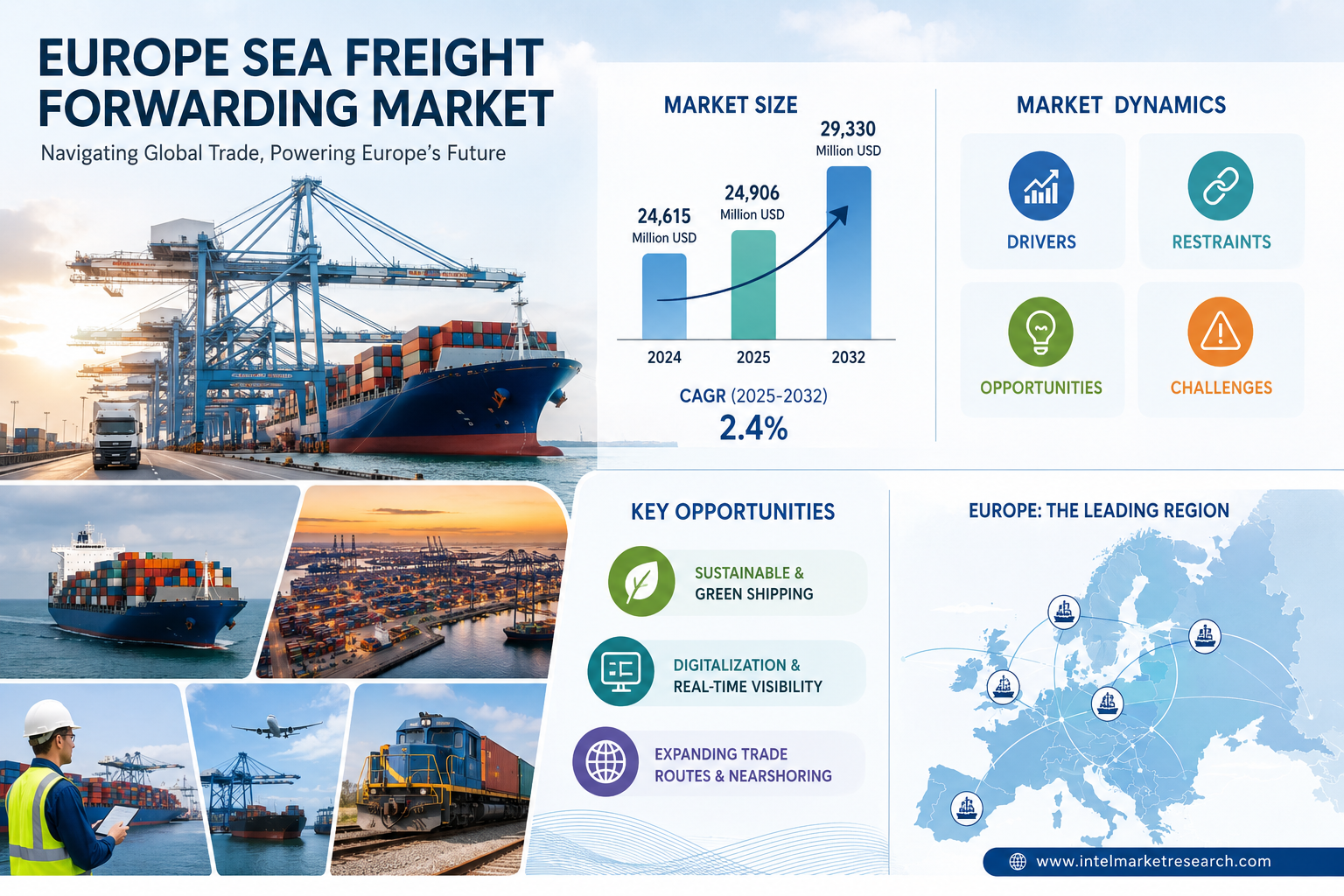
According to a new report from Intel Market Research, the Europe Sea Freight Forwarding Market was valued at USD 24,615 million in 2024 and is projected to grow from USD 24,906 million in 2025 to USD 29,330 million by 2032, exhibiting a CAGR of 2.4% during the forecast period (2025–2032). Europe accounts for approximately 35% of the global sea freight forwarding market, reinforcing its position as the largest regional market supported by its extensive port infrastructure and dense intra-continental trade networks.
Sea freight forwarding in Europe encompasses a broad range of logistics services whereby forwarders act as intermediaries between shippers and ocean carriers, coordinating the movement of goods through the continent's major gateway ports, including Rotterdam, Hamburg, and Antwerp. These service providers manage end-to-end logistics operations, including ocean carrier negotiations, customs documentation, cargo insurance, and inland distribution via well-developed rail and barge hinterland connections that are a defining characteristic of European freight infrastructure.
📥 Download FREE Sample Report:
Europe Sea Freight Forwarding Market - View in Detailed Research Report
What is Europe Sea Freight Forwarding?
The Europe sea freight forwarding market is experiencing steady growth driven by the region's robust international trade volumes, the expansion of e-commerce, and increasing demand for less-than-container load (LCL) services among small and medium-sized enterprises. Forwarders operating in this space serve as essential intermediaries that manage the complexity of international ocean shipments-from carrier booking and rate negotiation to customs compliance, documentation, and final-mile delivery. The market contends with the complexities arising from post-Brexit customs procedures and stringent EU environmental regulations, including IMO emissions compliance requirements such as CII and EEXI standards. Sustainability initiatives are increasingly shaping carrier selection decisions across the region, as European shippers face mounting pressure to meet ESG commitments. Leading players such as Kuehne + Nagel, DHL Group, and DB Schenker Logistics-all headquartered in Europe-continue to leverage advanced digital platforms, including blockchain-based documentation and AI-driven predictive analytics, to maintain competitive differentiation and drive market expansion across key European trade corridors.
This report provides a deep insight into the Europe Sea Freight Forwarding market covering all its essential aspects-from a macro overview of the market to micro details such as market size, competitive landscape, development trends, niche markets, key drivers and challenges, SWOT analysis, and value chain analysis.
The analysis helps the reader understand competition within the industry and strategies for enhancing profitability. Furthermore, it provides a framework for evaluating and accessing the position of a business organization. The report also focuses on the competitive landscape of the Europe Sea Freight Forwarding Market, introducing market share, performance, product positioning, and operational insights of major players. This helps industry professionals identify key competitors and understand the competition pattern.
In short, this report is a must-read for industry players, investors, researchers, consultants, business strategists, and all those planning to foray into the Europe Sea Freight Forwarding market.
Key Market Drivers
1. Rising Intra-European and Global Trade Volumes
The Europe sea freight forwarding market is fundamentally propelled by the continent's deep integration in global supply chains. Strong trade relationships with Asia and North America, coupled with robust intra-European Union commerce, generate consistent demand for containerized shipping. The growth of e-commerce and the import of consumer goods and manufacturing components necessitates reliable and scalable sea freight solutions across European ports like Rotterdam, Antwerp, and Hamburg.
2. Strategic Shift Towards Nearshoring and Supply Chain Resilience
In response to recent global supply chain disruptions, many European manufacturers are actively pursuing nearshoring strategies. This involves relocating or diversifying sourcing closer to home, often within Eastern Europe or the Mediterranean region. This trend bolsters regional sea freight traffic in the Baltic, Black, and Mediterranean Seas, creating a more complex and dynamic routing landscape that forwarders are positioned to manage. Furthermore, stringent EU environmental regulations, such as the "Fit for 55" package, are accelerating the adoption of green logistics practices within the Europe sea freight forwarding market-serving as a key driver for innovation in sustainable shipping and multimodal transport solutions.
3. Digital Transformation Across Freight Corridors
The integration of digital platforms for booking, tracking, and documentation is becoming a baseline expectation, driving forwarders to modernize to remain competitive. The adoption of AI-driven route optimization, blockchain-based documentation, and real-time shipment visibility tools is accelerating across European freight corridors. European forwarders are investing in technology to enhance shipment visibility, reduce transit time variability, and offer data-driven insights to clients managing complex supply chains.
Market Challenges
- Persistent Operational and Geopolitical Disruptions – The Europe sea freight forwarding market continues to face significant headwinds from geopolitical instability and infrastructure strain. Ongoing conflicts affecting key trade routes, coupled with periodic labor disputes at major European ports, lead to unpredictable schedules, congestion, and rate volatility.
- Regulatory Compliance and Complexity – Navigating the diverse and evolving customs regulations across European nations, alongside stringent security and safety protocols, requires significant expertise and administrative resources. Compliance with the EU's Carbon Border Adjustment Mechanism (CBAM) adds another layer of complexity for forwarders handling affected goods.
- Capacity Constraints and Cost Pressures – Despite a normalization from pandemic peaks, imbalances between vessel capacity and demand on specific trade lanes persist. Coupled with volatile bunker fuel prices and elevated operational costs, maintaining profitable service levels while offering competitive rates remains a delicate balancing act for forwarders in the European market.
Market Restraints
High Dependence on Economic Cycles and Fuel Costs
The performance of the Europe sea freight forwarding market is intrinsically linked to broader economic health. A slowdown in manufacturing output or consumer spending within the EU directly translates to reduced shipping volumes. Furthermore, the industry's heavy reliance on fossil fuels makes it exceptionally vulnerable to oil price shocks, which can rapidly erode profit margins and deter investment in long-term contracts.
Infrastructure Bottlenecks and Intermodal Inefficiencies
Congestion at major gateway ports and aging hinterland connections, such as inland waterways and rail networks, act as a significant brake on market efficiency. These bottlenecks delay cargo, increase dwell times, and limit the fluidity of intermodal transport, which is essential for a seamless Europe sea freight forwarding service. Investments in port modernization and hinterland links are capital-intensive and slow to materialize.
Emerging Opportunities
The European logistics landscape is becoming increasingly favorable for forwarders who can combine digital capability with sustainable service delivery. Growing shipper demand for carbon-transparent logistics, supportive EU policy frameworks, and strategic industry collaborations are accelerating market expansion. Key growth enablers include:
- Digitalization and End-to-End Visibility – Implementing advanced platforms that provide real-time supply chain visibility, predictive analytics, and automated documentation streamlines operations, reduces errors, and enhances customer value. This technological edge is critical for capturing market share in the competitive European freight landscape.
- Expansion of Sustainable Logistics Services – Forwarders can differentiate themselves by developing robust green service offerings, such as optimizing routes for fuel efficiency, utilizing biofuels, and offering carbon-inset or offset programs. Leadership in sustainable sea freight forwarding is becoming a key criterion for shipper selection in Europe.
- Specialization in High-Growth Niches – Targeting specialized verticals such as pharmaceuticals (requiring cold chain solutions), perishables, or high-value manufacturing components allows forwarders to build expertise and command premium fees. The growth of renewable energy projects across Europe also presents specific opportunities for project logistics and oversized cargo handling via sea freight.
Regional Market Insights
- Western Europe: Western Europe stands as the undisputed leading sub-region within the Europe sea freight forwarding market, owing to its deeply entrenched maritime heritage, world-class port infrastructure, and highly sophisticated logistics networks. Countries such as Germany, the Netherlands, Belgium, and France anchor this dominance, with the Port of Rotterdam serving as one of the busiest and most technologically advanced container hubs in the world. The transition toward green shipping practices is most pronounced in this sub-region, driven by stringent European Union environmental mandates.
- Northern Europe: Northern Europe represents a strategically significant sub-region, characterized by strong maritime traditions, advanced logistics competencies, and a growing emphasis on sustainable shipping corridors. Countries including Sweden, Denmark, Finland, Norway, and the Baltic states have cultivated robust sea freight ecosystems. The Baltic Sea serves as a vital intra-regional waterway facilitating short-sea shipping operations, complementing deep-sea freight services.
- Southern Europe: Southern Europe is an increasingly prominent sub-region driven by its advantageous geographic positioning at the crossroads of Mediterranean and intercontinental trade routes. Spain, Italy, Greece, and Portugal host major seaports-including Valencia, Genoa, Piraeus, and Sines-that serve as critical transshipment and cargo distribution hubs connecting Europe with Asia, Africa, and the Americas.
- Eastern Europe: Eastern Europe is emerging as a dynamic growth frontier, underpinned by expanding industrial output, improving port infrastructure, and deepening integration with pan-European supply chains. Poland, Czechia, Romania, and Hungary are among the leading economies driving freight forwarding demand in the sub-region, with Baltic and Black Sea ports playing increasingly important roles.
- Central Europe: Central Europe, encompassing landlocked economies such as Austria, Switzerland, Slovakia, and Hungary, interacts with the Europe sea freight forwarding market predominantly through inland logistics networks and multimodal connections to major coastal ports. Freight forwarding operators serving this sub-region have developed sophisticated intermodal solutions combining sea freight with rail and road transport.
Market Segmentation
By Type
- Full Container Load (FCL)
- Less-Than Container Load (LCL)
- Others
By Application
- Automotive
- Electronics
- Agricultural & Food Products
- Pharmaceuticals & Healthcare
- Others
By End User
- Manufacturing & Industrial
- Retail & Consumer Goods
- Pharmaceutical & Healthcare
- Others
By Service Mode
- Port-to-Port
- Door-to-Port
- Port-to-Door
- Door-to-Door
By Sustainability Orientation
- Conventional Freight Services
- Green & Low-Emission Freight Services
- Carbon-Neutral Logistics Solutions
By Region
- Western Europe
- Northern Europe
- Southern Europe
- Eastern Europe
- Central Europe
Competitive Landscape
The European sea freight forwarding market accounts for approximately 35% of global revenue, making it the world's largest regional market. This dominance is underpinned by strategically vital gateway ports such as Rotterdam, Hamburg, and Antwerp, which serve as critical nodes in global east-west trade corridors. The market is led by Kuehne + Nagel, headquartered in Switzerland, which commands a leading share through its expansive global network, advanced digital freight platform, and comprehensive end-to-end logistics solutions tailored to European shippers. DHL Global Forwarding, the freight division of the DHL Group, is another dominant force, leveraging its unmatched infrastructure and industry vertical expertise across automotive, pharmaceutical, and consumer goods sectors. DB Schenker, operating as part of Deutsche Bahn, holds a strong position with deep hinterland rail connectivity that complements its sea freight offerings across the continent. DSV, headquartered in Denmark and significantly expanded following its acquisitions, has emerged as one of the top global forwarders with a powerful European base. GEODIS, the logistics arm of SNCF Group, reinforces the French presence in the European market with broad sea freight capabilities across major intra-European and intercontinental trade lanes.
Beyond the top-tier players, a number of regionally significant and specialized forwarders actively compete within the European sea freight forwarding landscape. Dachser, a German family-owned logistics company, is recognized for its strong European network and integrated ocean freight services. Hellmann Worldwide Logistics offers competitive LCL and FCL solutions with a focus on sustainability and digital innovation. Bolloré Logistics maintains a notable European presence, particularly on Africa-Europe trade lanes. CEVA Logistics, now part of the CMA CGM Group, benefits from its carrier-side parent synergies to offer competitive ocean freight products. Rhenus Logistics is a growing mid-tier player with expanding sea freight capabilities in Northern and Central Europe.
The report provides in-depth competitive profiling of 15+ key players, including:
- Kuehne + Nagel
- DHL Global Forwarding (DHL Group)
- DB Schenker Logistics
- DSV
- GEODIS
- Dachser
- Hellmann Worldwide Logistics
- Bolloré Logistics
- CEVA Logistics
- Rhenus Logistics
- Scan Global Logistics
- Röhlig Logistics
- Ziegler Group
- Pantos Logistics
- Agility Logistics
Report Deliverables
- Europe and sub-regional market forecasts from 2025 to 2032
- Strategic insights into digitalization trends, sustainability initiatives, and regulatory developments
- Market share analysis and SWOT assessments of leading forwarders
- Segmentation analysis by container type, application, end user, service mode, and sustainability orientation
- Competitive benchmarking and key player strategic profiles
📘 Get Full Report Here:
Europe Sea Freight Forwarding Market - View Detailed Research Report
📥 Download FREE Sample Report:
Europe Sea Freight Forwarding Market - View in Detailed Research Report
About Intel Market Research
Intel Market Research is a leading provider of strategic intelligence, offering actionable insights in biotechnology, pharmaceuticals, and healthcare infrastructure. Our research capabilities include:
- Real-time competitive benchmarking
- Global clinical trial pipeline monitoring
- Country-specific regulatory and pricing analysis
- Over 500+ healthcare reports annually
Trusted by Fortune 500 companies, our insights empower decision-makers to drive innovation with confidence.
🌐 Website: https://www.intelmarketresearch.com
📞 Asia-Pacific: +91 9169164321
🔗 LinkedIn: Follow Us

