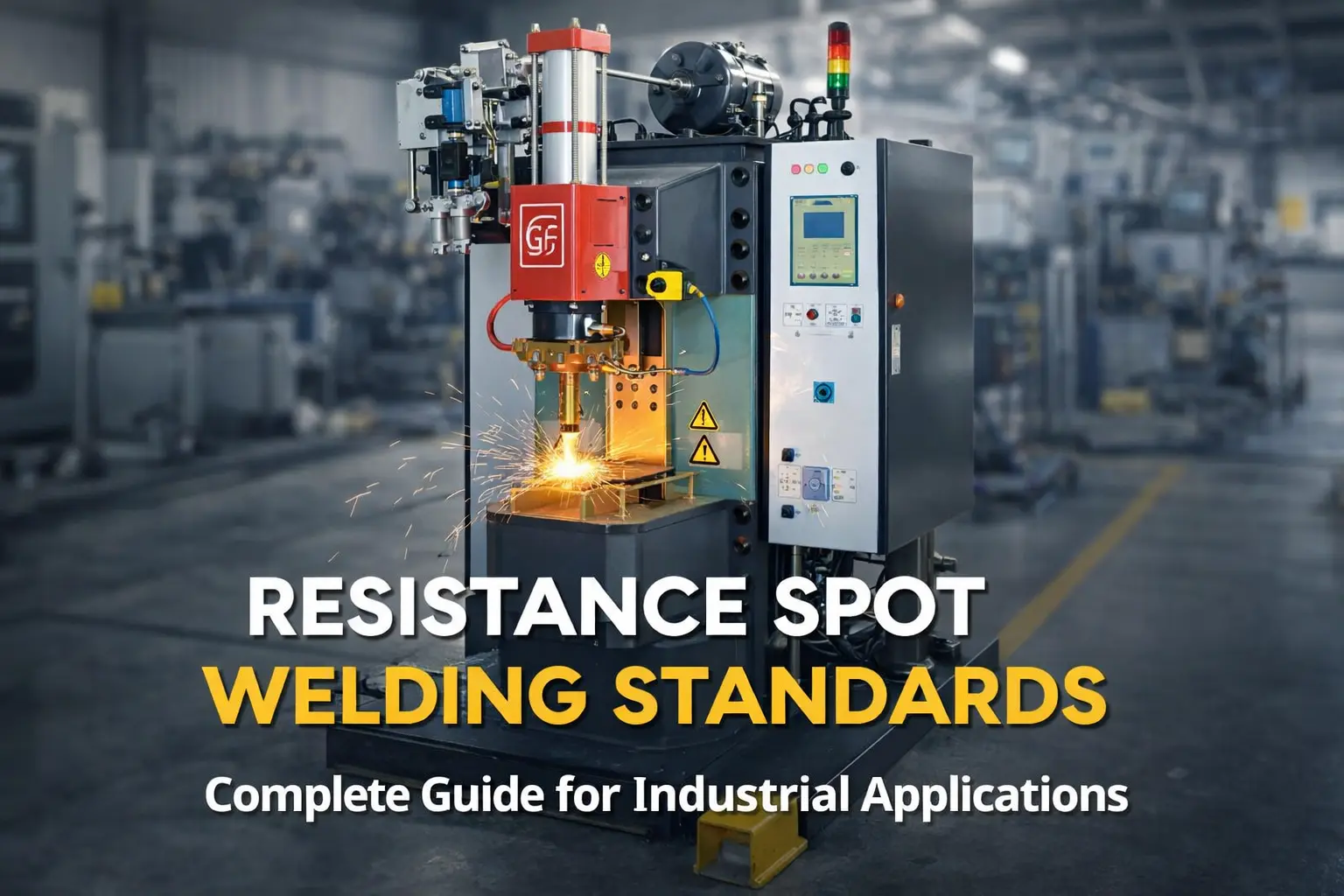
In modern manufacturing, resistance spot welding remains one of the most efficient, scalable, and cost-effective metal joining technologies especially for sheet metal fabrication and high-volume production environments. From automotive body-in-white assembly to electrical enclosures and appliance manufacturing, this process is the backbone of mass production joining systems.
For OEMs, automation integrators, and production engineers, understanding how resistance spot welding works and how to optimize it directly impacts product quality, cycle time, and production cost efficiency. As a global specialist in resistance welding systems, Heron Welder delivers advanced spot welding machines, MFDC systems, and automated production solutions designed for industrial precision and repeatability.
What is Resistance Spot Welding?
Resistance spot welding (RSW) is a fusion welding process where two or more metal sheets are joined by applying:
- High electrical current
- Controlled electrode pressure
- Precise welding time
The heat generated at the interface is based on Joule heating principle, where electrical resistance converts current into localized heat. This heat melts the metal at the contact point, forming a weld “nugget” that solidifies under pressure.
In simple industrial terms, it is a fast, localized, and repeatable joining method that eliminates the need for filler materials or flux.
Working Principle of Resistance Spot Welding
The process is based on four critical parameters:
1. Welding Current
High current passes through copper electrodes into the workpiece. Heat is generated at the interface due to resistance in the metal sheets.
2. Electrode Force
Electrodes clamp the sheets together, ensuring proper contact and controlling weld nugget formation.
3. Welding Time
Heat is applied for a very short duration (milliseconds), allowing rapid melting and solidification.
4. Contact Resistance
Heat is concentrated at the interface where resistance is highest, ensuring localized fusion without damaging surrounding material.
According to industrial studies, heat generation follows:
Q ∝ I²Rt
where current has the strongest influence on weld quality.
Key Advantages of Resistance Spot Welding
For industrial-scale production, resistance spot welding offers several engineering and commercial benefits:
✔ High Production Speed
Each weld is completed in milliseconds, making it ideal for robotic assembly lines.
✔ Low Operating Cost
No filler materials, shielding gases, or consumables are required.
✔ Automation-Friendly
Easily integrated into robotic systems and CNC-controlled production lines.
✔ Clean & Repeatable Welds
Produces consistent weld nuggets with minimal surface contamination.
✔ Energy Efficient Process
Heat is localized, reducing energy waste compared to arc welding methods.
Industrial Applications of Resistance Spot Welding
Resistance spot welding is widely used in industries where high-volume, precision sheet metal joining is required:
Automotive Manufacturing
- Car body panels
- Door assemblies
- Chassis components
(Thousands of spot welds per vehicle)
Electrical & Battery Industry
- Battery tabs and packs
- Electrical enclosures
- Busbars and terminals
Appliance Manufacturing
- Washing machines
- Refrigerators
- HVAC sheet structures
Industrial Equipment
- Control cabinets
- Metal frames
- Enclosures and panels
Its versatility makes it a core process in virtually every modern manufacturing ecosystem.
Types of Resistance Spot Welding Systems
Different production needs require different RSW technologies:
1. AC Spot Welding
Traditional system used for general fabrication and moderate precision applications.
2. MFDC Spot Welding (Medium Frequency DC)
Advanced system offering:
- Stable current control
- Reduced heat loss
- Higher weld consistency
3. Capacitor Discharge Welding
Used for small components requiring ultra-fast energy release.
4. Automated Robotic Spot Welding
Fully integrated systems for automotive and mass production lines.
Heron Welder specializes in MFDC and automated resistance welding solutions, designed for high-speed industrial production environments.
Resistance Spot Welding vs Other Joining Methods
| Factor |
Spot Welding |
MIG Welding |
Riveting |
Adhesive Bonding |
| Speed |
Very High |
Medium |
Medium |
Low |
| Automation |
Excellent |
Moderate |
Moderate |
Low |
| Consumables |
None |
Wire/Gas |
Rivets |
Adhesive |
| Heat Input |
Localized |
High |
None |
None |
| Production Suitability |
Mass Production |
Fabrication |
Structural Assembly |
Lightweight Assembly |
For high-volume OEM production, resistance spot welding remains the most efficient and scalable solution.
Common Defects and Quality Control Factors
To ensure consistent weld quality, engineers must control:
- Incorrect current settings → weak weld nugget
- Improper electrode force → surface expulsion
- Excessive welding time → material burn-through
- Electrode wear → inconsistent weld diameter
Advanced systems like Heron’s MFDC welders provide real-time monitoring to maintain stable weld parameters and repeatability across production cycles.
Best Practices for Optimal Spot Welding Performance
To achieve industrial-grade weld quality:
- Maintain electrode tip cleanliness
- Use correct force and current balance
- Optimize weld time based on material thickness
- Implement routine electrode dressing
- Use automation for consistency in mass production
Proper process control ensures longer electrode life, reduced defects, and higher throughput.
Why Heron Welder for Resistance Spot Welding Solutions?
Heron Welder is a global manufacturer specializing in resistance welding technology and automated joining systems, offering:
- MFDC resistance spot welding machines
- Projection and seam welding systems
- Self-piercing riveting (FSPR) solutions
- Welding guns and intelligent controllers
- Fully automated production line integration
With decades of engineering experience, Heron focuses on delivering precision, stability, and production efficiency for global manufacturing industries.
FAQs About Resistance Spot Welding
1. What materials can be joined using resistance spot welding?
It is commonly used for steel, stainless steel, aluminum alloys, and galvanized sheet metals.
2. Is resistance spot welding suitable for automation?
Yes, it is one of the most automation-friendly welding processes used in robotic production lines.
3. What industries use spot welding the most?
Automotive, appliance manufacturing, electronics, battery production, and industrial fabrication.
4. What is a weld nugget?
It is the molten metal zone formed at the interface of the workpieces that solidifies into a strong joint.
5. How does MFDC improve spot welding quality?
MFDC systems provide stable current control, reduced energy loss, and highly consistent weld formation.
Conclusion
Resistance spot welding continues to be a cornerstone of modern manufacturing due to its speed, reliability, and scalability. As industries move toward higher automation and precision-driven production, advanced welding systems play a critical role in ensuring quality and efficiency.
If you are looking to upgrade your production line or implement a high-performance resistance welding system, Heron Welder provides customized solutions tailored to your manufacturing needs.
Contact Heron Welder today to request a quote or consult with our engineering team for advanced resistance spot welding and automation solutions.