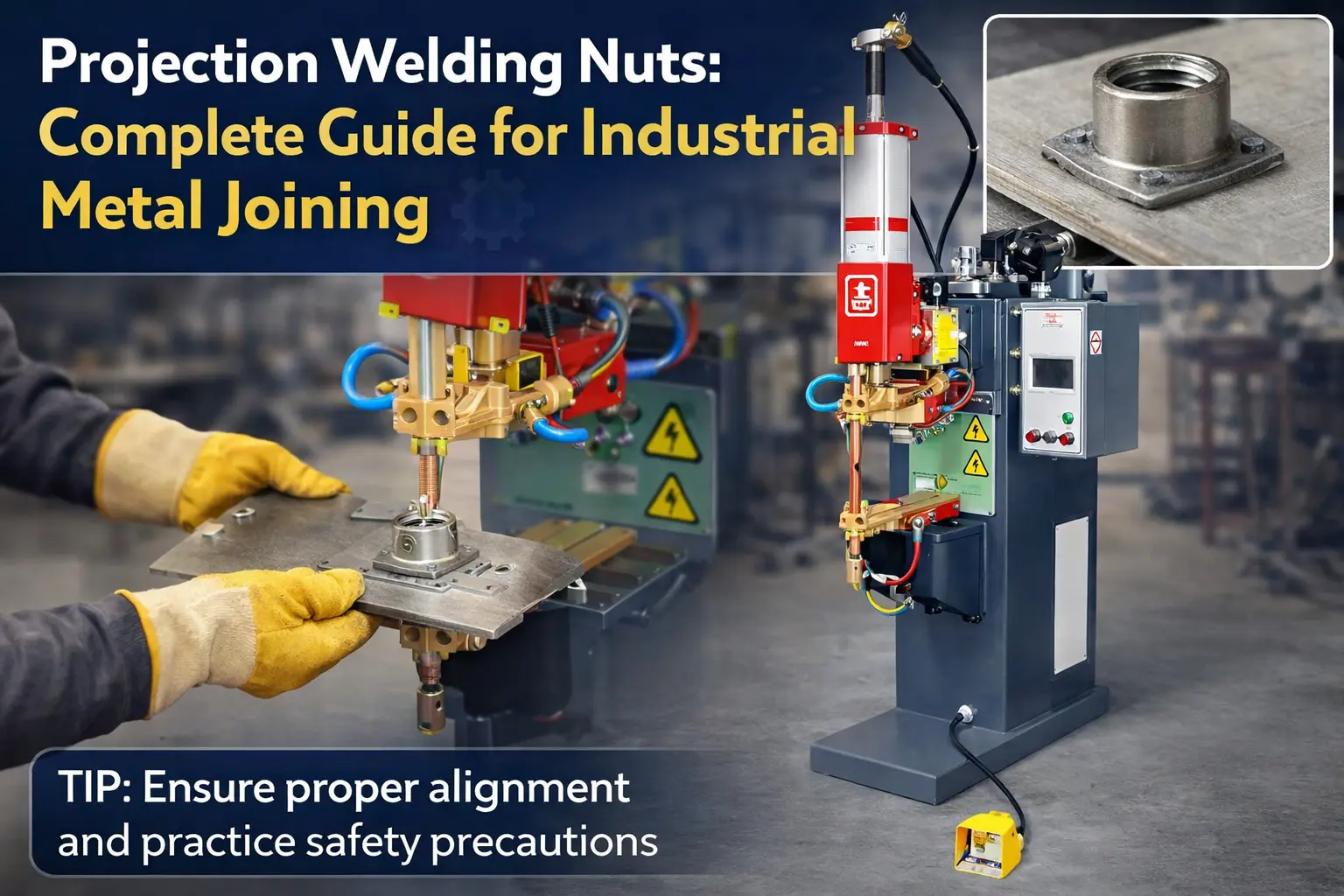
Projection welding is one of the most efficient and widely used resistance welding processes in modern manufacturing. It is especially valued in high-volume production environments where precision, repeatability, and automation are critical. For OEMs, automotive suppliers, and industrial fabricators, projection welding offers a powerful solution for joining complex metal assemblies with speed and consistency.
As a global manufacturer of advanced resistance welding and automation systems, Heron Welder supports industries with high-performance projection welding machines, intelligent controllers, and turnkey production lines designed for demanding manufacturing environments.
What is Projection Welding?
Projection welding is a resistance welding technique where small raised points (projections) on a metal surface concentrate electrical current and heat at precise locations. These projections act as controlled contact points that collapse under pressure and current, forming strong, localized weld nuggets.
In simple terms, instead of welding a broad surface like in spot welding, projection welding creates multiple controlled weld points simultaneously, improving efficiency and consistency.
This process is widely used for:
- Fasteners (nuts, bolts, studs)
- Sheet metal assemblies
- Automotive components
- Electrical contacts
The process relies on three key elements:
- Controlled electrode pressure
- High electrical current
- Pre-designed projections on parts
How Projection Welding Works (Step-by-Step)
The projection welding process follows a precise, automated sequence:
1. Positioning and Clamping
Two workpieces are placed between flat or specially designed electrodes. One part contains pre-formed projections.
2. Current Application
A high electric current passes through the projections, where electrical resistance is highest. This generates rapid, localized heat.
3. Projection Collapse
The projections soften and collapse under electrode pressure, forming molten weld nuggets at exact locations.
4. Solidification
Once current stops, the molten zones cool and solidify, forming strong metallurgical bonds.
According to industry studies, this entire cycle can be completed in seconds, making it ideal for mass production lines.
Types of Projection Welding
Manufacturing environments use different projection designs depending on application requirements:
1. Embossed Projection Welding
- Created by stamping sheet metal
- Common in automotive panels and brackets
2. Solid Projection Welding
- Used in machined parts and fasteners
- High strength and durability applications
3. Annular Projection Welding
- Circular projection geometry
- Common in seals, fittings, and pressure components
4. Multi-Projection Welding
- Multiple welds formed in one cycle
- Ideal for high-speed automation systems
Key Advantages of Projection Welding
Projection welding is preferred in industrial production due to its engineering and economic benefits:
✔ High Production Efficiency
Multiple welds can be completed in a single cycle, significantly reducing takt time.
✔ Excellent Weld Consistency
Because projections define the weld location, variability is minimized.
✔ Reduced Electrode Wear
Larger electrode contact area extends tool life in high-volume operations.
✔ Automation Friendly
Easily integrated into robotic welding cells and automated lines.
✔ Strong Mechanical Joints
Produces uniform weld nuggets with high structural integrity.
Projection Welding vs Spot Welding
Many engineers compare projection welding with spot welding when selecting a process.
- Spot welding relies on electrode pressure at a single contact point.
- Projection welding uses engineered projections to define multiple controlled weld points.
Projection welding offers:
- Better positioning accuracy
- Multi-point welding in one cycle
- Improved suitability for fasteners and complex parts
Spot welding is better for simple sheet-to-sheet joining, while projection welding excels in structured, repeatable assembly operations.
Industrial Applications of Projection Welding
Projection welding is widely adopted across multiple industries:
Automotive Manufacturing
- Seat frames
- Door reinforcements
- Engine mounts
- Fastener welding
Electrical Industry
- Battery terminals
- Electrical contacts
- Busbars
Appliance Manufacturing
- Washing machine drums
- Refrigerator frames
- Structural housings
Heavy Engineering
- Steel frameworks
- Industrial equipment assemblies
- Structural brackets
Its ability to handle dissimilar thickness materials and complex geometries makes it essential in modern production systems.
Best Practices for High-Quality Projection Welding
To ensure strong, defect-free welds, engineers should follow these best practices:
1. Precise Projection Design
Geometry and height must be optimized for consistent collapse under current.
2. Proper Surface Preparation
Oxides and contaminants reduce weld quality and must be controlled.
3. Optimized Welding Parameters
Current, time, and pressure must be calibrated for each material type.
4. Electrode Maintenance
Regular inspection ensures uniform pressure distribution.
5. Process Automation
Using intelligent controllers improves repeatability and reduces human error.
Heron Welder’s Role in Projection Welding Technology
Modern manufacturing demands more than basic welding equipment it requires precision-engineered, automated welding systems.
Heron Welder specializes in:
- MFDC projection welding machines
- Automated welding production lines
- Custom welding guns and fixtures
- Smart welding controllers
Our systems are designed for:
- High-volume automotive production
- Precision electrical component manufacturing
- OEM assembly lines
- Industrial automation integration
By combining mechanical engineering with digital control systems, Heron delivers stable weld quality, reduced cycle time, and long-term production efficiency.
Future of Projection Welding in Smart Manufacturing
As Industry 4.0 evolves, projection welding is becoming more intelligent and data-driven. Modern systems now integrate:
- Real-time process monitoring
- Adaptive welding control
- Quality feedback loops
- Robotic automation
This shift allows manufacturers to reduce defects, improve traceability, and increase productivity across global supply chains.
FAQs
1. What materials are suitable for projection welding?
Projection welding works well with steel, stainless steel, aluminum (with proper setup), and coated metals used in industrial manufacturing.
2. Is projection welding better than spot welding?
It depends on the application. Projection welding is better for fasteners and multi-point joints, while spot welding is better for simple sheet metal joining.
3. Can projection welding be automated?
Yes. It is highly compatible with robotic systems and automated production lines, making it ideal for mass manufacturing.
4. What industries use projection welding most?
Automotive, electrical, appliance manufacturing, and heavy engineering industries are the primary users.
5. What affects weld quality in projection welding?
Key factors include projection design, current settings, electrode condition, and surface cleanliness.
Conclusion
Projection welding is a highly efficient, precise, and automation-friendly resistance welding process that plays a critical role in modern manufacturing. From automotive structures to electrical assemblies, it enables strong, repeatable joints with high production efficiency.
With advanced engineering capabilities and industrial-grade solutions, Heron Welder helps manufacturers achieve consistent weld quality and optimized production performance.
If you are looking to upgrade your welding line or develop a customized projection welding solution, Heron Welder can support you with expert consultation and tailored system design.
Contact Heron Welder today to request a quote or discuss your customized welding and automation requirements.