


How to conduct a feasibility study: Step-by-step guide with examples
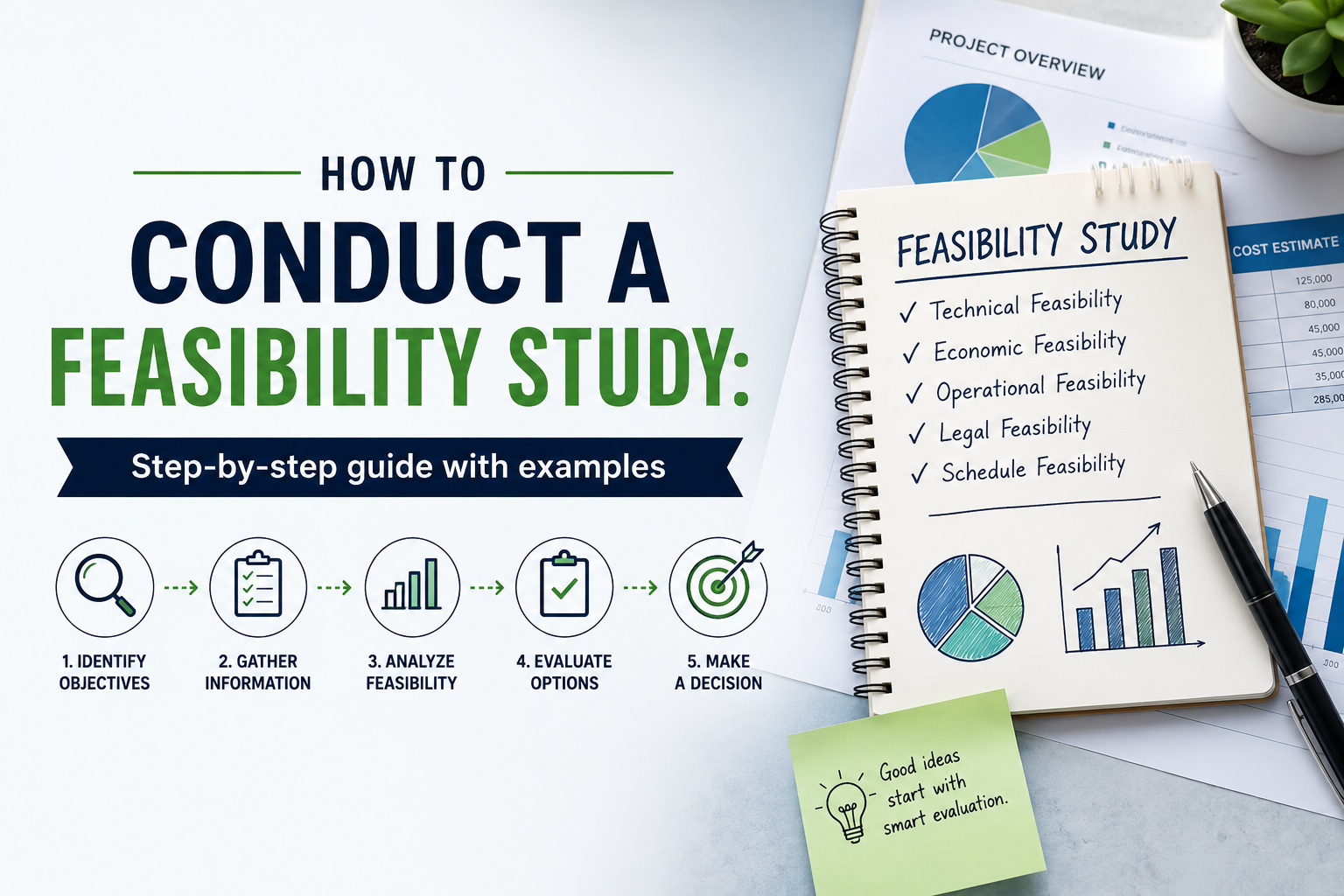
A successful business project relies upon sound decision-making and well-laid plans. Before putting in time, money and resources into a new undertaking, companies need to determine whether the project is feasible and worthwhile. This is where a feasibility study can become a crucial business tool.
An effective feasibility study will determine business opportunities and potential, estimate cost, assess the risks and feasibility. No matter what, this study, prior to placing major resources, will not waste your time or money. Whether you are starting out a business, branching out or entering a new market, the data gathered will not fail to benefit you.
Navifin Capital Management Consultancy is there to help companies with expert guidance and strategic ideas in order to place business investment wisely, with thorough financial evaluation and researches.
What Is a Feasibility Study?
A feasibility study is the process of identifying potential problems that might come up in the implementation phase of a business idea or project and understanding what the future opportunities are. This document analyzes a project from four angles: technically, financially, legally and operationally.
Essentially there is one question that needs to be answered by a feasibility study:
Will this project work?
Through an investigation of various dimensions, companies can reduce uncertainty.
Why Is a Feasibility Study Important?
Conducting a feasibility study offers numerous advantages, including:
- Reduces financial risks
- Identifies potential operational challenges
- Improves resource allocation
- Supports informed decision-making
- Increases investor confidence
- Enhances project planning
- Aligns business objectives with market demand
Businesses that invest in proper planning are more likely to achieve sustainable growth and long-term success.
Types of Feasibility Studies
Before beginning the process, it is important to understand the major areas evaluated during a feasibility study.
Technical Feasibility
This examines whether the required technology, infrastructure, equipment, and expertise are available to complete the project successfully.
Questions include:
- Is the technology accessible?
- Does the company have skilled personnel?
- Can the infrastructure support implementation?
Financial Feasibility
Financial feasibility analyzes project costs, expected revenue, profitability, funding requirements, and return on investment.
It includes:
- Capital investment
- Operating expenses
- Cash flow projections
- Break-even analysis
- ROI estimation
Operational Feasibility
This determines whether the organization has the necessary workforce, systems, and operational capabilities to execute the project effectively.
Legal Feasibility
Every project must comply with local regulations, licensing requirements, tax laws, and industry standards.
Legal analysis prevents costly compliance issues in the future.
Market Feasibility
Market analysis evaluates customer demand, competition, industry trends, and business opportunities.
Without sufficient market demand, even technically sound projects may fail.
How to Conduct a Feasibility Study: Step-by-Step Guide
Step 1: Define the Project
Start by clearly defining the business idea or project.
Identify:
- Objectives
- Expected outcomes
- Target market
- Business goals
- Scope of work
A clearly defined project creates the foundation for accurate analysis.
Step 2: Conduct Market Research
Understanding your target audience is crucial.
Analyze:
- Customer needs
- Industry trends
- Market size
- Competitor landscape
- Pricing strategies
For example, if a company plans to launch a premium financial advisory service, market research should determine whether sufficient demand exists among corporate clients.
Step 3: Analyze Technical Requirements
Evaluate whether the required resources are available.
This includes:
- Technology
- Software
- Equipment
- Skilled workforce
- Infrastructure
If additional expertise or technology is required, estimate associated costs and implementation timelines.
Step 4: Assess Financial Viability
Financial evaluation is one of the most important stages of a feasibility study.
Estimate:
- Initial investment
- Operational costs
- Projected income
- Profit margins
- Funding requirements
For example, a manufacturing company planning expansion should compare expected revenue growth against equipment purchases and operational expenses.
A detailed financial analysis helps determine whether the investment is economically sustainable.
Step 5: Evaluate Operational Capability
Determine whether your organization has the internal capacity to manage the project.
Review:
- Human resources
- Supply chain
- Production capacity
- Workflow processes
- Management systems
Operational readiness significantly impacts project success.
Step 6: Identify Potential Risks
Every business initiative carries risks.
Common risks include:
- Market fluctuations
- Regulatory changes
- Technology failures
- Budget overruns
- Project delays
- Resource shortages
Risk identification enables businesses to create contingency plans before implementation begins.
Step 7: Review Legal and Regulatory Compliance
Ensure the project complies with:
- Government regulations
- Industry standards
- Licensing requirements
- Environmental laws
- Tax obligations
Legal due diligence protects businesses from penalties and operational disruptions.
Step 8: Prepare the Final Feasibility Report
Summarize all findings into a comprehensive report.
The report should include:
- Executive summary
- Market analysis
- Technical evaluation
- Financial assessment
- Risk analysis
- Operational review
- Final recommendation
The final recommendation typically falls into one of three categories:
- Proceed with the project
- Modify the project
- Do not proceed
Feasibility Study Example
Imagine a company planning to establish a logistics warehouse in the UAE.
The feasibility study would evaluate:
Market Analysis
Growing demand for warehousing due to expanding e-commerce activity.
Technical Analysis
Availability of land, automation systems, and warehouse technology.
Financial Analysis
Construction cost of AED 12 million with projected annual revenue of AED 5 million.
Operational Analysis
Availability of skilled labor and logistics infrastructure.
Legal Analysis
Compliance with UAE commercial regulations and zoning requirements.
After reviewing these factors, management can confidently determine whether the investment aligns with business objectives.
Common Mistakes to Avoid
Many organizations make avoidable mistakes during the feasibility process.
Some common errors include:
- Using outdated market data
- Ignoring competitor analysis
- Underestimating project costs
- Overestimating revenue projections
- Failing to identify operational risks
- Neglecting legal compliance
Avoiding these mistakes significantly improves project planning and execution.
Why Businesses Choose Professional Feasibility Study Services
Preparing a comprehensive feasibility report requires expertise across finance, market research, operations, and regulatory compliance.
Professional feasibility study services provide:
- Independent project evaluation
- Financial modeling
- Market intelligence
- Risk assessment
- Investment analysis
- Strategic recommendations
This professional approach enhances decision-making and improves project success rates.
Choosing the Right Feasibility Study Company
Selecting an experienced feasibility study company is crucial for obtaining accurate and reliable insights.
Look for a consultancy that offers:
- Industry expertise
- Financial advisory experience
- Customized reports
- Market research capabilities
- Risk management solutions
- Proven track record
Experienced consultants provide objective recommendations that help businesses make informed investment decisions.
Feasibility Study UAE: Supporting Business Growth
The feasibility study UAE market has become increasingly important as businesses expand across industries such as real estate, manufacturing, logistics, healthcare, hospitality, and financial services.
For investors entering the UAE market, thoroughly detailed evaluations of economic environment, regulatory structure, competition and financial feasibility must be done before new business establishment.
With thorough feasibility reports, businesses can minimize risk while detecting profitable business opportunities in one of the most dynamic business environments in the world.
Why Choose Navifin Capital Management Consultancy?
Navifin Capital Management Consultancy offers strategic financial advisory and business consulting services to encourage informed investment decisions.
Through project analysis, financial strategy, market analysis and risk assessments, it offers its business clients with accurate information so that their project could achieve success and make large profit.
Its experts help companies translate its creativity into profitable, enduring businesses.
Conclusion
Conducting a detailed feasibility study is the most essential way to assess business opportunities and determine viability before committing valuable resources. By taking into consideration all technical, financial, operational, legal and market issues involved in a proposal, organizations can diminish any possible risks and boost success.
Whether it is for start up, enlargement or new market development, working with experts can provide you a competitive edge. Navifin Capital Management Consultancy offers businesses the appropriate analysis, planning and consulting services for sound business decisions and sustained growth.

