


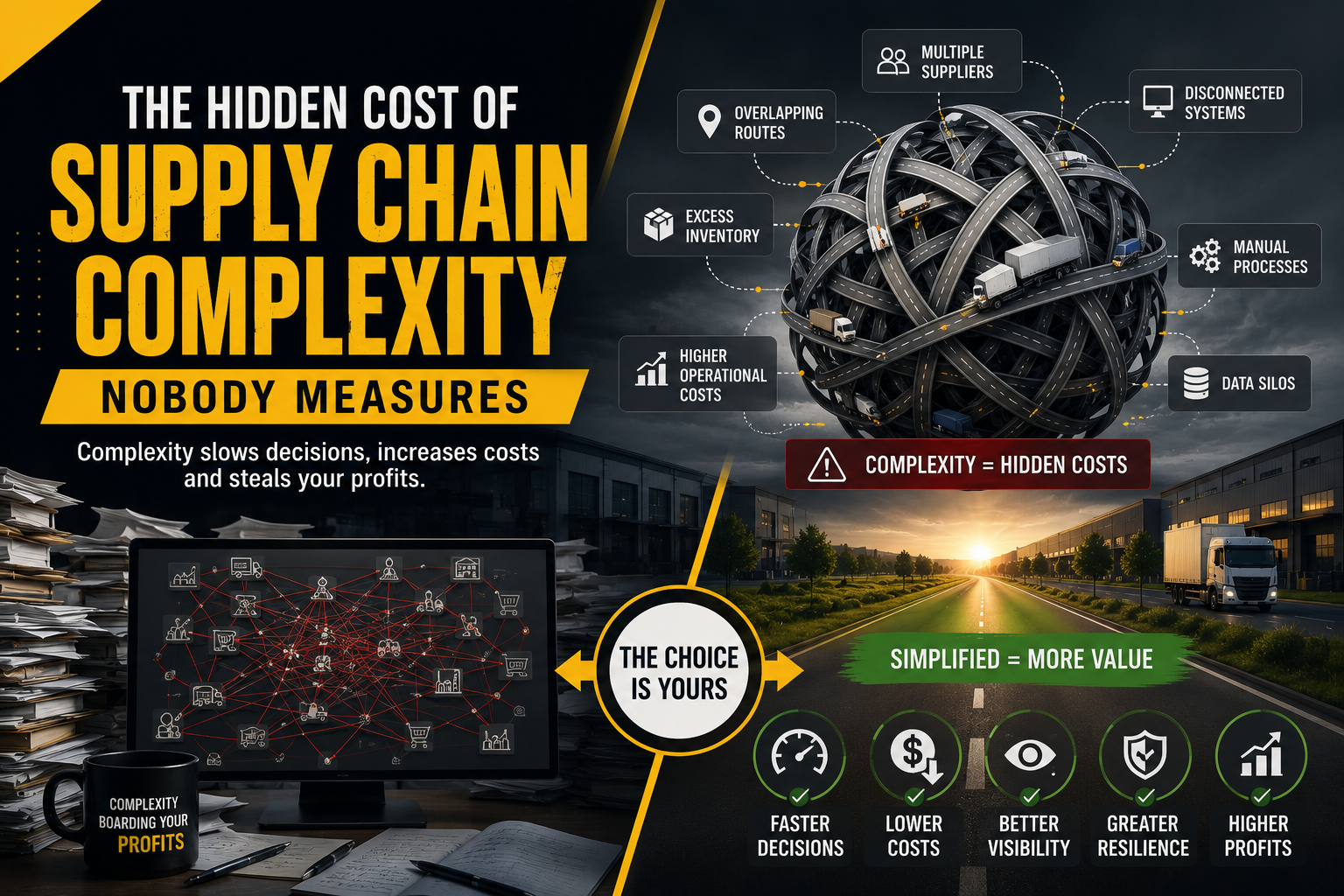
The Hidden Cost of Supply Chain Complexity Nobody Measures
Most businesses monitor freight spend, inventory carrying costs, labor expenses, and supplier pricing.
Very few measure complexity.
Yet complexity has quietly become one of the largest hidden costs inside modern supply chains.
Additional suppliers, fragmented systems, overlapping processes, disconnected warehouses, multiple carriers, and excessive manual work all increase operational friction that slowly erodes profitability.
For business owners, operations managers, procurement leaders, and supply chain executives, complexity is no longer just an operational challenge.
It is a financial problem.
What Supply Chain Complexity Really Looks Like
Complexity does not always appear obvious.
In many organizations it develops gradually as the business grows.
Common examples include:
- Multiple suppliers for identical products.
- Separate reporting systems across departments.
- Different inventory planning methods across locations.
- Excessive manual data entry.
- Numerous transportation partners with inconsistent processes.
- Duplicate operational workflows.
Individually these issues may seem manageable.
Together they create significant inefficiencies.
The Costs That Rarely Appear on Financial Reports
The biggest problem with complexity is that its costs are often invisible.
Businesses may experience:
Slower Decision Making
Teams spend more time gathering information and less time acting on it.
Higher Inventory Levels
Limited visibility often forces businesses to hold excess stock as protection against uncertainty.
Increased Administrative Work
Employees spend valuable time updating spreadsheets, reconciling reports, and correcting errors.
Supplier Management Challenges
Managing a larger supplier base increases communication requirements and operational risks.
Reduced Agility
Complex organizations typically respond slower during disruptions.
Why Complexity Is Growing Faster Than Ever
Several trends are accelerating operational complexity:
- Global sourcing strategies.
- Omnichannel distribution.
- Rising customer expectations.
- Expanding product portfolios.
- Increased regulatory requirements.
- Technology fragmentation.
Businesses are generating more data than ever before but often struggle to convert that information into actionable insights.
The Technology Paradox
Many organizations attempt to solve complexity by adding more software.
Unfortunately, additional systems often create additional silos.
Technology should simplify operations rather than increase fragmentation.
This explains why businesses increasingly seek support from professional 3PL logistics consulting services providers, third party logistics advisors, and supply chain transformation specialists who focus on process alignment before technology implementation.
Simplification Creates Competitive Advantage
The most successful organizations are not necessarily the largest.
Often they are simply easier to operate.
Simplified supply chains typically deliver:
- Faster decisions.
- Lower operating costs.
- Better customer service.
- Improved visibility.
- Greater flexibility.
- Stronger resilience.
Reducing complexity often improves profitability without requiring additional sales.
Questions Every Executive Should Ask
Business leaders should regularly evaluate:
- How many suppliers provide similar products?
- How many systems are used to manage operations?
- How much manual reporting exists?
- How quickly can decisions be made during disruptions?
- Which processes create unnecessary delays?
The answers frequently reveal opportunities for improvement.
The Role of External Expertise
Internal teams often become accustomed to existing processes and may overlook inefficiencies that have developed over time.
Experienced 3PL consulting professionals, logistics optimization experts, and outsourced logistics advisors can provide independent perspectives and identify opportunities for simplification.
Businesses exploring how operational expertise supports long term growth can find additional insights through Why Logistics Consultants Drive Business Growth.
The increasing unpredictability of global trade environments has also accelerated the need for more agile operations, a topic explored further in Predictable Supply Chains Are Over. Now What?.
Complexity Tax Versus Growth Tax
Many executives assume operational inefficiencies are simply the cost of growth.
They are not.
Growth creates opportunity.
Complexity creates waste.
The organizations that separate the two will build faster, more profitable, and more resilient businesses.
Conclusion
Supply chain complexity may not appear on balance sheets, but its impact is felt throughout the organization.
Slower decisions, excess inventory, fragmented systems, and inefficient workflows quietly reduce margins and limit growth potential.
As supply chains continue becoming more connected and more demanding, experienced 3PL logistics consulting services providers, supply network advisors, and logistics strategy specialists will play an increasingly important role in helping businesses simplify operations and unlock hidden value.

