


The Hidden Risks of Choosing Cheap IT Support Services
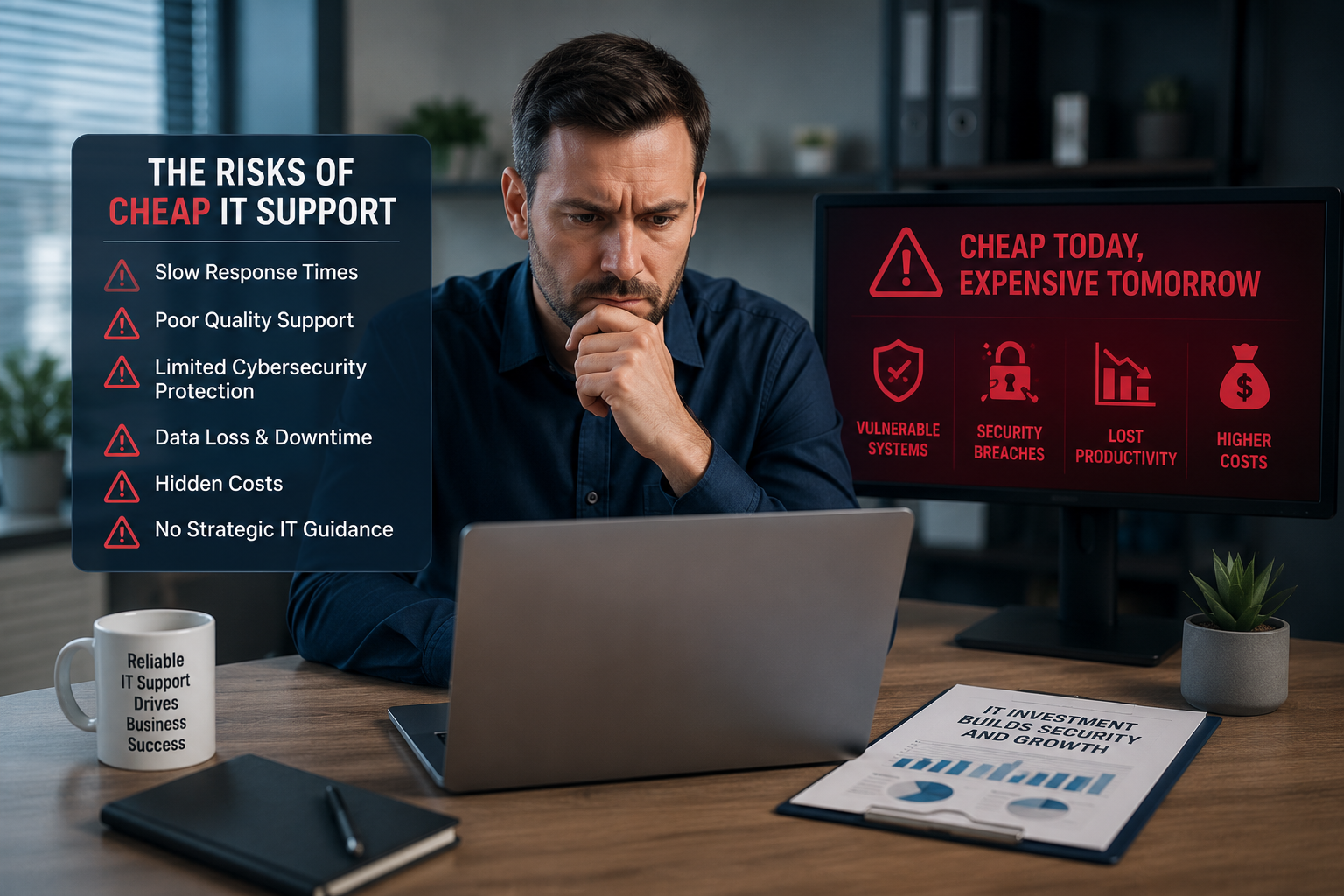
The Hidden Risks of Choosing an IT Support Provider Based Only on Price
Introduction
Choosing an IT support provider is one of the most important decisions a business can make. While keeping costs under control is essential, selecting an IT provider based only on the lowest price can expose your business to significant operational and financial risks. A low monthly fee may seem attractive initially, but inadequate IT support often results in higher long-term costs through downtime, cybersecurity incidents, lost productivity, and expensive emergency repairs.
Technology now powers nearly every aspect of business operations, from communication and collaboration to customer service, accounting, and data security. When your IT environment is not properly managed, even a minor technical issue can disrupt daily operations and affect customer confidence. That's why businesses should evaluate IT providers based on the value they deliver rather than focusing solely on price.
This guide explores the hidden risks of choosing the cheapest IT support provider, explains what to look for in a managed IT partner, and outlines how the right provider can help your business grow securely and efficiently.
Why the Cheapest IT Support Isn't Always the Best Choice
Every business wants to reduce expenses, especially during periods of economic uncertainty. However, IT support should be viewed as an investment rather than simply another business expense.
Low-cost providers often reduce their pricing by limiting services, employing fewer experienced technicians, offering slower response times, or excluding essential cybersecurity protections. These compromises may not become obvious until your business experiences a major technical issue or security incident.
Reliable IT support delivers value by preventing problems before they occur, improving productivity, protecting sensitive data, and helping businesses avoid expensive downtime.
Instead of comparing providers based only on monthly fees, businesses should evaluate:
-
Technical expertise
-
Response and resolution times
-
Cybersecurity capabilities
-
Proactive monitoring
-
Backup and disaster recovery
-
Customer support
-
Strategic IT planning
-
Scalability for future growth
Choosing an experienced IT partner often saves businesses far more money over time than selecting the cheapest available option.
The Hidden Risks of Low-Cost IT Support
Limited Cybersecurity Protection
Cybersecurity has become one of the biggest challenges facing modern businesses. Cybercriminals continue to develop increasingly sophisticated attacks targeting organizations of every size.
Many low-cost IT providers offer only basic antivirus software while overlooking critical layers of protection.
Without comprehensive cybersecurity, businesses may lack:
-
Endpoint Detection and Response (EDR)
-
Multi-Factor Authentication (MFA)
-
Email security filtering
-
Firewall management
-
Vulnerability assessments
-
Continuous security monitoring
-
Security awareness training
A single ransomware attack or data breach can result in thousands of dollars in recovery costs, operational disruption, reputational damage, and regulatory penalties.
Investing in strong cybersecurity is significantly less expensive than recovering from a successful cyberattack.
Slow Response and Resolution Times
When employees cannot access systems, every minute of downtime affects productivity and customer service.
Budget IT providers frequently support a large number of clients with limited technical staff, resulting in delayed responses and extended issue resolution times.
Common consequences include:
-
Longer help desk wait times
-
Delayed remote support
-
Extended system outages
-
Limited after-hours assistance
-
Reduced emergency availability
Businesses should review Service Level Agreements (SLAs) carefully to understand guaranteed response times before signing an IT support contract.
Reactive Instead of Proactive Support
One of the biggest differences between inexpensive IT providers and high-value managed service providers is their overall approach.
Low-cost providers often operate reactively, meaning they only fix problems after something breaks.
Reactive IT support frequently results in:
-
Unexpected server failures
-
Software crashes
-
Network outages
-
Hardware failures
-
Security vulnerabilities
-
Reduced employee productivity
Proactive IT support continuously monitors your systems, installs software updates, performs preventive maintenance, and resolves issues before they interrupt business operations.
Preventing problems is always more cost-effective than repairing them after they occur.
Hidden Costs Beyond the Initial Price
A low monthly IT support fee may not include everything your business actually needs.
Many providers advertise attractive prices but charge additional fees for services such as:
-
On-site support visits
-
Emergency assistance
-
Security monitoring
-
Software updates
-
New user setup
-
Hardware installation
-
Network configuration
-
Backup management
These extra charges can quickly exceed the cost of working with a provider offering a more comprehensive support package.
Businesses should always request a detailed breakdown of included services before comparing providers.
Limited Technical Expertise
Technology evolves rapidly, and businesses increasingly rely on cloud platforms, cybersecurity solutions, Microsoft 365, remote work technologies, virtualization, artificial intelligence, and advanced networking.
An inexpensive provider may lack specialists with experience across these technologies.
Limited technical expertise often leads to:
-
Temporary fixes instead of permanent solutions
-
Longer troubleshooting times
-
Poor system optimization
-
Missed security vulnerabilities
-
Reduced business efficiency
Experienced IT professionals continually update their certifications and technical knowledge, enabling them to support modern business environments more effectively.
Poor Scalability for Business Growth
As your business grows, your technology requirements will become more complex.
Growing businesses often need:
-
Additional employees and user accounts
-
Cloud migration
-
Hybrid work solutions
-
Enhanced cybersecurity
-
Larger network infrastructure
-
Multiple office locations
-
Business application integration
A provider focused only on basic support may struggle to scale alongside your organization.
Selecting a provider with long-term capabilities allows your technology to grow with your business instead of limiting future expansion.
Increased Business Downtime
Downtime is one of the most expensive consequences of inadequate IT support.
When systems become unavailable, employees cannot work efficiently, customers experience delays, and business operations slow dramatically.
Common causes include:
-
Poor maintenance
-
Aging hardware
-
Unpatched software
-
Network failures
-
Cybersecurity incidents
-
Slow technical response
Reliable managed IT providers minimize downtime through continuous monitoring, preventive maintenance, and rapid issue resolution.
Even preventing a few hours of downtime each year can save businesses thousands of dollars in lost productivity.
What to Look for in an IT Support Provider
Selecting the right IT support partner requires evaluating overall business value rather than simply comparing prices.
The best providers combine technical expertise, proactive management, strategic planning, and exceptional customer service.
Proven Industry Experience
Experience matters when supporting business-critical systems.
Choose providers with a strong track record of working with organizations similar to yours.
Ask about:
-
Years in business
-
Technical certifications
-
Client testimonials
-
Industry experience
-
Case studies
-
Customer retention rates
Experienced providers understand industry-specific challenges and can recommend technology solutions that support long-term business objectives.
Comprehensive Cybersecurity Services
Cybersecurity should be included within every managed IT service—not offered as an expensive add-on.
Look for providers that include:
-
Endpoint Detection and Response (EDR)
-
Firewall management
-
Email protection
-
Multi-Factor Authentication
-
Patch management
-
Vulnerability scanning
-
Security monitoring
-
Employee cybersecurity awareness training
A comprehensive security strategy significantly reduces business risk while improving compliance and resilience.
Clear Service Level Agreements (SLAs)
Professional IT providers define expectations through detailed Service Level Agreements.
A strong SLA should clearly specify:
-
Guaranteed response times
-
Resolution targets
-
Business hours
-
Emergency support availability
-
Included services
-
Performance commitments
Transparent SLAs help businesses understand exactly what level of service they will receive and ensure accountability throughout the partnership.
Proactive Monitoring and Maintenance
The best IT support providers don't wait for problems to occur. Instead, they use proactive monitoring tools to identify and resolve issues before they disrupt your business.
Proactive IT maintenance typically includes:
-
24/7 network monitoring
-
Automated software updates
-
Patch management
-
Hardware health monitoring
-
Performance optimization
-
Security monitoring
-
Preventive maintenance
This proactive approach minimizes downtime, improves system performance, and extends the lifespan of your IT infrastructure. Rather than reacting to emergencies, your IT provider works continuously to keep your technology running smoothly.
Reliable Backup and Disaster Recovery
Every business should be prepared for unexpected events such as cyberattacks, hardware failures, accidental data deletion, or natural disasters.
A reliable IT support provider should offer a comprehensive backup and disaster recovery strategy that protects your critical business data.
Key services should include:
-
Automated daily backups
-
Secure cloud backups
-
Encrypted data storage
-
Regular backup testing
-
Fast recovery procedures
-
Business continuity planning
Without a disaster recovery plan, data loss can lead to prolonged downtime, financial losses, and damage to customer trust. Reliable backups ensure your business can recover quickly and continue operating with minimal disruption.
Transparent Pricing
One of the most important qualities of a trustworthy IT provider is transparent pricing.
Rather than advertising unrealistically low monthly fees, reputable providers clearly explain what is included in their support packages and whether additional services incur extra costs.
Look for pricing that includes:
-
Help desk support
-
Remote assistance
-
Routine maintenance
-
Software updates
-
Security monitoring
-
System monitoring
-
Technical advice
Transparent pricing helps businesses budget more effectively and eliminates unexpected invoices that can quickly increase overall IT costs.
Strategic IT Consulting
Technology should support your business goals, not simply keep your computers running.
The best managed IT providers act as strategic partners by helping businesses make informed technology decisions.
Strategic IT consulting may include:
-
Technology roadmaps
-
Cloud migration planning
-
Cybersecurity strategy
-
Infrastructure upgrades
-
Software recommendations
-
Budget forecasting
-
Digital transformation planning
This long-term guidance helps businesses invest in technology that improves efficiency, supports growth, and delivers a better return on investment.
Affordable IT Support vs. Value-Driven IT Support
Affordable IT support and value-driven IT support are not always the same thing.
The cheapest provider may appear attractive initially, but if they lack expertise, proactive monitoring, or strong cybersecurity services, your business could face higher costs through downtime, emergency repairs, and security incidents.
Value-driven IT support focuses on delivering measurable business benefits, including:
|
Affordable IT Support |
Value-Driven IT Support |
|
Lowest monthly cost |
Long-term business value |
|
Reactive support |
Proactive monitoring |
|
Limited cybersecurity |
Comprehensive protection |
|
Basic troubleshooting |
Strategic IT planning |
|
Slower response times |
Fast response and resolution |
|
Minimal scalability |
Supports future growth |
|
Higher long-term risk |
Reduced business risk |
Choosing value over the lowest price helps businesses avoid unnecessary expenses while improving productivity and security.
Questions to Ask Before Choosing an IT Support Company
Before signing a contract, ask potential providers the following questions:
-
How quickly do you respond to support requests?
-
What cybersecurity services are included?
-
Do you provide 24/7 monitoring?
-
What backup and disaster recovery solutions do you offer?
-
Can you support cloud platforms like Microsoft 365?
-
Are there additional charges for onsite visits or emergency support?
-
What certifications do your engineers hold?
-
Can you provide client references?
-
How do you help businesses scale as they grow?
-
What is included in your Service Level Agreement?
The answers will help you compare providers based on value rather than simply price.
Red Flags to Avoid When Selecting an IT Service Provider
Not every IT company offers the same level of service.
Watch for these warning signs when evaluating potential providers:
Unrealistically Low Pricing
If pricing seems significantly lower than competitors, important services may be excluded.
No Clear Service Level Agreement
Without written response times and service commitments, businesses have little assurance regarding support quality.
Limited Cybersecurity Services
Providers that only install antivirus software without offering broader cybersecurity protection leave businesses exposed to modern threats.
Poor Communication
Slow responses during the sales process often indicate similar delays after becoming a client.
No Proactive Monitoring
Waiting until systems fail increases downtime and repair costs.
Limited Business Experience
Providers with little experience supporting businesses may struggle with complex IT environments or industry-specific compliance requirements.
Lack of Client References
Reliable providers should be able to demonstrate successful long-term relationships with satisfied clients.
How the Right Business IT Partner Supports Long-Term Growth
Technology plays a critical role in business growth. The right IT support provider does much more than resolve technical problems—they become a trusted partner in your company's success.
An experienced managed IT provider helps businesses:
-
Improve cybersecurity
-
Increase employee productivity
-
Reduce costly downtime
-
Support remote and hybrid work
-
Plan future technology investments
-
Scale infrastructure as the business grows
-
Maintain regulatory compliance
-
Improve business continuity
By aligning technology with business objectives, organizations gain greater operational efficiency, reduced risk, and the flexibility needed to adapt to changing market demands.
Instead of reacting to technology challenges, businesses can confidently focus on innovation, customer service, and sustainable growth.
Conclusion
Choosing an IT support provider based solely on price can lead to hidden costs that far exceed any initial savings. Limited cybersecurity, slow response times, reactive support, poor scalability, and increased downtime can all affect productivity, customer satisfaction, and profitability.
Rather than selecting the cheapest option, businesses should focus on finding an IT partner that delivers long-term value through proactive support, robust cybersecurity, transparent pricing, strategic guidance, and reliable service.
Investing in high-quality managed IT services helps protect your business today while creating a strong foundation for future growth. If you're looking for an experienced technology partner that prioritizes security, performance, and long-term success, Framewerx offers tailored IT solutions designed to keep your business secure, efficient, and ready for the future.
Frequently Asked Questions
How do you choose the right IT support provider?
Evaluate providers based on experience, cybersecurity capabilities, response times, proactive monitoring, customer reviews, Service Level Agreements (SLAs), scalability, and overall value rather than price alone.
What is the most important quality of an IT support provider?
Reliability is one of the most important qualities. A dependable provider delivers fast support, proactive maintenance, strong cybersecurity, and strategic technology guidance that helps your business operate efficiently.
Is affordable IT support a good option for small businesses?
Affordable IT support can be a good choice if it provides comprehensive services and reliable support. Businesses should compare the value offered instead of choosing solely based on the lowest monthly cost.
What services should a managed IT provider offer?
A managed IT provider should offer help desk support, proactive monitoring, cybersecurity, cloud services, backup and disaster recovery, patch management, network management, and strategic IT consulting.
How can IT support improve cybersecurity?
Professional IT support strengthens cybersecurity through continuous monitoring, endpoint protection, firewall management, multi-factor authentication, software updates, employee security training, and rapid threat detection.
What questions should I ask before hiring an IT support company?
Ask about response times, cybersecurity services, monitoring, backup solutions, certifications, pricing, SLAs, client references, and how they support business growth.
How do I compare IT service providers before making a decision?
Compare providers based on expertise, customer reviews, included services, response times, cybersecurity capabilities, scalability, transparent pricing, and long-term value rather than focusing only on monthly fees.

