


AI Companion Market Enters a New Era of Innovation and Growth
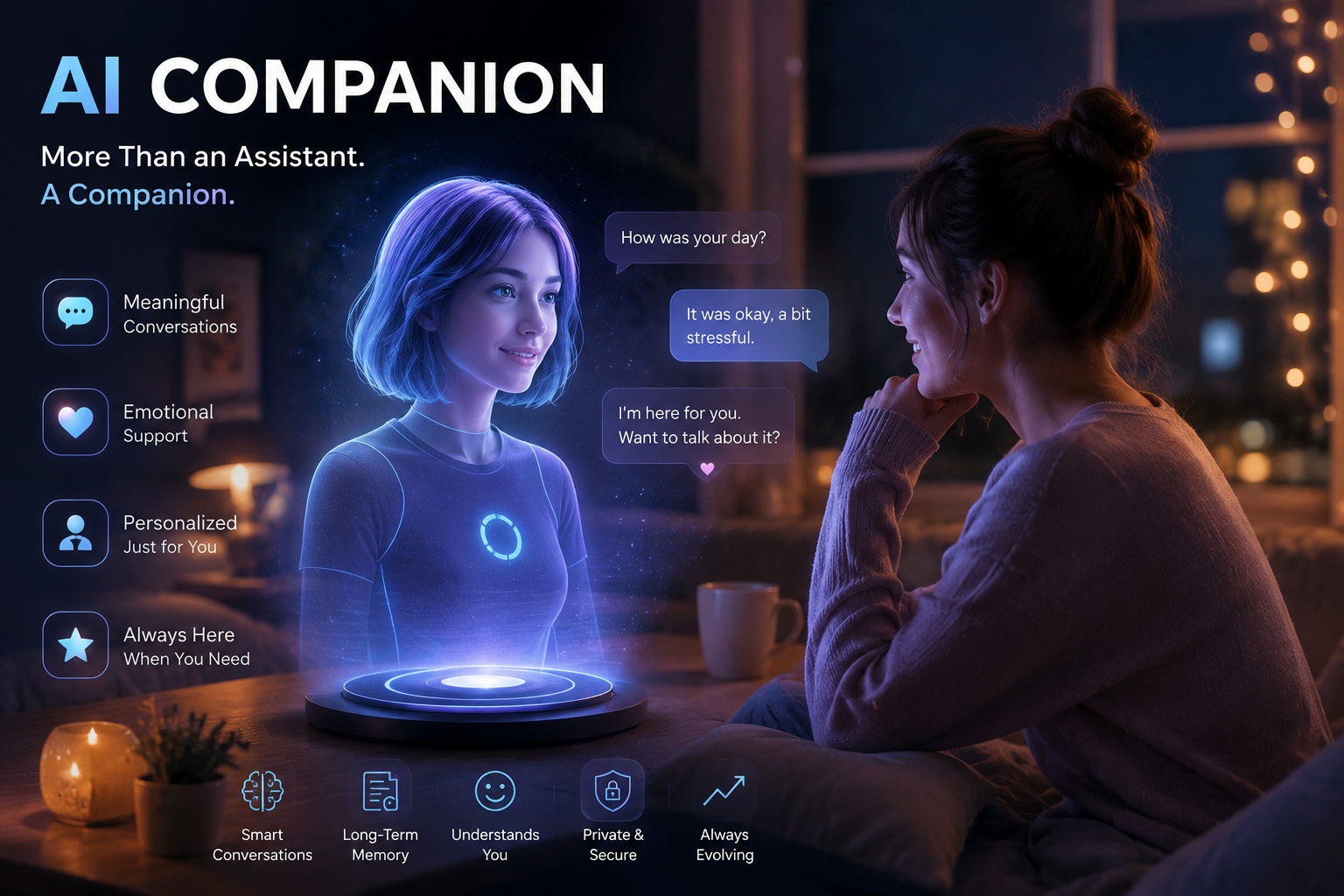
Artificial intelligence is moving beyond task automation and search assistance into a more personal area of digital interaction. AI companions are becoming part of everyday conversations, entertainment, creative expression, emotional support, and personalized experiences. Improvements in language models, memory systems, voice generation, image creation, and multimodal interaction are making these products feel more responsive and context-aware.
Personalized AI Experiences Are Driving a New Wave of Demand
AI companions are gaining attention because they can provide an interaction that remains available whenever a user wants to talk, create, practice, or simply spend time in a digital environment.
Traditional chatbots were generally designed around questions and answers. Modern companion products are moving toward persistent personalities, conversational memory, voice interaction, visual identities, and customized communication styles.
This shift is important because users are no longer judging an AI system only on whether it provides a correct answer. They are also evaluating how naturally it responds, whether it remembers previous conversations, and whether its personality remains consistent.
For example, an AI girlfriend experience may focus on conversational continuity, personality customization, emotional expression, and relationship-oriented interaction. Meanwhile, another user may prefer a virtual friend, mentor, gaming character, study partner, or creative collaborator.
Xchar AI reflects this broader movement toward customizable digital personalities, where character identity and conversational experience become central parts of the product rather than secondary interface elements.
The commercial opportunity is therefore expanding beyond a single use case. Companion technology can serve entertainment, storytelling, personal interaction, education, creativity, and social engagement.
Character Intelligence Is Becoming More Important Than Simple Chat
The quality of a companion depends heavily on what happens after the first few conversations.
A user may initially download an application because of an attractive character or interesting concept. Retention, however, depends on whether the system can maintain context and provide conversations that feel fresh.
Modern companion systems are increasingly built around several connected intelligence layers:
-
Long-term memory for relevant user preferences
-
Short-term conversation context
-
Personality instructions
-
Emotion and sentiment detection
-
Adaptive response generation
-
Voice and speech interaction
-
Image and avatar generation
-
Safety and moderation systems
-
Personalized recommendations
The combination creates a more persistent experience.
An AI roleplay chat system, for instance, can move beyond fixed scripted responses when the underlying model can remember character traits, conversation history, scene details, and user preferences.
This capability also creates opportunities for storytelling. Characters can maintain distinct personalities while responding to changing situations, making interactive narratives more dynamic.
Xchar AI can be positioned within this broader shift toward character-driven interaction, where users have more control over personality, conversation style, and the overall experience.
Global Adoption Is Creating a Stronger Business Case
The numbers surrounding AI companion applications suggest that users are willing to spend money on personalized digital interaction.
Appfigures data reported through TechCrunch showed $221 million in consumer spending across AI companion apps as of July 2025. Revenue had increased 64% compared with the same period in 2024. The data also showed that the top 10% of companion apps generated 89% of category revenue, highlighting the importance of product quality and differentiation.
Market research firms use different definitions for the AI companion category, so estimates can vary substantially. Still, the direction is consistent: investment, consumer adoption, and product development are all moving upward.
Social Interaction Is Becoming a Major AI Use Case
The growth is not limited to dedicated companion applications.
A July 2026 survey from Elon University’s Imagining the Digital Future Center found that 27% of internet-using U.S. adults reported social interactions with AI large language models, including systems from major AI providers. The study surveyed 1,000 U.S. adults in May 2026.
That finding matters because it broadens the definition of an AI companion.
A user does not necessarily need a dedicated companion application to develop a social relationship with an AI system. General-purpose assistants are also being used for personal conversations, emotional discussions, advice, and casual interaction.
This creates a larger competitive environment.
Dedicated companion companies need to differentiate through personality, memory, character design, voice, customization, community features, and specialized experiences rather than relying only on access to a conversational model.
Multilingual Companions Can Open New Markets
Language is another major opportunity for AI companion businesses.
English may provide the starting point, but global users expect more than literal translation. Character personality, humor, expressions, conversation starters, onboarding messages, and marketing copy need local adaptation.
A multilingual system should therefore separate language generation from the core personality layer.
For example, the same character can maintain identical personality traits while speaking Spanish, French, German, Japanese, or another supported language.
The user experience can then remain consistent without making every language feel mechanically translated.
SEO also becomes important at this stage. Local keyword research, localized page structures, language-specific metadata, and hreflang implementation can help search engines identify the correct version for each audience.
Xchar AI can benefit from this approach as multilingual companion experiences become more accessible to users across different regions.
Safety and Product Quality Will Shape Long-Term Growth
Growth alone will not determine which AI companion businesses succeed.
As these products become more personal, safety becomes part of product quality. Memory controls, age safeguards, moderation systems, privacy settings, transparent AI disclosures, and responsible interaction design need to be considered during product development.
Recent developments show why this matters. In July 2026, China introduced tighter rules affecting AI companion services, with concerns around emotional dependency and potential harm to younger users. Major technology companies adjusted or discontinued some companion offerings in response.
Research also points toward the need for careful product design. A 2025 study examining 1,131 users and thousands of chatbot sessions found associations between intensive companionship-oriented use, high self-disclosure, limited human social support, and lower well-being. The findings do not mean every AI companion interaction produces negative outcomes, but they do reinforce the need for responsible design.
For businesses, safety should therefore be treated as part of the product architecture rather than an afterthought.
Competition Will Shift Toward Experience Quality
Access to powerful AI models is becoming easier. That means the model itself may not remain the strongest differentiator.
Instead, companies will compete around:
-
Character quality
-
Memory accuracy
-
Response consistency
-
Voice realism
-
Personalization
-
Visual identity
-
Multilingual support
-
User retention
-
Safety controls
-
Subscription value
-
Community experiences
A strong product can combine these elements into a coherent experience.
Meanwhile, AI companion businesses will need to monitor user behavior closely. Metrics such as daily active users, conversation duration, retention, paid conversion, subscription renewal, and average revenue per user can reveal whether the product creates lasting value.
Conclusion
The AI companion market is moving into a phase where conversational intelligence, personalization, voice, memory, and multimodal interaction are becoming closely connected. Market forecasts point toward substantial growth, while app downloads, consumer spending, and broader social use of AI indicate that companionship is becoming a meaningful part of digital behavior.
The opportunity is considerable, but long-term success will depend on more than launching another chatbot. Products need distinctive personalities, consistent memory, natural interaction, multilingual support, responsible safeguards, and a user experience that gives people a reason to return.

