


What equipment is supplied and installed by an IVF Lab Design Company?
INTRODUCTION
An IVF Lab Design Company can supply and install a wide range of specialized equipment and infrastructure required to create a controlled, efficient, and contamination-conscious assisted reproductive technology laboratory. Unlike conventional laboratories, IVF facilities require carefully coordinated areas for embryology, andrology, cryopreservation, media preparation, specimen handling, and supporting activities. Equipment selection must therefore consider laboratory workflow, environmental stability, process requirements, safety, ergonomics, and applicable regulatory and quality requirements.
The exact equipment package varies according to the size of the fertility centre, procedures performed, laboratory workflow, level of automation, and project specifications. A well-planned IVF laboratory combines specialized reproductive laboratory equipment with HVAC, filtration, monitoring, electrical, medical-gas, and cleanroom-related infrastructure.
Why Specialized IVF Laboratory Equipment Matters
IVF laboratory procedures involve highly sensitive biological material. Embryos, oocytes, sperm, culture media, and other specimens require controlled handling and carefully managed environmental conditions.
Appropriate equipment can help laboratories achieve:
- Better workflow organization
- Controlled specimen handling
- Stable environmental conditions
- Improved operator efficiency
- Reduced contamination risks
- Reliable monitoring
- Organized cryogenic storage
- Better laboratory safety
- Easier maintenance and documentation
Equipment should be selected according to the laboratory's actual clinical and embryology processes rather than simply purchasing a standard equipment list.
1. Laminar Airflow Workstations
Laminar airflow workstations may be installed in areas where controlled working conditions are required.
Depending on the application, these systems can provide:
- HEPA-filtered airflow
- Controlled work areas
- Reduced particulate exposure
- Stable airflow patterns
- Ergonomic working arrangements
The specific type of airflow workstation should be selected according to the intended procedure and laboratory design.
2. IVF Workstations
Specialized IVF workstations provide an organized area for embryologists to perform delicate laboratory procedures.
They may incorporate:
- Heated work surfaces
- Micromanipulation equipment
- Integrated lighting
- Electrical connections
- Gas connections
- Temperature monitoring
- Equipment mounting provisions
The workstation layout should support smooth movement between different stages of laboratory processing.
3. Embryology Microscopes
Microscopy is fundamental to many IVF laboratory procedures.
Laboratories may require:
- Inverted microscopes
- Stereo microscopes
- Specialized imaging systems
- Micromanipulation microscopes
Microscope selection depends on the procedures performed and the required level of observation and manipulation.
4. Micromanipulation Systems
Advanced IVF laboratories may use micromanipulation systems for procedures such as intracytoplasmic sperm injection (ICSI).
A micromanipulation setup can include:
- Micromanipulators
- Microinjectors
- Specialized microscope
- Heated stage
- Anti-vibration arrangements
- Control mechanisms
Proper installation is important because vibration and temperature fluctuations can affect delicate laboratory procedures.
5. CO₂ Incubators
CO₂ incubators are among the most important pieces of equipment in an embryology laboratory.
They provide controlled conditions for embryo culture, including:
- Temperature control
- CO₂ regulation
- Humidity management
- Gas monitoring
- Alarm functions
Depending on the laboratory's workflow, multiple incubators may be installed to provide adequate capacity and operational redundancy.
6. Benchtop or Time-Lapse Incubators
Some advanced IVF laboratories use specialized incubators equipped with imaging systems.
These systems may support:
- Continuous embryo observation
- Automated image capture
- Reduced disturbance to cultures
- Developmental monitoring
- Time-lapse analysis
The choice depends on the laboratory's clinical protocols and investment strategy.
7. Embryo Transfer Equipment
Equipment associated with embryo transfer can include specialized:
- Transfer catheters
- Preparation workstations
- Warming equipment
- Transfer-related accessories
Although the clinical transfer procedure occurs in the treatment area, coordination between the IVF laboratory and clinical team is essential.
8. Sperm Preparation Equipment
Andrology areas may require equipment for semen processing and sperm preparation.
Potential equipment includes:
- Centrifuges
- Microscopes
- Heating systems
- Sample preparation stations
- Sperm analysis systems
- Refrigerated or controlled-temperature equipment where required
The equipment selection should reflect the laboratory's diagnostic and treatment protocols.
9. Computer-Assisted Sperm Analysis Systems
Computer-assisted sperm analysis (CASA) systems can help laboratories evaluate parameters such as:
- Sperm concentration
- Motility
- Movement characteristics
- Morphological parameters, depending on the system
These systems can improve standardization and documentation when appropriately validated and operated.
10. Centrifuges
Centrifuges may be required in the andrology and supporting laboratory areas.
They can be used for specific specimen-processing procedures according to laboratory protocols.
Important selection factors include:
- Speed range
- Rotor configuration
- Capacity
- Temperature control where required
- Safety features
- Maintenance requirements
11. Heated Stages and Heating Blocks
Temperature stability is important during handling of reproductive cells and embryos.
Heating equipment may include:
- Heated microscope stages
- Heating blocks
- Warming surfaces
- Tube warmers
- Temperature-controlled work areas
These systems help minimize unnecessary temperature fluctuations during laboratory procedures.
12. Embryo Warming Systems
Cryopreserved embryos require controlled warming procedures before use.
A laboratory may use:
- Controlled warming equipment
- Temperature-controlled workstations
- Timers
- Specialized warming accessories
Equipment selection should be compatible with the laboratory's cryopreservation protocols.
13. Cryopreservation Equipment
Cryopreservation is a major component of many modern IVF facilities.
Equipment can include:
- Cryostorage tanks
- Liquid-nitrogen storage systems
- Cryocanes
- Cryoboxes
- Sample identification systems
- Temperature monitoring systems
Cryogenic storage areas require carefully planned safety and monitoring infrastructure.
14. Cryogenic Monitoring Systems
Cryogenic storage systems should be monitored continuously or according to facility procedures.
Monitoring may include:
- Temperature monitoring
- Liquid nitrogen levels
- Alarm systems
- Remote alerts
- Data logging
Reliable monitoring helps laboratory personnel identify abnormal conditions quickly.
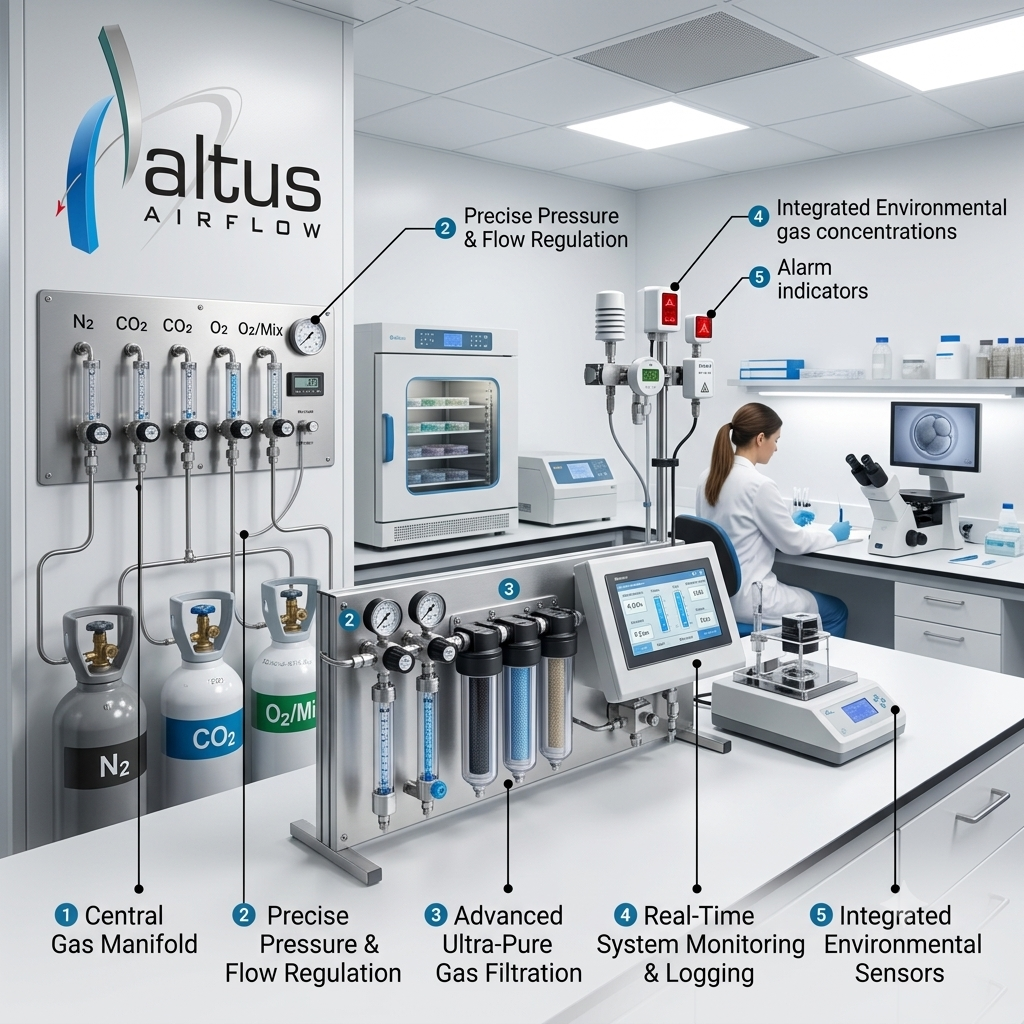
15. Gas Management Systems
Embryology laboratories can require controlled supplies of gases used by incubators and related equipment.
Depending on the laboratory configuration, infrastructure may include:
- CO₂ supply
- Nitrogen supply
- Medical or specialty gas connections where required
- Gas regulators
- Pressure monitoring
- Gas alarms
Gas systems should be designed and installed according to applicable safety requirements and equipment specifications.
16. Gas Purification and Filtration
Gas quality can be important for sensitive laboratory processes.
Depending on the equipment, systems may incorporate:
- Gas filters
- Regulators
- Purification components
- Pressure controls
- Monitoring devices
The appropriate arrangement depends on the incubator and laboratory equipment specifications.
17. Air Handling and HVAC Equipment
Equipment supplied by an IVF laboratory project may extend beyond laboratory benches and instruments.
HVAC infrastructure can include:
- Air-handling units
- Filtration systems
- Ductwork
- Terminal HEPA filtration where specified
- Temperature controls
- Humidity controls
- Pressure monitoring
- Air distribution systems
HVAC design is especially important because embryology environments require stable conditions.
18. HEPA Filtration Systems
HEPA filtration can form part of the laboratory's environmental-control strategy.
A project may include:
- HEPA filter modules
- Filter housings
- Terminal filtration
- Pressure monitoring
- Filter integrity testing
The filtration approach should be determined by the laboratory's environmental requirements and design specifications.
19. Environmental Monitoring Systems
Continuous monitoring can provide information about critical laboratory conditions.
Systems may monitor:
- Temperature
- Humidity
- Differential pressure
- CO₂
- O₂ where applicable
- Incubator conditions
- Cryogenic storage conditions
Alarms can notify staff when predefined operating limits are exceeded.
20. Temperature Monitoring Systems
Independent temperature monitoring can provide an additional layer of oversight.
Monitoring may be applied to:
- Incubators
- Refrigerators
- Freezers
- Cryogenic systems
- Workstations
- Storage areas
Data logging can support laboratory records and quality-management processes.
21. Laboratory Refrigerators
Specialized laboratory refrigerators may be required for appropriate storage of:
- Reagents
- Media
- Laboratory supplies
- Temperature-sensitive materials
The refrigerator specification should match the materials being stored and the required temperature range.
22. Laboratory Freezers
Freezers can be included where required for laboratory materials and specific storage processes.
Selection considerations include:
- Temperature range
- Capacity
- Alarm functions
- Backup power
- Monitoring
- Maintenance
The laboratory should define storage requirements before equipment selection.
23. Media Preparation Equipment
Media preparation areas may require equipment such as:
- Precision balances
- Water purification systems
- Heating equipment
- Mixing equipment
- pH measurement systems
- Sterile workstations
The actual equipment list depends on whether media are prepared on-site or supplied ready for use.
24. Water Purification Systems
Where laboratory processes require purified water, suitable water-treatment equipment may be installed.
Possible systems include:
- Reverse osmosis
- Deionization
- UV treatment
- Final filtration
Water quality requirements should be established based on laboratory processes and equipment specifications.
25. UPS and Backup Power Systems
Power reliability is critical because several IVF laboratory devices must operate continuously.
Backup infrastructure can include:
- UPS systems
- Emergency power
- Dedicated electrical circuits
- Surge protection
- Power monitoring
The backup strategy should be designed according to the criticality of each connected system.
26. Laboratory Safety Equipment
Safety equipment can include:
- Emergency alarms
- Gas monitoring
- Oxygen-deficiency monitoring where cryogenic systems require it
- Fire-safety provisions
- Emergency electrical arrangements
- Spill-response equipment
Cryogenic areas require particular attention to ventilation and safety procedures.
27. Laboratory Furniture and Workstations
An IVF project may include specialized laboratory furniture designed around workflow.
This can include:
- Work benches
- Storage cabinets
- Mobile tables
- Equipment stands
- Sink units where appropriate
- Ergonomic seating
Furniture dimensions and locations should be coordinated with laboratory equipment.
28. Data and Laboratory Information Systems
Modern laboratories may incorporate digital systems for:
- Sample identification
- Embryo records
- Equipment monitoring
- Temperature logging
- Inventory management
- Documentation
The exact digital infrastructure depends on the facility's workflow and software requirements.
29. Equipment Installation and Integration
Supplying equipment is only one part of an IVF laboratory project.
Installation may involve:
- Positioning
- Electrical connections
- Gas connections
- HVAC coordination
- Network connections
- Equipment leveling
- Temperature stabilization
- Functional testing
Equipment should be installed according to manufacturer requirements and project specifications.
30. Testing and Commissioning
After installation, critical equipment should undergo appropriate checks.
Commissioning can include:
- Functional testing
- Temperature verification
- Gas-pressure checks
- Alarm testing
- Airflow testing
- HEPA integrity testing where applicable
- Electrical checks
- Environmental monitoring verification
Testing helps confirm that the laboratory is ready for controlled operation.
31. Validation and Documentation
Depending on the equipment and regulatory framework, validation documentation may be required.
Documents can include:
- Equipment specifications
- Installation records
- Calibration certificates
- Test reports
- Commissioning documents
- Operating procedures
- Maintenance instructions
A structured documentation system supports quality assurance and future audits.
32. Staff Training
Equipment performance also depends on correct operation.
A project provider may support training covering:
- Equipment operation
- Alarm response
- Cleaning procedures
- Preventive maintenance
- Safety procedures
- Emergency response
Training should be aligned with the equipment manufacturers' instructions and the laboratory's standard operating procedures.
How Equipment Selection Supports IVF Laboratory Workflow
Equipment should not be selected independently of the laboratory layout.
A well-designed laboratory considers the movement of:
Patient/sample → Processing → Examination → Culture → Cryopreservation → Storage → Transfer
The objective is to reduce unnecessary movement, avoid workflow crossovers, and provide convenient access to critical equipment.
Factors to Consider When Selecting IVF Equipment
Healthcare organizations should evaluate:
- Clinical procedures performed
- Laboratory capacity
- Equipment compatibility
- Environmental requirements
- Manufacturer support
- Calibration requirements
- Maintenance availability
- Spare-parts availability
- Energy consumption
- Backup requirements
- Staff training
- Future expansion
Equipment selection should be based on documented laboratory requirements rather than brand names alone.
Conclusion
The equipment supplied and installed by an IVF Lab Design Company can extend from specialized embryology and andrology instruments to incubators, microscopes, micromanipulation systems, cryopreservation equipment, gas systems, HVAC, HEPA filtration, environmental monitoring, backup power, laboratory furniture, safety systems, and digital infrastructure. A successful IVF laboratory requires these components to work together within an appropriately planned workflow and controlled environment. Proper installation, testing, commissioning, documentation, and staff training are equally important to equipment supply. For fertility centres seeking an integrated laboratory planning and implementation approach, Altus Airflow provides specialized IVF laboratory infrastructure and engineering solutions designed around operational, environmental, and workflow requirements.
Frequently Asked Questions
1. What equipment does an IVF Lab Design Company typically supply?
An IVF Lab Design Company can supply and install microscopes, IVF workstations, CO₂ incubators, micromanipulation systems, cryopreservation equipment, sperm-processing equipment, environmental monitoring systems, HVAC infrastructure, HEPA filtration, gas systems, backup power, and laboratory furniture.
2. Does an IVF Lab Design Company install CO₂ incubators?
Yes. An IVF Lab Design Company can coordinate the installation of CO₂ incubators, including appropriate positioning, electrical connections, gas connections, environmental conditions, monitoring, and commissioning.
3. Does an IVF Lab Design Company provide cryopreservation equipment?
Depending on the project scope, an IVF Lab Design Company can supply and integrate cryopreservation infrastructure such as cryogenic storage tanks, monitoring systems, sample-storage accessories, and related safety systems.
4. Does an IVF Lab Design Company install HVAC and HEPA filtration?
Yes. An IVF Lab Design Company can integrate HVAC, filtration, air distribution, temperature control, humidity control, and environmental monitoring into the overall IVF laboratory design.
5. What equipment is required for ICSI?
ICSI generally requires specialized microscopy and micromanipulation equipment, including an appropriate microscope, micromanipulators, microinjectors, heated stage, and related accessories. An IVF Lab Design Company can coordinate the infrastructure needed to accommodate these systems.
Read Our Previous Blog------>How does a Modular Ophthalmic OT Setup Company integrate laminar airflow and HVAC systems?

