


Humanoid Robot Demand Rises With Industry 4.0 and Smart Automation
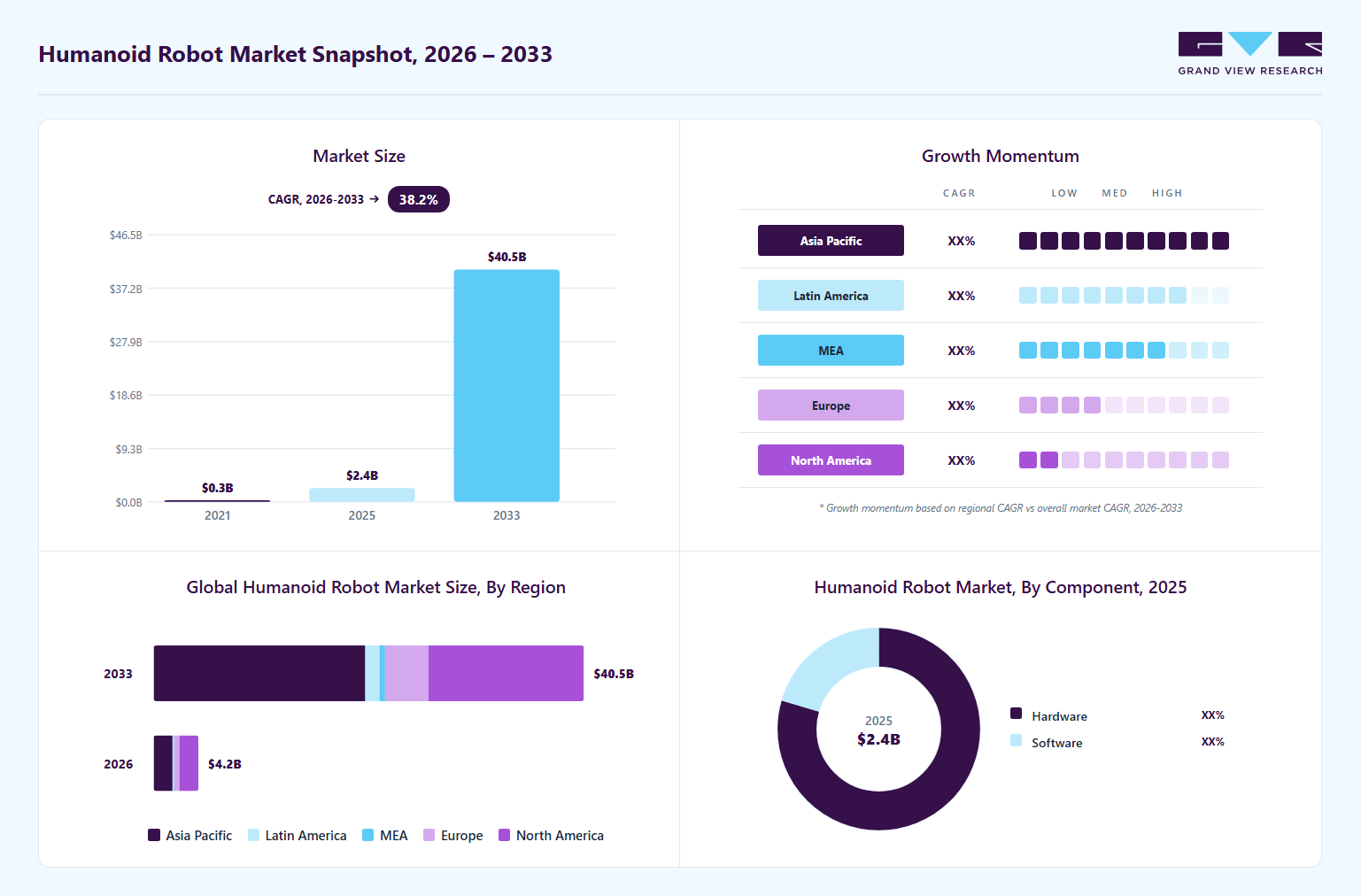
Humanoid robots are moving rapidly from research laboratories and pilot projects toward practical industrial and service applications. Advances in artificial intelligence, machine learning, computer vision, mobility, and human-robot interaction are making these systems increasingly capable of performing tasks in environments designed for people. The humanoid robot market was valued at USD 2.4 billion in 2025 and is projected to grow from USD 4.2 billion in 2026 to USD 40.5 billion by 2033, registering a CAGR of 38.2% from 2026 to 2033.
Market Overview
The market is expanding as businesses increasingly explore flexible automation capable of operating alongside people and within existing environments. Humanoid robots can perform repetitive, labor-intensive, and physically demanding activities across manufacturing, logistics, healthcare, retail, hospitality, defense, education, and residential settings.
Hardware represented the largest component share at 79.4% in 2025, reflecting the importance and cost of physical systems such as sensors, actuators, control systems, power units, robotic frames, and mobility systems. Meanwhile, software is expected to register a CAGR of over 45.0% from 2026 to 2033, supported by advances in artificial intelligence, machine learning, deep learning, perception, autonomous decision-making, and human-robot interaction.
Key Market Drivers
Labor Shortages:
Persistent workforce shortages are encouraging organizations to consider humanoid robots for repetitive and labor-intensive operations. Manufacturing and logistics businesses can use humanoid systems for activities such as material handling, assembly support, inspection, and other workflows where workforce availability is becoming increasingly challenging.
The manufacturing segment accounted for the largest application share of 31.9% in 2025. Demand is being supported by the need to improve productivity and operational efficiency while automating repetitive, precision-based, and hazardous tasks.
Artificial Intelligence:
Artificial intelligence is a central technology behind the market's expansion. Improvements in machine learning, computer vision, perception, navigation, reasoning, and motion control are allowing humanoid robots to operate with greater autonomy and adaptability.
Generative AI, edge computing, and real-time data analytics are further improving robotic decision-making and operational intelligence. These developments are helping humanoid robots transition from experimental systems toward broader real-world deployments across industrial and service environments.
The biped segment dominated the motion type category with a revenue share of over 71.0% in 2025. Its ability to replicate human locomotion allows robots to navigate environments containing stairs, narrow pathways, uneven terrain, and other infrastructure designed for people.
Lower Costs:
Cost considerations are becoming increasingly important as humanoid robotics moves toward commercialization. The wheel-drive segment is expected to witness significant growth through 2033, supported by improvements in autonomous navigation, sensor fusion, and AI-based path planning.
Wheel-driven systems can provide lower costs, higher energy efficiency, and easier deployment in structured environments such as warehouses and retail facilities. These characteristics can make them attractive for repetitive material-handling and service applications.
Major Regions and Players
China and Asia-Pacific:
Asia Pacific is expected to register the fastest CAGR of over 41.0% from 2026 to 2033, supported by rapid industrialization, expanding manufacturing activity, and government support for robotics and AI development. The region is increasingly adopting humanoid robots to improve productivity, reduce labor dependency, and strengthen operational efficiency.
North America:
North America dominated the market with a 43.4% revenue share in 2025. Strong technological capabilities in artificial intelligence, robotics, and advanced automation, combined with significant investment and labor shortages, are supporting adoption across manufacturing, logistics, healthcare, and defense.
Pricing Tiers:
Pricing is becoming an important consideration as the industry moves from high-cost prototypes toward more commercially viable robotic platforms. Hardware complexity, AI capabilities, sensors, actuators, mobility systems, software, and integration requirements all influence the overall economics of deployment.
The market is also seeing increasing strategic partnerships and investment as technology developers work to improve performance and commercial scalability. As production capabilities mature and technology improves, broader deployment could support greater accessibility across industrial and service applications.
Explore the detailed regional outlook, market opportunities, and growth trends across key markets.
FAQ
1. What trends are shaping the humanoid robot market?
Key trends include AI-driven autonomy, embodied intelligence, improved computer vision, advanced mobility, human-robot interaction, Industry 4.0 adoption, increasing industrial automation, and expanding deployments across manufacturing, logistics, healthcare, retail, and residential applications.
2. Which region dominates the humanoid robot market?
North America dominated the market with a 43.4% revenue share in 2025, while Asia Pacific is expected to record the fastest CAGR of over 41.0% from 2026 to 2033.
Key Humanoid Robot Companies:
· 1X Technologies
· Agility Robotics, LLC
· Apptronik
· Boston Dynamics
About us:
Grand View Research, a market research and consulting company, provides syndicated research reports, customized research reports, and consulting services. Grand View Research database is used by the world's renowned academic institutions and Fortune 500 companies to understand the global and regional business environment. Our database features thousands of statistics and in-depth analysis on 46 industries in 25 major countries worldwide.

