


How Can jinglitools Air Compressor Match Different Workshop Applications?
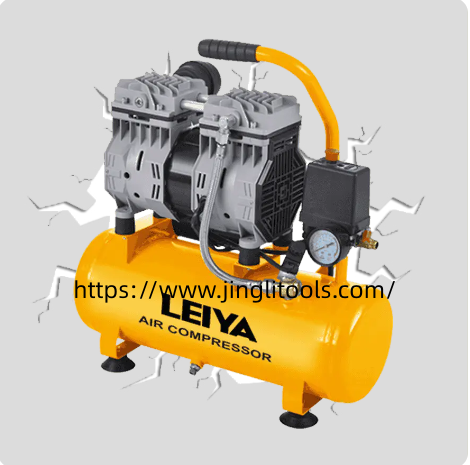
Air Compressor selection should start with the application rather than simply comparing motor ratings or product sizes. Buyers need to consider how much compressed output their tools require, what pressure range is suitable, how often the equipment will operate, and where it will be installed. These factors can make a significant difference when choosing equipment for workshops, maintenance areas, production spaces, or other working environments.
Identify the Actual Workload
The first step is to understand what the equipment will be used for. Pneumatic nailers, spray equipment, cleaning tools, impact tools, and other devices can have different consumption requirements. A small repair station may have intermittent demand, while a production area could require repeated operation throughout the working day.
Make a list of the pneumatic devices that will be connected and check their recommended pressure and flow requirements. If several tools may operate at the same time, consider their combined demand rather than evaluating each device separately.
This approach gives buyers a clearer reference when comparing different configurations.
Compare Pressure and Delivery Specifications
Maximum pressure and delivery capacity are two important specifications, but they should not be considered independently. The selected model should provide a working range that corresponds with the requirements of the connected equipment.
For example, the LEIYA-7909 model listed by jinglitools has a maximum pressure of 0.8 MPa and a maximum delivery of 135 L/min, with a 9L container.
Another configuration, the LY-89-40, provides a 40L container, 250 L/min maximum delivery, and 0.8 MPa maximum pressure.
These differences show why buyers should compare complete specifications instead of selecting a model according to one number.
Consider Tank Size
Container volume can influence how the system handles changing demand. A compact tank may be convenient for applications where portability and limited installation space matter. A larger container may be useful when the application requires a greater stored volume.
The LY-239-60, for example, uses a 60L tank and two motors, with a listed maximum delivery of 350 L/min.
The appropriate size depends on the actual workload, available space, and frequency of use. Buyers should avoid choosing a container simply because it appears larger or smaller without considering the application.
Check Electrical Compatibility
Electrical requirements should be verified before purchase. Voltage, frequency, input power, and available connections all need to match the installation environment.
Many models in the jinglitools range list 220V and 50Hz to 60Hz specifications, but buyers should still confirm the exact configuration of the selected model before ordering.
Checking electrical compatibility in advance can help prevent installation problems and makes it easier to prepare the working area properly.
Pay Attention to Noise and Workspace Conditions
Sound level can matter when equipment operates near workers, offices, clinics, laboratories, or indoor service areas. Buyers should review the stated noise specification and consider the location where the unit will be used.
The LEIYA-7909 lists a noise level of no more than 68 dB, while the LY-89-40 lists no more than 72 dB.
Ventilation and installation space should also be considered. The equipment should have sufficient room for inspection, cleaning, and routine service.
Decide Whether an Oil-Free Design Fits
Some applications place greater importance on avoiding lubricating oil within the compression process. Oil-free configurations can be considered for environments where clean compressed output is part of the application requirements.
The jinglitools product range includes oil-free and silent configurations as well as diaphragm and centrifugal designs, allowing buyers to compare different structures according to their intended use.
However, buyers should still review the technical requirements of their specific application rather than assuming one configuration is suitable for every workplace.
Review Maintenance and Product Support
Maintenance requirements deserve attention before an order is placed. Buyers can ask about filter cleaning, drainage, inspection intervals, replacement components, and operating instructions.
It is also useful to review manufacturer information and technical documentation. Clear specifications make it easier to compare models and prepare for installation. For businesses purchasing equipment in batches, communication with the manufacturer can also help clarify configuration, packaging, customization, and application questions.jinglitools offers a range of power tools and compressed-air equipment through its official website, with different configurations covering compact portable units, silent models, larger tank options, and specialized oil-free designs. Buyers can review available models and product information at the https://www.jinglitools.com/

