


Quality Management for Spring Hardware Production
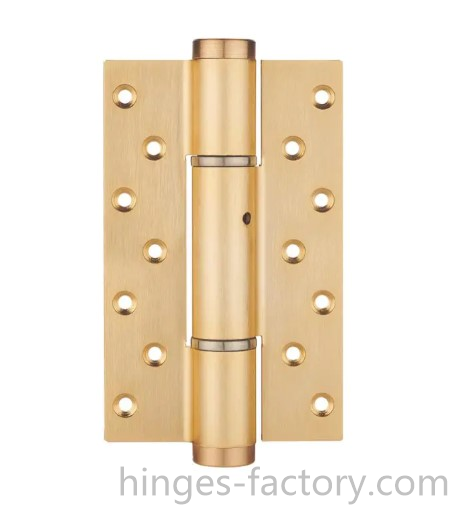
Modern door hardware must balance movement, structural support, installation requirements, and long-term durability. Within this field, Damping Spring Hinges combine spring-based mechanical action with movement control in a compact architectural component. Their development requires attention to spring behavior, material characteristics, friction, structural loading, surface treatment, and assembly accuracy. When these elements are coordinated, the hinge can become an integrated part of the door system rather than simply a connecting component.
Spring material is central to the engineering process. A spring repeatedly stores and releases mechanical energy, so its material must provide appropriate elasticity and fatigue resistance for the intended application. Spring steel is widely associated with mechanical spring systems because its characteristics can support repeated deformation when properly processed. Engineers also need to consider surface condition, heat treatment, manufacturing accuracy, and environmental exposure when selecting a suitable material.
Heat treatment can influence the mechanical characteristics of spring components. Controlled thermal processing may help achieve an appropriate relationship between hardness, elasticity, and fatigue resistance. However, treatment must be carefully matched to the material and manufacturing process. Inconsistent heating or cooling can create variation between components, making process control an important part of production quality.
The damping function requires coordination between the spring mechanism and other moving components. Spring force alone can produce rapid movement if it is not appropriately controlled. A damping structure can help regulate the release of stored mechanical energy and influence how movement progresses. Manufacturers therefore need to evaluate the interaction between spring force, friction, moving interfaces, and structural constraints during product development.
Precision manufacturing is particularly important because mechanical movement depends on accurate component relationships. CNC machining, turning, milling, drilling, grinding, forming, and controlled assembly can be used according to the product structure. Critical contact surfaces should be manufactured consistently so that moving components remain properly positioned. Dimensional inspection can help identify deviations before they affect final assembly.
Surface engineering provides another layer of protection. Door hardware may be exposed to humidity, dust, cleaning chemicals, fingerprints, and repeated contact. Appropriate coating, plating, polishing, or other finishing processes can help protect metal surfaces while maintaining a suitable architectural appearance. Surface preparation should be consistent because poor preparation can reduce coating adhesion or create visual differences between components.
Structural design should consider the complete load path. The hinge transfers forces between the door and frame, while the spring mechanism introduces additional internal loading. Mounting plates, pins, housings, connection points, and surrounding door materials therefore need to be evaluated together. Engineers can use structural analysis and physical testing to identify areas where stress may concentrate during repeated movement.
Installation accuracy can significantly affect mechanical behavior. A poorly aligned door may introduce uneven loading and additional resistance, forcing the hinge mechanism to operate under conditions different from those considered during design. Installers should verify mounting positions, frame alignment, clearances, and fastener stability. Careful installation helps maintain a more predictable relationship between the door, frame, and hinge.
Safety is another important consideration in spring-assisted hardware. Stored mechanical energy means that the mechanism should be assembled and installed with appropriate procedures. Designers need to consider how forces are transferred during normal operation and what happens if alignment changes over time. Stable mounting and controlled movement can help reduce unnecessary mechanical impact while supporting predictable operation.
Manufacturing automation can improve consistency across production batches. Automated spring forming, machining, measurement, assembly assistance, and inspection systems can reduce repetitive manual variation. Digital measurement equipment can provide detailed dimensional information, while traceable production records can connect inspection results with specific manufacturing stages. These practices are useful for B2B suppliers serving projects where consistent hardware is required across many doors.
Application conditions should also guide product selection. Residential doors may prioritize smooth operation and compact architectural integration. Commercial environments can involve frequent daily movement, while hotels and hospitality projects may require consistent appearance and serviceability throughout large installations. Institutional buildings may place greater emphasis on maintenance access and predictable long-term operation.
Lifecycle considerations can influence manufacturing decisions as well. Efficient material utilization can reduce production waste, while durable surface finishes and maintainable mechanical structures may help reduce unnecessary replacement. Manufacturers can also optimize packaging to protect precision components during transportation without excessive material use. These measures connect product engineering with broader resource-efficiency goals.
Quality assurance should cover spring materials, heat treatment, dimensional accuracy, assembly, surface condition, and functional movement. A comprehensive inspection process provides more useful information than final appearance checks alone. For international buyers, documentation and traceability can also make it easier to evaluate supplier consistency and manage repeated purchasing programs.
For architectural hardware buyers, supplier assessment should include engineering capability, spring manufacturing knowledge, material control, machining accuracy, surface treatment, assembly processes, and quality management. Damping Spring Hinges perform most effectively when spring action, damping behavior, structural loading, and installation requirements are developed as one coordinated system. Lanxi Maya Hardware Co., Ltd. provides further architectural hardware information through https://www.hinges-factory.com/product/catalogue-download/ for buyers researching suitable door hinge solutions.

