


Jewellery Buying Guide: What to Check Before You Buy Bridal Jewellery
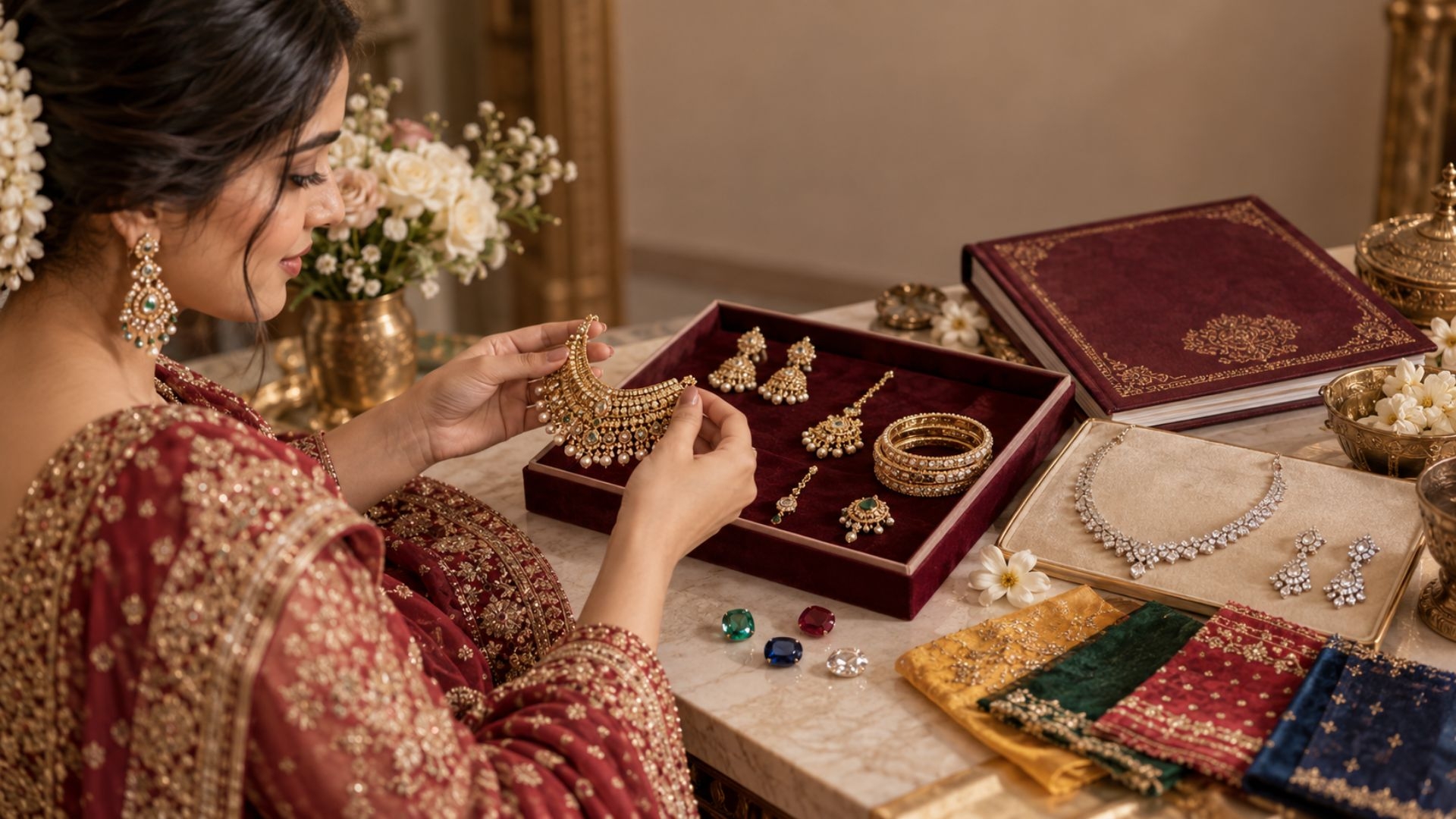
Buying bridal jewellery is a bigger decision than buying an everyday piece. You're picking gold and stones that need to survive a decade of photographs, family opinions, and possibly a resale somewhere down the line, often decided inside one afternoon at the showroom.
This jewellery buying guide walks through what actually matters before you sign the bill: the hallmark, the diamond certificate, the budget, and how a piece will sit against your outfit on the day. None of it is complicated once you know what to look for.
What Does the BIS Hallmark on Gold Jewellery Actually Mean?
A BIS hallmark confirms an accredited centre has tested the piece and verified its purity in karats. Since 1 April 2023, every hallmarked piece has also carried a 6-digit HUID (Hallmark Unique Identification) number, a unique code you can check against the BIS Care app or bis.gov.in to confirm it matches the item in your hand.
Hallmarking has been mandatory in India since 16 June 2021, rolled out district by district. As of the sixth phase amendment in March 2026, it covers 380 districts across six caratages: 14K, 18K, 20K, 22K, 23K, and 24K. A 9K grade also exists, but it remains voluntary under the latest government update.
Here's how the karats break down:
| Karat | BIS Fineness Mark | Gold Content | Typical Use |
|---|---|---|---|
| 24K | 999 | 99.9% | Coins and bars; too soft to hold set stones |
| 23K | 958 | 95.8% | Rarely used for finished jewellery |
| 22K | 916 | 91.6% | Most traditional Indian gold jewellery, including bridal sets |
| 20K | 833 | 83.3% | Occasional use in heavier traditional pieces |
| 18K | 750 | 75.0% | Diamond and gemstone-studded jewellery, lighter daily wear |
| 14K | 585 | 58.3% | Modern, Western-style, everyday jewellery |
| 9K | 375 | 37.5% | Budget jewellery; still a voluntary grade in India |
22K is the default for Indian bridal sets because it holds fine detail work while staying wearable. If your set has diamonds or is meant for repeat daily wear after the wedding, 18K is usually the more practical choice.
Why Don't Polki, Kundan, and Jadau Pieces Carry a Hallmark?
Kundan, Polki, and Jadau jewellery are specifically exempted from mandatory BIS hallmarking under the government's own order, alongside watches and fountain pens. That doesn't mean the gold underneath is untested; it means the burden of asking shifts to you.
The exemption exists because these pieces are lac-filled and foil-backed by hand, which makes standard assaying difficult without damaging the setting. In practice, this means:
- Ask the jeweller to write the declared gold purity on your invoice, even though it isn't hallmark-stamped.
- Ask whether the base gold under the stones can be tested separately.
- Get the stone type (glass versus real uncut diamond) written down too, since this affects both price and resale value.
[CLIENT TO FILL: If Shaadinama offers an in-house or third-party purity certificate for Polki, Kundan, or Jadau pieces, name it here — this is exactly the kind of first-hand detail that strengthens this section.]
How Do You Tell If a Diamond Is Certified and Worth the Price?
A genuine diamond purchase comes with an independent certificate, most commonly from GIA or IGI, listing the 4Cs: cut, colour, clarity, and carat weight. Ask for the certificate number and check it directly on the issuing lab's own website before you pay, not just the printed copy handed to you.
GIA created the original 4Cs grading system and remains the stronger choice for natural diamonds, particularly where resale value matters. IGI has become the dominant lab for lab-grown diamonds, a position that got stronger after GIA withdrew from full lab-grown grading on 1 October 2025 and now issues only a simplified Premium or Standard assessment for those stones instead of a detailed 4Cs report.
So: for a natural diamond centrepiece, GIA certification protects resale value best. For a lab-grown stone, an IGI report is the more established, better-recognised option.
What's the Real Difference Between Polki, Kundan, and Jadau?
Kundan and Polki are stones. Kundan is polished glass or gemstone set into refined gold foil; Polki is a natural, uncut diamond used in its raw form. Jadau is the setting technique used to embed either one into gold, so a single necklace can be Polki Jadau or Kundan Jadau depending on which stone sits inside it.
- Kundan: glass or gemstone set into gold foil, usually finished with meenakari (enamel work) on the underside. Brighter, more uniform shine, and the more affordable of the two.
- Polki: real, uncut diamond in its natural form. Costs more, holds resale value better, and has a softer, slightly uneven sparkle that comes from being handmade rather than machine-cut.
- Jadau: the craft technique itself. Artisans press stones by hand into lac-lined gold without solder or glue. Most Kundan and Polki jewellery is made this way.
How Should You Budget for Bridal Jewellery?
Bridal jewellery cost comes down to two moving parts: the day's gold rate and the making (or wastage) charge added on top. Both should appear as separate line items on your bill, not folded into one number.
Some practical guardrails:
- Ask for that day's per-gram gold rate in writing before the price is finalised. Rates move daily.
- Making charges are usually a percentage of the gold value, not fixed by law the way purity is. Ask the percentage upfront and don't be shy about negotiating it.
- Decide which pieces need to be heirloom-grade (the main necklace set) versus pieces you'll rotate for other functions (earrings, bangles, a simpler chain), and weight your budget accordingly.
- GST applies on top of the gold value and making charges. Confirm it's included in any quote you're comparing.
How Do You Match Jewellery to Your Outfit and Neckline?
The neckline of your outfit decides what jewellery will actually be visible, not just what looks good on a hanger. A high, heavily embroidered neckline needs less weight up top; a plain or low neckline can carry a bigger piece.
- V-neck or sweetheart neckline: a single pendant or short necklace draws the eye down the centre without fighting the neckline.
- High or closed neckline (heavily embroidered collars): skip the choker. Let statement earrings and a maang tikka do the work instead.
- Heavily embellished outfit: choose a simpler jewellery set. Let either the outfit or the jewellery be the focal point, not both.
- Traditional ceremony outfits (banarasi, kanjeevaram): gold, Polki, or Kundan sets sit naturally against these fabrics and their existing zari or thread work.
- Reception gowns or lighter fabrics: diamond sets or lightweight 18K pieces tend to photograph better and don't weigh the outfit down.
What Should You Ask the Jeweller Before You Pay?
- The HUID number on the hallmark, and whether you can verify it yourself on the BIS Care app before leaving the store.
- For Polki, Kundan, or Jadau pieces: a written declaration of gold purity, since these are exempt from mandatory hallmarking.
- The certificate number and issuing lab (GIA or IGI) for any diamond, checked independently rather than taken on trust.
- Making and wastage charges, itemised separately from the gold and stone cost.
- The exchange, buyback, and resizing policy in writing, not a verbal promise.
Frequently Asked Questions
Is a BIS hallmark required on Polki or Kundan jewellery? No. The government's hallmarking order specifically exempts Kundan, Polki, and Jadau jewellery, along with watches and fountain pens. You can still ask the jeweller for a written purity declaration.
What is a HUID number? A unique 6-digit alphanumeric code stamped on every hallmarked gold item since April 2023. You can check it against the BIS Care app or bis.gov.in to confirm it matches the piece you're buying.
Is IGI certification as reliable as GIA? Both are legitimate labs. GIA remains the stronger choice for natural diamonds and resale value, while IGI has become the standard for lab-grown diamonds, especially since GIA scaled back its own lab-grown reports in October 2025.
Which karat of gold is best for bridal jewellery? 22K (916 purity) is the most common choice for traditional Indian bridal sets because it holds fine detailing while staying durable. Lighter 18K or 14K suits diamond-set or everyday-wear pieces better.
Can old, unhallmarked gold jewellery be hallmarked now? Yes. Jewellers can test and hallmark existing pieces, or accept them as an exchange toward a new hallmarked purchase.
The Final Word
A jewellery buying guide can tell you what to check on paper, but the piece still has to feel right on you: comfortable enough for a full day of ceremonies, and timeless enough that you'll still want to wear it next year. Take the checklist above into the store and ask the questions out loud before you decide.
Browse Shaadinama's bridal collections to see hallmark-checked gold alongside Polki, Kundan, and Jadau sets in person.

