


Rack and Pinion Technology for Heavy Machinery
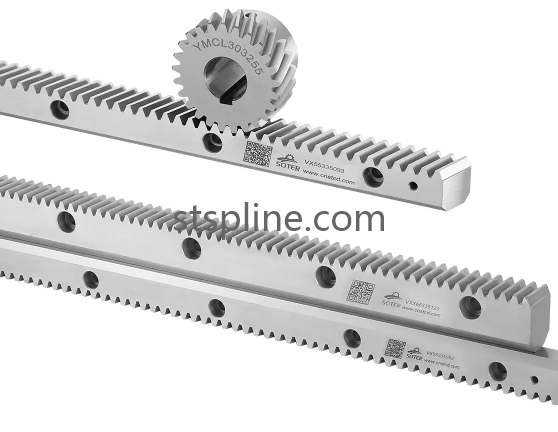
Industrial machinery often requires a transmission system capable of converting motor rotation into controlled linear movement over a defined travel distance. Industrial Rack And Pinion systems provide a practical mechanical arrangement for this purpose, combining a rotating pinion with a linear rack. Their suitability for demanding equipment depends on material selection, tooth geometry, machining technology, mounting stability, and the relationship between the transmission and the machine's guidance system.
Material selection is an important starting point for industrial transmission components. Steel is commonly considered because it can provide a useful balance of mechanical strength, machinability, toughness, and resistance to repeated contact. Different material grades may be appropriate for different production requirements. The choice should take into account operating conditions, machining processes, surface treatment, and the expected pattern of mechanical loading.
The rack and pinion function as a matched pair. As the pinion rotates, its teeth engage with those on the rack and generate linear displacement. Consistent tooth spacing and an appropriate tooth profile help maintain predictable engagement along the working length. If the geometry varies excessively, the transmission may experience changes in contact conditions, which can influence movement smoothness and mechanical loading.
Manufacturing accuracy is therefore a central consideration. Controlled milling and other machining processes can form the required tooth geometry while maintaining the relationship between the teeth and reference surfaces. The rack's mounting areas are also important because they determine its position relative to the pinion. Accurate machining should be combined with controlled dimensional inspection to support repeatable assembly.
Surface treatment can be selected according to the material and application. Heat treatment may be used to modify surface hardness and improve resistance to repeated tooth contact. However, the manufacturing process should also consider structural toughness and dimensional stability. Excessive hardness or distortion may create different problems, so treatment conditions need to be matched to the complete component design.
Industrial rack-and-pinion systems are widely applicable to machinery requiring extended linear travel. CNC gantry equipment can use this transmission principle to move structures along machine axes. Similar arrangements may be used in laser processing equipment, industrial robots, automated handling systems, material-transfer machinery, and production-line equipment where a motor-driven pinion needs to move an assembly across a longer path.
The guide system is an important part of the overall design. A rack transmits the driving force, while linear rails, rollers, guideways, or other structures control the direction of movement. These systems need to remain properly aligned so that the drive does not experience unnecessary lateral forces. A rigid supporting structure can help maintain the intended relationship between the rack, pinion, and moving assembly.
Long travel applications may require multiple rack sections to form one continuous transmission path. The connection between sections needs careful attention because tooth positioning should remain consistent from one piece to the next. A mismatch at the joint can influence the pinion during transition. Proper manufacturing tolerances, reference surfaces, and installation procedures are therefore important when building extended axes.
The operating environment should also be considered. Industrial machinery may be exposed to metal chips, dust, moisture, temperature changes, or other contaminants. The rack and pinion should be integrated with suitable protective and maintenance measures. Depending on the machine design, regular cleaning, inspection, and lubrication may help preserve the condition of the working surfaces.
For equipment manufacturers, supplier capability is another important factor. Technical drawing review, machining experience, material knowledge, inspection procedures, and customization support can influence the efficiency of a project. This is particularly relevant when a rack must be adapted to a specific machine frame or when several components need to maintain consistent manufacturing characteristics.
Quality control should cover the functional areas of the transmission as well as the mounting features. Tooth profile, pitch, dimensional consistency, surface condition, and reference surfaces can all be inspected according to the production requirements. Stable quality procedures help manufacturers maintain consistency between batches and support compatibility when multiple rack components are used in one machine.
From an engineering perspective, industrial rack-and-pinion performance is determined by the interaction of several factors rather than a single specification. Materials provide the mechanical foundation, machining establishes the geometry, treatment influences surface characteristics, and alignment determines how the components interact during operation. The machine structure and maintenance conditions complete the system.
For manufacturers developing CNC machines, industrial robots, automated production equipment, and other machinery requiring controlled linear movement, Industrial Rack And Pinion technology provides a flexible mechanical transmission approach. SOTER manufactures rack and transmission products for industrial applications, with related product information available at https://www.stspline.com/product/straight-teeth-rack/.

