


Artificial Disc Replacement in Germany: What to Check Before You Travel
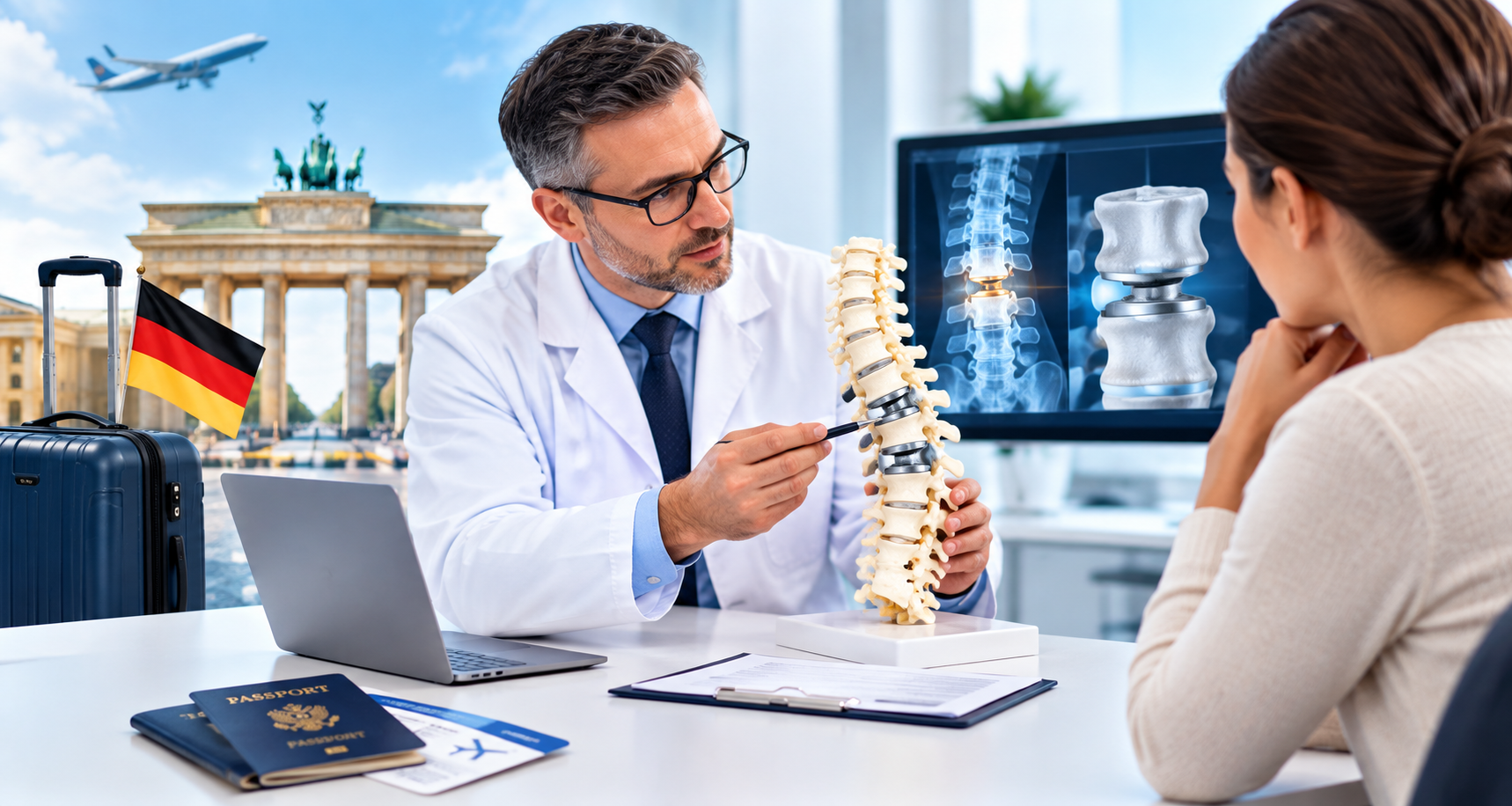
You have degenerative disc disease in your lower back, conservative treatment has not worked, and the operation you have been offered at home is a fusion. Somewhere in your research, artificial disc replacement came up, and so did Germany.
It is a reasonable line of enquiry. It is also one where the right questions matter more than the destination. Here is what to understand before you book anything.
Why Germany comes up
The connection is historical. The first widely used lumbar artificial disc, the SB Charité, was designed in 1982 by Kurt Schellnack and Karin Büttner-Janz at the Charité hospital in Berlin, and its current three-part design was first manufactured in 1987 [1]. German spinal surgery has decades of experience with motion-preserving implants as a result.
That history is a genuine advantage. It is not, on its own, a reason to assume any particular surgeon or hospital is right for you.
What the evidence says, honestly
Disc replacement is not a better operation than fusion for everyone. A Cochrane systematic review found that people who had disc replacement did slightly better on back pain and function than those who had fusion in the short term, but the difference was small, and long-term risks had not been well studied [2].
In the UK, NICE has judged the evidence on lumbar disc replacement adequate to support its use under normal clinical governance, provided patients are selected by a specialist multidisciplinary team and only after conservative treatment has failed [3].
In practice, disc replacement works best in carefully chosen patients. The case for it rests on candidacy, not on the implant being universally superior.
Candidacy is the whole question
A prosthetic disc restores movement at the treated level. That only helps if the rest of the segment can cope with movement. Surgeons typically look for:
• Degeneration at one or two levels, with symptoms that clearly match those levels.
• Healthy facet joints. These small joints at the back of the spine share load with the disc, and if they are already arthritic, restoring motion can make pain worse rather than better.
• Good bone density, so the vertebrae can support the implant.
• No instability, slip or pars defect at the level being treated.
• No previous fusion at that segment.
The facet joint criterion rules out more people than most expect. Imaging studies of people with no back pain have found facet degeneration in roughly a third of 50-year-olds and half of 60-year-olds [4]. Age alone is not the deciding factor, but it tends to narrow the field.
Start with candidacy, not the surgeon
Searching for the best German ADR surgeon feels like the obvious first step. It is actually the second. The first is finding out whether you are a candidate at all, from a specialist who has reviewed your standing X-rays, flexion-extension films and MRI rather than only your radiology report.
Once that is clear, these are the questions worth putting to any centre:
• How many lumbar disc replacements does the surgeon perform each year?
• Which implant do they use, and why that one for my anatomy?
• What happens if they find during surgery that replacement is not possible?
• If the implant ever needs revising, what would that involve?
• Who reviews my recovery once I am home, and how will they communicate with my local doctor?
A centre that answers these directly, including telling you when you are not suitable, is showing you the thing that matters most.
The practical side of travelling
Plan for the full stay, not just the operation. That typically covers a pre-operative consultation, the surgery and hospital stay, a period of rehabilitation, and clearance from your surgeon before you fly home. Bring complete imaging and reports, confirm how records will be shared with your doctor at home, and agree the follow-up schedule before you leave.
Getting assessed
If you have been told fusion is your only option, it is worth finding out whether that is true for your spine specifically.
Spine Connection arranges independent reviews of your imaging with senior spine surgeons, including specialists in artificial disc replacement in Germany at ONZ International, where motion-preserving surgery is central to the work. You receive a clear opinion on whether disc replacement suits your spine, a fixed and transparent price if it does, and no waiting list. Send us your scans and find out what your options really are.
References
1. Link HD. History, design and biomechanics of the LINK SB Charité artificial disc. European Spine Journal. 2002;11(Suppl 2):S98–S105.
2. Jacobs W, Van der Gaag NA, Tuschel A, de Kleuver M, Peul W, Verbout AJ, Oner FC. Total disc replacement for chronic back pain in the presence of disc degeneration. Cochrane Database of Systematic Reviews. 2012;(9):CD008326.
3. National Institute for Health and Care Excellence. Prosthetic intervertebral disc replacement in the lumbar spine. Interventional procedures guidance IPG306. 2009.
4. Brinjikji W, Luetmer PH, Comstock B, et al. Systematic literature review of imaging features of spinal degeneration in asymptomatic populations. American Journal of Neuroradiology. 2015;36(4):811–816.

