


Why Does My Child Sleep With Their Mouth Open Understanding Snoring Adenoids and Paediatric ENT Problems
You tuck your child into bed, check that everything is fine, and notice the same thing again — their mouth is wide open while they sleep. Perhaps there is also snoring, noisy breathing or a blocked nose that seems to come and go. It may look like a harmless sleeping habit, but persistent mouth breathing can sometimes be a sign that your child is finding it difficult to breathe comfortably through the nose.
For parents in Singapore, this raises an important question: does my child need to see an ENT specialist? Occasional mouth breathing during a cold is not unusual, but when it becomes a regular pattern, especially alongside snoring or persistent nasal congestion, it may be worth discussing the symptoms with a paediatric ENT specialist.
Mouth Breathing Is Not Always Just a Habit
Children may breathe through their mouths when their noses are temporarily blocked. A common cold, allergies or other short-term nasal problems can make nose breathing uncomfortable, so the child naturally switches to mouth breathing.
The concern is different when your child continues breathing through the mouth regularly, including during sleep, even when there is no obvious cold. In that situation, parents may want to understand why the nose seems difficult to breathe through rather than simply treating mouth breathing as a habit.
Look at What Happens During Sleep
Night-time behaviour can provide useful clues. Does your child snore regularly? Do they sleep with their mouth open throughout the night? Do they move around frequently or seem to have restless sleep?
These signs do not automatically indicate a medical condition. However, when several symptoms appear together, they can provide a useful reason to discuss your child's breathing and sleep with an ENT clinic.
Is Snoring Normal for Children?
Occasional snoring can happen when a child has a cold or temporary nasal congestion. It becomes more relevant when snoring happens regularly or when it is accompanied by other symptoms.
Parents may notice loud breathing, persistent mouth breathing, frequent waking or unusual sleeping positions. If these signs occur repeatedly, an ENT specialist can assess whether there may be an underlying problem affecting the child's upper airway.
Frequency Matters More Than One Bad Night
One noisy night does not necessarily tell you much about your child's overall health. A pattern that continues for weeks or months provides a different reason for investigation.
Try to notice how often your child snores and whether it occurs when they are otherwise well. This information can be useful during a consultation and may help the specialist understand whether further assessment is appropriate.
Could Enlarged Adenoids Be the Reason?
Adenoids are tissues located behind the nose and form part of the body's immune system. In some children, the adenoids become enlarged and can contribute to obstruction in the area behind the nose.
When nasal airflow is affected, a child may naturally begin breathing through the mouth. Enlarged adenoids can also be associated with snoring and other sleep-related breathing symptoms, although they are not the only possible cause.
Not Every Child With Snoring Has Enlarged Adenoids
This is an important distinction for parents. Snoring alone does not prove that enlarged adenoids are responsible, and it is not appropriate to diagnose the cause based only on what happens at bedtime.
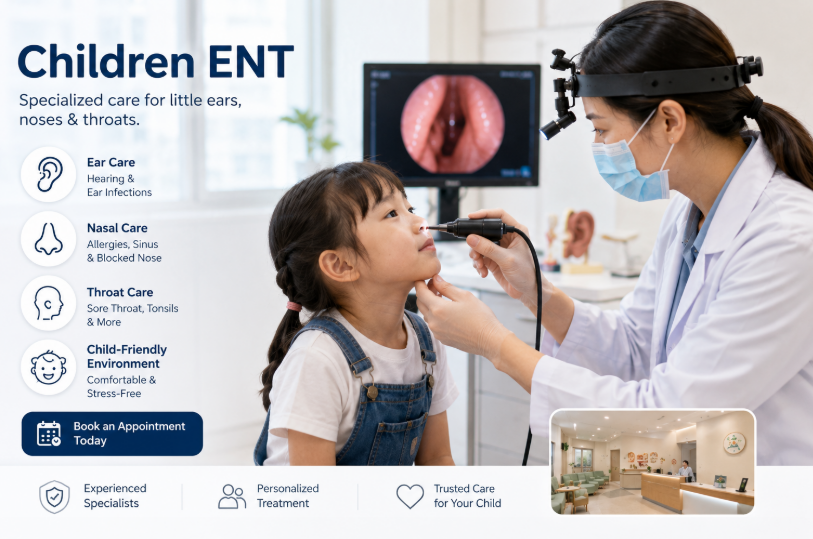
An ENT specialist can assess the child's symptoms and decide whether examination of the nasal airway is appropriate. Novena ENT states that child-friendly nasoendoscopy may be used to assess the nasal airway when clinically indicated.
What Other Things Can Cause a Blocked Nose?
A child's nose can become blocked for many different reasons. Viral infections are common, while allergies may cause ongoing congestion, sneezing and a runny nose.
Other nasal conditions can also contribute to breathing difficulties. This is why parents should avoid assuming that every child with mouth breathing has the same underlying problem.
Persistent Congestion Deserves a Closer Look
If your child seems to have a blocked nose almost all the time, regularly breathes through the mouth or struggles to breathe comfortably at night, it may be useful to discuss the pattern with a doctor.
An assessment can help distinguish between temporary congestion and symptoms that may require further ENT investigation. The appropriate treatment depends on the cause identified during the assessment.
Could Mouth Breathing Affect Sleep?
Comfortable breathing is an important part of restful sleep. When a child has difficulty breathing through the nose, sleep may become more restless, although sleep problems can have many different causes.
Parents may notice frequent movement, noisy breathing or repeated waking. If these behaviours occur together with persistent snoring and mouth breathing, they are worth mentioning during an ENT consultation.
Look at Your Child During the Day Too
Night-time symptoms are only one part of the picture. During the day, does your child frequently breathe through the mouth? Do they seem to have a persistently blocked nose or complain that nasal breathing is difficult?
A consistent pattern across daytime and night-time can provide more useful information than a single observation. Parents should share both with the specialist rather than focusing only on the snoring.
When Should a Child See an ENT Specialist?
There is no rule saying that every child who snores needs specialist care. Many childhood respiratory symptoms are temporary and settle as the underlying illness improves.
However, an ENT assessment may be worth considering when symptoms are persistent, recurring or affecting everyday life. Parents may seek medical advice when regular snoring occurs alongside mouth breathing, persistent nasal obstruction, repeated ear infections, hearing concerns, recurrent throat problems or disrupted sleep.
Do Not Wait for the Symptoms to Become Severe
Parents sometimes wait because the child appears otherwise healthy during the day. But children can adapt to ongoing symptoms, making it difficult to judge how much a recurring problem is affecting them.
Seeking an assessment does not mean your child will automatically require treatment. Sometimes the appropriate outcome is reassurance or monitoring, while other situations may require further investigation or management.
What Happens at a Paediatric ENT Appointment?
A visit to a pediatric ENT clinic usually starts with understanding the child's symptoms and medical history. Parents may be asked about snoring, breathing, sleep, nasal congestion, ear infections, hearing and other relevant concerns.
The specialist can then examine the ears, nose and throat and decide whether additional assessment is necessary. The exact process depends on the child's symptoms and ability to cooperate during examination.
Parents Should Describe What They See at Home
Children may not remember what happens while they sleep, so parents' observations can be particularly useful. Tell the specialist whether your child snores, sleeps with the mouth open, breathes noisily or wakes frequently.
If possible, keep a simple record of how often the symptoms occur. Parents may also find it useful to note whether the symptoms happen only during colds or continue even when the child is otherwise well.
Could Ear Problems Be Connected?
The ear, nose and throat are closely related, and some children experience more than one type of ENT problem. A child with persistent nasal or adenoid problems may also have a history of ear infections or hearing concerns.
This does not mean that one symptom necessarily causes another. However, a broader ENT assessment can help the specialist consider the child's complete medical picture instead of looking at snoring or nasal congestion in isolation.
Hearing Should Still Be Checked When Appropriate
If your child also has repeated ear infections or signs of hearing difficulty, mention these concerns during the appointment. Hearing problems can sometimes be subtle, especially in younger children who cannot clearly explain what they are experiencing.
Novena ENT provides paediatric hearing assessments using different methods according to the child's age and developmental stage, including newborn hearing screening, auditory brainstem response, otoacoustic emissions, tympanometry, visual reinforcement audiometry and play audiometry.
What Parents Can Do Before Seeing an ENT
You do not need to diagnose the cause of your child's mouth breathing. Instead, concentrate on collecting useful observations that can help the specialist understand the situation.
Notice whether your child snores every night, breathes through the mouth during the day, has persistent nasal congestion, frequently wakes during sleep or has repeated ear or throat problems. These details can provide a much clearer picture during the consultation.
Avoid Assuming It Is Simply a Bad Habit
It can be tempting to tell a child to “close your mouth” when they are breathing through it. But if nasal breathing is difficult, the child may not be choosing to breathe through the mouth.
Understanding the reason behind the behaviour is more useful than repeatedly correcting the behaviour itself. A medical assessment can help determine whether the nose, adenoids, allergies or another ENT issue may be contributing.
Choosing a Paediatric ENT Clinic in Singapore
Parents searching for an ENT clinic near me or nearest ENT clinic naturally want a convenient location. But when the patient is a child, the clinic's paediatric capabilities may be just as important.
Consider whether the clinic provides children's ENT assessment, hearing services and facilities designed for younger patients. This can be especially useful when the child has several symptoms that may require assessment over more than one appointment.
Why Novena ENT Is Relevant for Children's ENT Care
Novena ENT provides dedicated children ENT services covering a range of ear, nose and throat conditions. Its paediatric services include assessment of snoring, enlarged adenoids, nasal problems, recurrent throat conditions, ear infections and hearing concerns.
The clinic also provides dedicated children's hearing facilities and multidisciplinary support involving ENT surgeons, audiologists and speech therapists for appropriate paediatric hearing and communication needs.
A Better Night's Sleep Starts With Understanding the Cause
Parents understandably want their children to sleep comfortably. But persistent snoring or mouth breathing should not be approached by assuming there is one universal solution.
The cause matters. A child whose nose is blocked because of a temporary cold may need a very different approach from a child experiencing persistent nasal obstruction associated with allergies or enlarged adenoids. Proper assessment is the first step towards understanding the difference.
Get Your Child's ENT Health Checked at Novena ENT
If your child regularly sleeps with their mouth open, snores frequently, breathes noisily or seems to struggle with nasal breathing, it may be time to look beyond the habit and understand what is causing the pattern. Persistent symptoms deserve proper attention, particularly when they are accompanied by hearing concerns, repeated ear infections or disrupted sleep.
Get your child's ears checked at Novena ENT and speak with a specialist team experienced in children ENT and paediatric ENT care in Singapore. For parents searching for a pediatric ENT clinic, Singapore ENT clinic, paediatric ENT specialist or nearest ENT clinic, Novena ENT provides dedicated children's ENT and hearing services designed around young patients. Explore the Novena ENT Paediatric ENT service and arrange an appointment to better understand your child's breathing, hearing and ENT needs.

