


Chinese Tuition Singapore for Secondary School Students
Building Stronger Chinese Language Skills with the Right Tuition Support
Chinese is an important part of the Singapore school curriculum, but secondary school students can sometimes find the subject challenging as lessons become more demanding. Vocabulary becomes broader, comprehension passages become more complex, and students are expected to express their ideas clearly in both written and spoken Chinese.
For students taking Higher Chinese, the level of difficulty can be even greater. Consistent practice, proper guidance and a clear understanding of the language can make a meaningful difference in how students approach the subject.
This is where focused Chinese Tuition Singapore can provide useful academic support, particularly when tuition is tailored to the needs of secondary school students.
Why Chinese Can Become More Challenging in Secondary School
Primary school Chinese generally focuses on building basic vocabulary, sentence structures and communication skills. In secondary school, students need to develop a wider range of abilities.
They may need to:
- Understand longer and more detailed passages
- Identify important information from comprehension texts
- Write organised and meaningful compositions
- Improve vocabulary and sentence construction
- Understand idioms and commonly used expressions
- Answer questions accurately within examination requirements
- Develop stronger oral communication skills
- Apply Chinese naturally rather than simply memorising answers
Students who have gaps in their foundation may find these requirements difficult to manage. Regular guidance can help them identify weaknesses and gradually build stronger language habits.
The Importance of a Strong Foundation in Chinese
Learning Chinese is not simply about remembering more words. Students also need to understand how those words work in different contexts.
For example, knowing the meaning of a particular word does not always mean a student can use it correctly in a sentence. Similarly, memorising composition phrases may not help much if a student does not understand how to structure ideas logically.
A good learning approach should therefore combine vocabulary, grammar, comprehension, writing and communication.
Building Vocabulary Through Context
Students are more likely to remember vocabulary when they understand how words are used in real sentences.
Instead of learning isolated lists, tuition can introduce vocabulary through:
- Reading passages
- Example sentences
- Short writing exercises
- Common expressions
- Question-and-answer activities
This helps students recognise words when reading and use them more confidently when writing.
Improving Chinese Composition Skills
Composition can be one of the more demanding areas for secondary school students.
Students need to understand the topic, organise their ideas and express themselves clearly. A well-structured composition is not necessarily about using complicated vocabulary everywhere. Clear ideas, suitable expressions and logical development are equally important.
Students can improve by learning how to:
- Understand the question before writing.
- Organise key points logically.
- Select suitable vocabulary and expressions.
- Develop each paragraph with sufficient detail.
- Review the finished composition for errors.
Regular writing practice allows students to gradually become more comfortable expressing their thoughts in Chinese.
What Makes Higher Chinese Different?
Higher Chinese requires students to work with a broader and deeper range of Chinese language skills.
Students may encounter more demanding comprehension passages, vocabulary and writing tasks. They also need to develop greater confidence in using the language independently.
Because of this, Higher Chinese tuition can be particularly useful when lessons are designed specifically for the secondary school level rather than following a general approach for all learners.
A focused learning environment can allow students to spend more time working on areas where they need additional support.
Small-Group Tuition Can Encourage Active Learning
The learning environment also matters.
In a small group, students may have more opportunities to participate in discussions, answer questions and receive individual feedback. They can learn from common mistakes while also seeing how other students approach a question.
Small-group Chinese tuition may include activities such as:
- Guided comprehension practice
- Vocabulary development
- Composition planning
- Oral practice
- Examination-style questions
- Discussion and correction
- Targeted revision
The aim should be to help students understand why an answer is correct rather than simply providing them with the answer.
Choosing Chinese Tuition for Secondary School Students
Parents looking for Chinese tuition should consider whether the teaching approach matches their child's actual needs.
Some useful points to consider include:
1. Relevant Teaching Experience
A tutor with experience teaching secondary school Chinese can better understand the language requirements and challenges students commonly face at this level.
2. Appropriate Learning Materials
Good materials should support understanding and practice rather than encourage students to rely entirely on memorisation.
3. Personalised Guidance
Students have different strengths and weaknesses. One student may need help with comprehension, while another may struggle more with composition or vocabulary.
4. Consistent Practice
Language development takes time. Regular lessons and practice can help students develop stronger habits and retain what they learn.
5. A Comfortable Learning Environment
Students are more likely to participate actively when they feel comfortable asking questions and making mistakes during the learning process.
Meet Ms. Li – Higher Chinese Tutor in Singapore
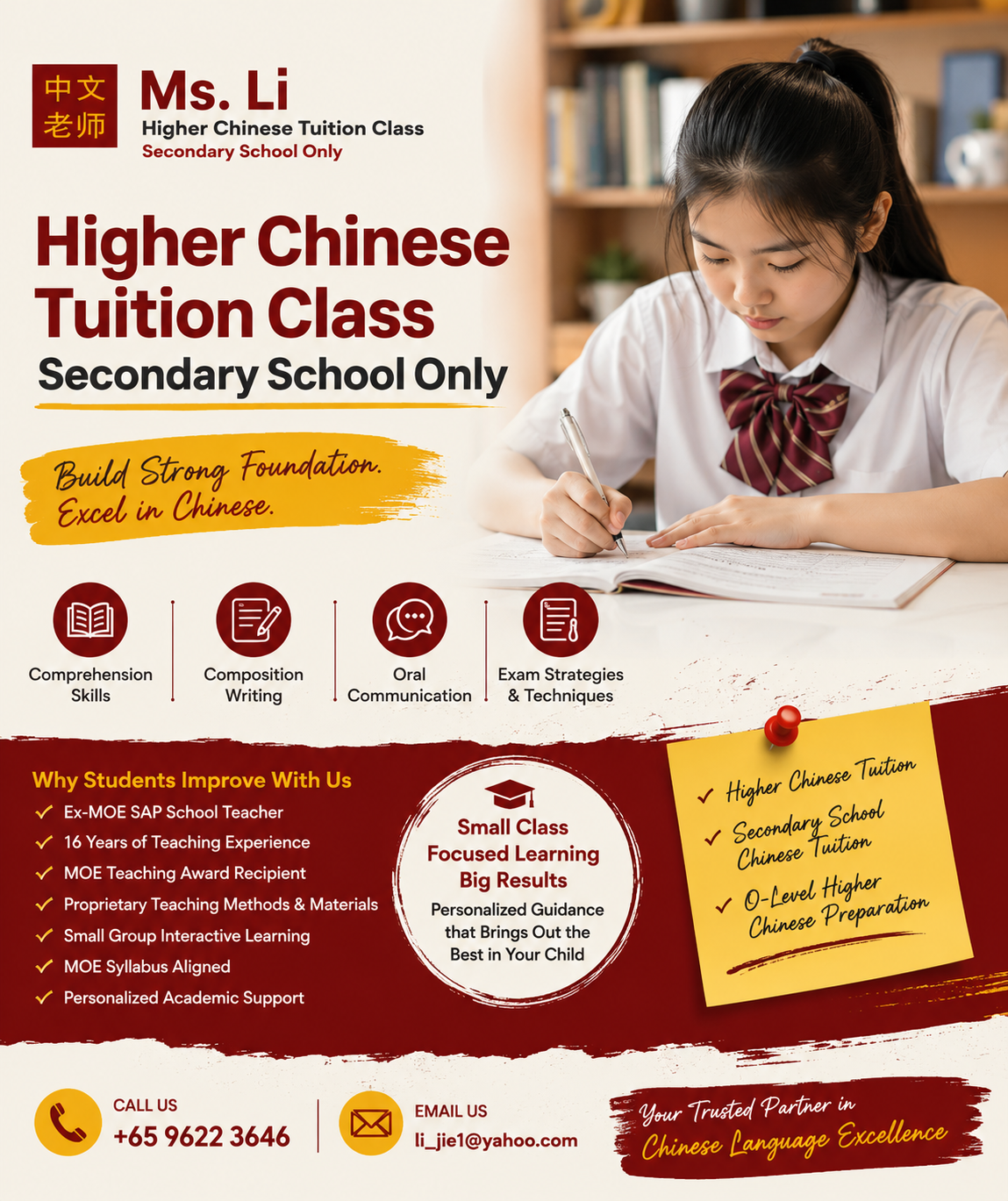
Ms. Li (Li LaoShi 李老师) is a full-time Higher Chinese Tutor in Singapore specialising in Chinese tuition for secondary school students.
She is an ex-MOE SAP school teacher with 16 years of teaching experience and graduated from RJC, NUS and NIE. Her academic background includes specialisation in Chinese Language and Chinese Studies.
Her teaching focuses on Secondary School Higher Chinese Language as well as small-group Chinese Language tuition. She also uses her own teaching methods and materials to support students' learning.
Rather than treating every learner in exactly the same way, effective tuition should help students understand their own areas for improvement and develop greater independence in using Chinese.
Developing Confidence Beyond Examination Preparation
Examination preparation is naturally an important part of secondary school tuition, but language learning can offer benefits beyond exam results.
Students who become more comfortable with Chinese may find it easier to read, communicate and express their ideas. They can also develop a better appreciation of how the language is structured and used in everyday situations.
For this reason, tuition should ideally balance examination skills with genuine language development.
A Practical Approach to Improving Chinese
Students do not need to rely entirely on tuition lessons to improve.
A simple weekly routine can reinforce what they learn:
- Read a short Chinese article or passage regularly.
- Record unfamiliar vocabulary and review it later.
- Practise using new words in sentences.
- Write short paragraphs on different topics.
- Read model compositions to understand structure and expression.
- Practise speaking instead of focusing only on written work.
- Review mistakes and understand how to correct them.
Small, consistent efforts can make language practice feel more manageable.
Frequently Asked Questions
1. Who is Chinese tuition suitable for?
Chinese tuition can be useful for secondary school students who want additional support with vocabulary, comprehension, composition, oral skills or general Chinese language development. The appropriate level of support depends on each student's current ability and learning needs.
2. Is Higher Chinese tuition different from regular Chinese tuition?
Yes. Higher Chinese generally involves more demanding language work, so students may benefit from tuition specifically focused on Higher Chinese requirements and secondary school learning.
3. Can small-group tuition help students learn Chinese?
Small-group lessons can provide opportunities for discussion, practice and feedback while allowing students to learn alongside peers. The effectiveness of a group class also depends on the teaching approach, group size and individual student's participation.
4. How can students improve Chinese composition?
Students can improve by practising regularly, learning how to understand different question types, organising ideas before writing and reviewing corrections carefully. Building vocabulary and learning appropriate expressions can also support better writing.
5. What should parents consider when choosing a Chinese tutor?
Parents can consider the tutor's relevant teaching experience, subject specialisation, teaching materials, class format and approach to student support. It is also useful to consider whether the learning environment suits the student's needs.
For parents and students interested in learning more about secondary school Chinese and Higher Chinese tuition, visit https://www.higherchinesetuition.sg/ Ms. Li can be contacted at +65 9622 3646 or li_jie1@yahoo.com for enquiries about the available tuition classes.
With structured guidance, regular practice and an approach suited to the learner, secondary school students can steadily develop stronger Chinese skills and greater confidence in using the language.

