


ANM Nursing Books: A Simple Guide to Choosing the Right Study Material
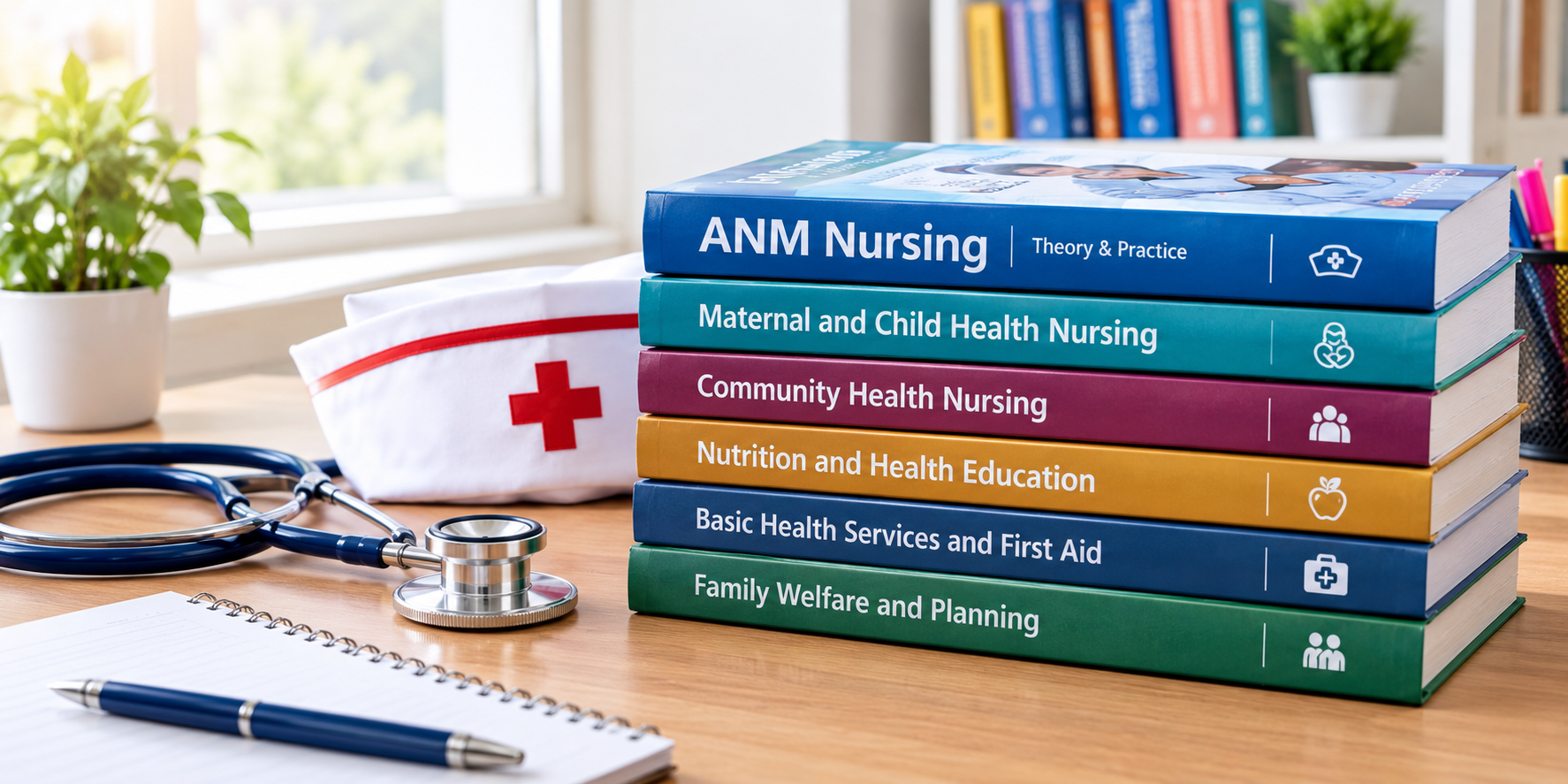
ANM Nursing Books: A Complete Guide for Nursing Students
Starting an Auxiliary Nurse Midwife course is exciting, but it can also feel like a lot. You have new subjects, new words, and practical work in hospitals and villages, all at once. Soon one question comes up: which books should I study from? This guide on ANM Nursing Books will help you understand what to look for, how to choose wisely, and how to use your books in a way that truly helps.

Why Choosing the Right Nursing Books Matters
Nursing is not about memorizing pages. You need to understand how the body works, why a mother or child needs a certain type of care, and why each step of a procedure is done. A good book explains these things in a clear and simple way.
Suitable study material helps you learn important definitions, revise difficult subjects, and prepare for exams. It also helps you understand procedures and connect what you read with what you see during practical training. Most of all, it builds a strong base. When your basics are clear, every new topic becomes easier to learn.
Classes move fast, but a book lets you slow down. You can read a topic again and again until it makes sense.
What Should You Look for in ANM Nursing Books?
Before buying any book, check a few simple things.
- Match with your syllabus. This is the first and most important point. Look at your institution's current curriculum before you choose.
- Clear and simple language. If a book is hard to follow, you will not enjoy reading it.
- Updated information. Health care guidelines change over time, so a recent edition is often a better choice.
- Diagrams and pictures. They make body systems and procedures easier to remember.
- Practical and clinical examples. These show you how a topic is used in real care.
- Question-and-answer sections. They let you test yourself after each chapter.
- Author, publisher and edition. A quick look at these details tells you how reliable the book may be. If you are unsure, ask your teacher.
Important Subjects Covered in ANM Nursing
During the course, you will study many subject areas. The exact subjects and course structure can differ depending on the institution and the curriculum it follows, so always check your own syllabus. In general, ANM students may come across topics like these:
- Anatomy and Physiology: how the body is built and how it works.
- Community Health Nursing: health care for families and villages.
- Nutrition: food, diet and healthy growth.
- Midwifery: care of women during pregnancy, birth and after birth.
- Obstetric and Gynecological Nursing: women's health and maternity care.
- Child Health or Paediatric Nursing: care of babies and children.
- Primary Health Care: basic health services close to people's homes.
- Health Promotion: helping people stay healthy.
- First Aid and Emergency Care: quick and correct action in urgent situations.
- Basic Nursing Procedures: simple everyday care skills.
- Community-based practical learning: learning by working with families and communities.
Let us look at a few of these in more detail.
Anatomy and Physiology Books for Building Strong Basics
Everything in nursing starts with the human body. If you know how organs and systems work, it becomes easier to understand illness, care and treatment.
A good anatomy and physiology textbook explains the major body systems, the structure and function of organs, and simple body processes. It also teaches common medical terms. Labelled diagrams are very helpful here, so choose a book that has clear ones.
Try to understand each concept instead of memorizing it blindly. For example, when you learn how the heart pumps blood, think about why a nurse checks the pulse. When you connect the topic with a reason, it stays in your memory.
Community Health Nursing Books for ANM Students
ANM education looks beyond the hospital. A big part of your work may be in homes, villages and health centres. Community health nursing books cover areas such as family health, community assessment, health education, maternal and child health, preventive care, and basic community-level services. They also explain home visits and documentation.
A good book helps you link classroom ideas with the practical work you do in the field.
Why Community-Based Learning Matters
In the community, you meet people in their own surroundings. You learn to talk kindly, observe carefully, and understand the needs of each person and family. Health education is a big part of this. You may explain handwashing, healthy food or the importance of check-ups. Writing proper records is also important. Your books can guide you, and your field experience will make the lessons real.
Midwifery and Obstetric Nursing Books
Midwifery is a core part of the ANM course. These books explain antenatal care (care during pregnancy), basic maternal health, how labour and delivery are understood, postnatal care, and newborn care. They also cover health education for mothers and how to recognize situations where a woman or baby needs a doctor or other professional help right away.
Use these books to build knowledge, but remember that they are for learning. Procedures related to childbirth must always be done under qualified supervision, never from reading alone.
Paediatric and Child Health Nursing Books
Children are not small adults. Their bodies, needs and feelings are different, so their care needs a different approach.
Child health books usually cover growth and development, nutrition, common childhood conditions, basic preventive care, and newborn and infant care. They also teach how to talk with children and their parents, which is a skill in itself. Look for books with diagrams, simple case examples and easy explanations. They make this subject much easier to follow.
Practical and Clinical Nursing Books
Practical books and procedure manuals help you organize what you learn in clinical and community settings. They can guide you on basic procedures, clinical observations, talking with patients, documentation, practical records and community visits.
These books are helpful, but they cannot replace supervised training. You learn procedures by watching, practicing with guidance, and getting feedback from qualified instructors. Think of the book as a reminder and a guide, not as your teacher.
Exam Preparation Books and Revision Material
Question banks and revision guides become useful as exams come closer. You can use them for chapter-wise questions, short-answer and long-answer practice, important definitions, and quick revision notes. Previous-style questions can also show you how answers are usually asked and written.
But there is one important rule: these books should support your textbook, not replace it. If you only read short notes, you may find it hard to answer a question that is asked in a new way. Finish the topic in your textbook first, then use exam material to practice.
How to Choose Books According to Your Study Needs
Choosing well does not need to be difficult. Follow these steps:
- Check your current syllabus.
- Find out which subjects feel difficult to you.
- Ask your teachers for suggestions.
- Look at the edition and publication details.
- Compare two or three books for clarity and depth.
- Pick books that match your learning level.
- Do not buy books you do not need.
Remember, the most expensive book is not always the best. A simple book that you understand and use every day is worth more than a costly one that stays on the shelf. When you pick your ANM Nursing Books this way, you save both money and time.
How ANM Students Can Study More Effectively
Good books are only half of the story. Here are habits that help.
- Make a weekly study timetable.
- Break big chapters into small topics.
- Write short revision notes in your own words.
- Learn important terms and their meanings.
- Use diagrams for anatomy topics.
- Revise often instead of waiting for exams.
- Practice questions after finishing a chapter.
- Talk to your teachers about topics you find hard.
- Keep your practical notes neat and organized.
No method can promise a particular result, but steady habits make you feel more prepared and less stressed.
Using Diagrams and Tables for Revision
Our minds remember pictures better than long paragraphs. A diagram can show the parts of an organ, and a table can compare two conditions side by side. You can also make your own small charts for classifications and steps. When you revise, these quick visuals save time and make memory stronger.
Combining Theory With Practical Learning
After a demonstration or a field visit, go back to your book and read the related topic. Then, before your next practical session, read it once more. This back and forth between book and practice helps you understand deeply, and it makes real work feel less scary.
Common Mistakes Students Make When Choosing Nursing Books
Many students repeat the same mistakes. The good news is that each one has an easy fix.
- Buying without checking the syllabus. Always compare the book with your curriculum first.
- Choosing a book only because it is popular. Pick what suits your course and your level.
- Using outdated material without checking. Ask your teacher if the content is still relevant.
- Buying too many books. Start with the core books and add more only when needed.
- Depending only on question banks. Read your textbooks too.
- Ignoring practical learning. Give equal time to theory and practice.
- Studying only before exams. Study a little every week.
- Selecting books that are too hard to understand. Read a few pages first and choose one that feels clear.
Building a Simple and Useful Nursing Study Collection
You do not need a big library. You need the right books. A simple and balanced collection can include core textbooks for main subjects, a few reference books for topics you find tough, practical or procedure material, and revision resources for exam time. Add subject-specific books only when your course truly needs them.
A small set of books that you use often is much easier to manage than a large pile that you rarely open. It also keeps your mind clear, because you always know where to look.
How to Use Nursing Books Alongside Classroom Learning
Books are one part of nursing education. To learn well, combine your reading with classroom teaching, demonstrations, practical sessions, clinical supervision, community-based learning, and guidance from your teachers. Revise regularly so that nothing is forgotten.
During practical training, always follow the instructions of your qualified teachers and healthcare professionals. If you are unsure about something, ask before you act. Safe care always comes first.
Final Thoughts
Choosing suitable study material can make your ANM education more organized and easier to manage. The right books explain things clearly, help you revise with confidence, and support the practical skills you learn in the field.
So choose according to your syllabus, your subject needs and your own way of learning. Focus on understanding concepts rather than collecting a lot of books. When you combine well-chosen ANM Nursing Books with classroom learning, practical training and regular revision, you build a strong base for becoming a caring and capable health worker.

