


Nursing Books in Delhi for BSc, GNM and ANM Students
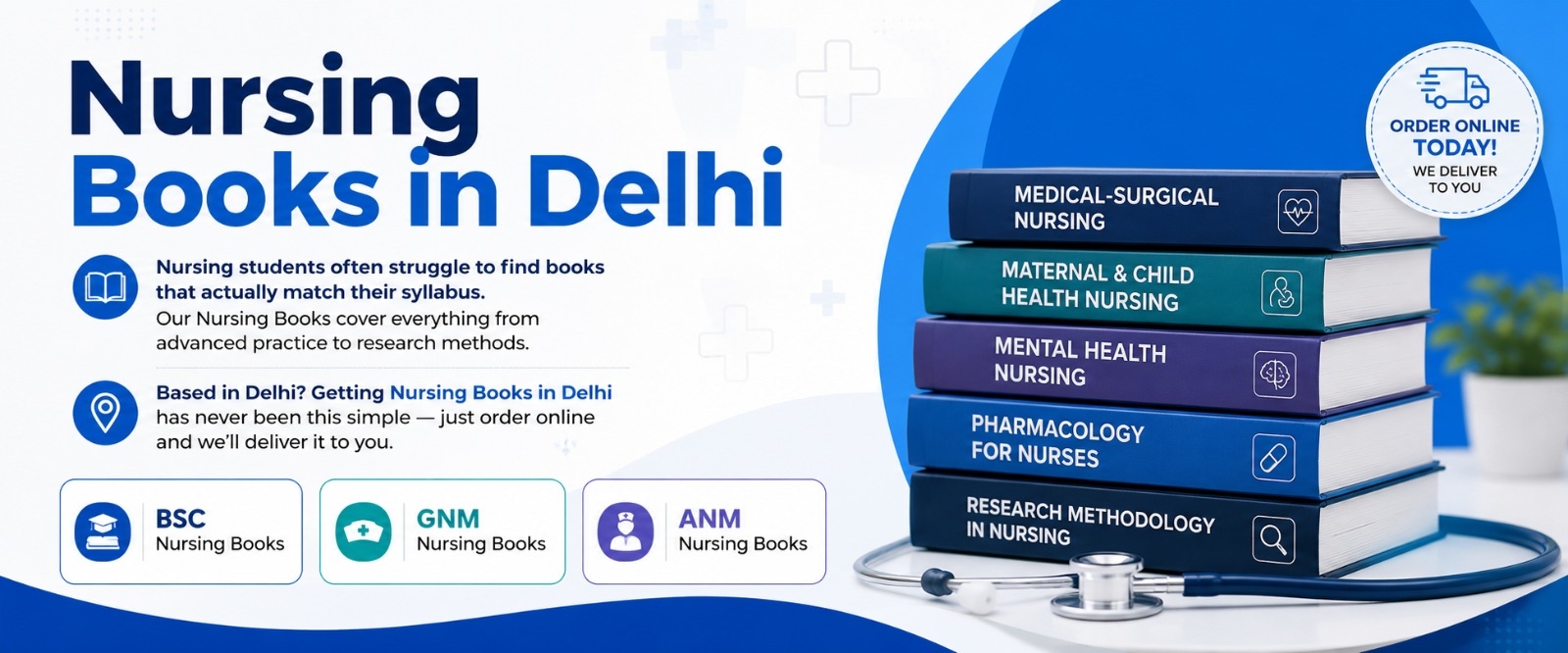
Nursing Books in Delhi for Nursing Students
Ask any nursing student what they wish they had known in their first month, and many will say the same thing: the books you pick can make or break your study routine. A good textbook feels like a patient senior sitting beside you, explaining things in order. A poor choice leaves you rereading the same paragraph at midnight, wondering what it means.
If you are searching for Nursing Books in Delhi, you are probably at the start of a course or moving into a new semester. Maybe you are in an ANM programme, a GNM diploma, or a BSc Nursing degree. Each of these paths has its own syllabus, pace, and style of learning, so the study material that suits one student may not suit another.
Nursing needs two kinds of strength. You have to understand why a condition develops, and you have to know what to do for the person in front of you. Textbooks build the first, and supervised practice builds the second. This guide covers how to choose books for each course level, what the main subjects involve, and how to study without burning out.
Importance of Choosing the Right Nursing Books
It is tempting to treat book-buying as a small task. You walk in, pick the thickest title, and move on. In practice, this one decision shapes months of your study time.
Here is what the right book does for you.
- It makes concepts clear. Nursing involves many linked ideas, such as how the kidneys affect blood pressure, or how nutrition affects wound healing. A well-written book explains these links step by step.
- It prepares you for exams. University and semester papers follow the syllabus. A book that matches the syllabus saves you from guessing which topics matter.
- It teaches medical language. Terms like “dyspnoea,” “oedema,” or “antenatal” stop sounding strange once you meet them again and again in context.
- It supports clinical learning. Reading about a procedure before you see it in the ward helps you follow what your instructor is doing and why.
- It helps you revise. Summaries, tables, and diagrams let you go back over a chapter quickly when exams are near.
One thing needs saying plainly. Your book should follow your prescribed syllabus, suit your course level, and match the way you learn. A famous title is not automatically the right one for you.
Different Types of Nursing Books Available for Students
Nursing books are not one-size-fits-all. They are written for different levels, and the depth changes a lot between a diploma-level text and a degree-level one. Here is how the main categories differ.
BSC Nursing Books for Undergraduate Students
The BSC Nursing course runs for four years and goes deeper into theory than the diploma routes. You study the human body, disease processes, nursing care, public health, research, and management. The books you use need to match that breadth.
Good BSC Nursing Books usually cover these subjects:
- Nursing Foundation
- Anatomy and Physiology
- Medical Surgical Nursing
- Community Health Nursing
- Child Health Nursing
- Mental Health Nursing
- Obstetrics and Gynaecological Nursing
- Nursing Research and Statistics
You do not need to buy all of these on day one. Look at your syllabus for the current year and semester, then choose books for those subjects first. Your shelf will grow naturally, and you will spend only on what you actually use.
How to Select Suitable B.Sc. Nursing Textbooks
When you have two or three options for the same subject, compare them on a few simple points.
- Syllabus coverage: Does it include every unit in your syllabus?
- Explanations: Can you follow a page without reading it three times?
- Illustrations: Are diagrams clear, labelled, and helpful?
- Practice questions: Are there review questions or short exercises at the end of chapters?
- Edition: Is it recent enough for subjects that change often?
- Relevance: Is it written for your course, or is it a general medical text?
Spend ten minutes flipping through a chapter you already half understand. If the book makes it clearer, that is a good sign.
GNM Nursing Books for Diploma Students
The General Nursing and Midwifery diploma is practical and fast-moving. Students rotate through hospital wards, learn bedside skills early, and sit for both written and practical assessments. Study material for this course should be clear, organised, and focused on what nurses actually do.
Useful GNM Nursing Books typically cover:
- Fundamentals of Nursing
- Anatomy and Physiology
- Community Health Nursing
- Medical Surgical Nursing
- Midwifery
- Child Health Nursing
- Mental Health and Psychiatric Nursing
The best ones present each topic in a logical order: what the condition is, how it appears, how it is managed, and what the nurse’s role is. That last part matters. It trains you to think like a nurse rather than a medical student. Books like these help you revise key concepts and understand your responsibilities before you face them on the ward.
Benefits of Using Subject-Wise GNM Books
Using a separate book for each subject has real advantages.
First, it keeps your study organised. When you sit down for Child Health Nursing, you open one book and focus on it. Nothing else distracts you.
Second, subject-wise books go deeper. A single combined guide may skim over topics that a dedicated book explains well.
Third, revision becomes easier. You can mark difficult chapters, add your own notes in the margins, and return to them week after week. Over a three-year diploma, that habit pays off.
ANM Nursing Books for Auxiliary Nursing Students
The Auxiliary Nurse Midwife course prepares students to work close to communities, often in sub-centres and rural health settings. The emphasis is on practical, everyday health care: caring for mothers and babies, promoting hygiene and nutrition, and supporting families.
ANM Nursing Books are most helpful when they cover areas such as:
- Community Health Nursing
- Primary Healthcare
- Maternal and Child Health
- Basic Nursing Care
- Health Education
- Nutrition
- Midwifery
Because this course is so hands-on, plain language matters more than fancy terminology. Look for books with short paragraphs, clear pictures, and real-life examples, such as how to explain a vaccination schedule to a new mother. The book should make you feel more confident, not more confused.
Tips for Choosing the Right ANM Study Materials
- Check the syllabus first. Make sure the topics in the book match your course units.
- Skim the chapter list. A good contents page shows you quickly whether the book covers what you need.
- Pick explanations you can follow. If you cannot understand a sample page, the book is not right for you yet.
- Use practice material. Questions at the end of chapters help you see what you have really learned.
- Ask your teacher. Instructors know which books suit your level and exam pattern.
Important Subjects Covered in Nursing Textbooks
Whichever course you choose, a handful of subjects form the backbone of nursing education. Knowing what each one involves helps you decide how to study it.
Nursing Foundation
This is where nursing practice begins. Foundation books introduce basic principles of patient care: taking vital signs, maintaining hygiene, positioning patients, preventing infection, communicating well, keeping records, and understanding professional responsibilities.
Because these are practical skills, a good foundation book includes step-by-step procedures and clear illustrations. Read a procedure, then practise it in the skills lab under supervision. Reading alone is never enough for this subject.
Anatomy and Physiology
Anatomy tells you how the body is built, and physiology tells you how it works. Together they explain everything else you will study. You cannot understand heart failure without knowing how the heart pumps, or recognise dehydration without knowing how the body handles fluids.
Look for books with labelled diagrams and flow charts. A useful habit is to draw a diagram from memory, check it against the book, and fix your mistakes. It feels slow at first, but it works.
Medical Surgical Nursing
This is among the largest subjects in nursing. It covers the care of adults with medical and surgical conditions: heart, lungs, kidneys, digestive system, nervous system, and more. Textbooks introduce common health conditions, patient assessment, nursing interventions, and care planning.
Most good books follow a pattern for each condition, covering causes, signs and symptoms, diagnosis, treatment, and nursing management. Studying with this pattern in mind helps you write well-organised exam answers.
It is also worth being clear about what textbooks can and cannot do. They support your learning, but they do not replace clinical supervision or professional medical guidance. In the ward, always follow your instructor and the care team.
Community Health Nursing
Community health nursing looks beyond the hospital. It focuses on preventing disease, promoting health, supporting families, and educating the public. Topics include epidemiology, immunisation, national health programmes, environmental health, and family welfare.
Because health programmes and policies get updated, this is one subject where the edition you use deserves a second look. Examples from villages, schools, and city neighbourhoods make the subject easier to remember.
Mental Health and Psychiatric Nursing
This subject teaches you to understand mental health conditions, communicate in a therapeutic way, support patients, and provide ethical, respectful care.
Choose books that explain disorders in simple language and include case examples and communication techniques. The subject also builds empathy, which is useful in every area of nursing, from the paediatric ward to the emergency room.
Child Health Nursing
Child health nursing, also called paediatric nursing, covers growth and development, common childhood illnesses, nutrition, immunisation, and age-appropriate care. Children are not small adults. A toddler and a teenager need very different approaches, and a newborn is different again.
Books that include growth charts, milestone tables, and age-wise care guidelines make revision much easier.
Obstetrics and Gynaecological Nursing
This subject supports learning about pregnancy, childbirth, maternal health, reproductive health, and newborn care. It is especially important for ANM and GNM students, whose clinical work often involves antenatal check-ups and deliveries.
Look for books that explain the stages of labour clearly, describe antenatal assessment step by step, and cover emergency situations with helpful diagrams.
How to Find Suitable Nursing Books in Delhi
Delhi has a large student population and plenty of choices, which can feel like a blessing and a headache at once. When you start looking for Nursing Books in Delhi, a clear checklist keeps you from getting overwhelmed.
- Identify your course and subject. Be specific. “GNM first-year Fundamentals of Nursing” is a much better search than “nursing book.”
- Check your prescribed syllabus. Keep a copy with you when comparing titles.
- Compare textbooks and editions. Two books on the same subject can differ in depth, style, and how current they are.
- Read the description and contents. The table of contents tells you more than the cover does.
- Confirm the language. Some students learn faster from simple English or a regional-language edition. Choose what helps you understand best.
- Compare prices and availability. Look at a few options before deciding, and check that the book is actually available when you need it.
- Decide what you need it for. Some books are best for theory, some for practical skills, and some for exam revision.
It also helps to browse online catalogues, where categories are sorted by course and subject. Seeing options side by side makes comparison simpler. Whatever source you use, confirm the details yourself and do not rely on assumptions about stock, delivery, or discounts.
Benefits of Buying Nursing Textbooks Online
Many students now browse for study material online, and the reasons are easy to see.
- Convenient browsing. You can look through options from home, during a break, or late in the evening after a ward shift.
- Easy category comparison. Catalogues are usually arranged by course, so you can move quickly between ANM, GNM, BSc, and MSc sections.
- Subject-specific materials. You can search for exactly the subject you need instead of scanning crowded shelves.
- Product descriptions. You can read about a book’s contents and features before making a decision.
- Price comparison. Looking at several options at once helps you stay within budget.
- Clearer course matching. Seeing books grouped by programme makes it easier to avoid buying for the wrong level.
A small caution applies, though. Before ordering anything, check the product details, edition, language, and availability. A few minutes of checking can save you from receiving a book that does not fit your needs.
For students interested in postgraduate study or wanting to understand how advanced material differs, browsing a category of Nursing Books in Delhi for MSc-level subjects can give a useful sense of what comes next in your learning journey.
How to Choose Nursing Books According to Your Syllabus
The syllabus should always be your starting point. It tells you what you will be taught, what you will be tested on, and how deep you need to go. Books are tools, and the syllabus tells you which tool to pick.
Here is a simple approach.
- Review your current syllabus. Read it fully, not just the headings.
- List subjects for each semester or year. Do not buy for the whole course at once.
- Pick books that cover the required topics. Compare the contents page with the syllabus units.
- Prefer updated editions when appropriate. This matters most for subjects with changing guidelines.
- Add a reference book for tough topics. A second source can explain a concept differently when the first one does not click.
- Keep separate notes for revision. Your own short notes become your fastest tool before exams.
- Ask teachers or mentors. They know the exam pattern and can point you to material that works.
A book that suits one course or semester may not be enough for another. A first-year GNM student and a third-year BSc student need very different levels of detail, even when the subject name sounds similar.
Best Study Practices for Nursing Students
Books only help if you use them well. Here are habits that tend to work for most students.
- Create a realistic timetable. Plan around your classes and clinical postings, not an ideal day that never happens.
- Set daily learning goals. “Finish one topic and write five key points” is better than “study a lot.”
- Read one subject at a time. Jumping between subjects every half hour splits your attention.
- Prepare short revision notes. Writing in your own words helps you remember far more than highlighting an entire page.
- Review diagrams and definitions. Quick visual revision is great for anatomy, physiology, and procedures.
- Practise questions. Short notes, long answers, and objective questions all help you see what you know.
- Revise difficult chapters regularly. Go back to them after a day, a week, and a month.
- Connect theory with supervised practice. When you read about a procedure, find a chance to see or practise it in the lab or ward under your instructor.
Steady daily effort beats a last-minute rush every time. Half an hour of focused reading each day adds up to far more than one exhausting weekend before the exam.
How to Prepare for Nursing Examinations
Exam preparation works best when you break it into stages.
Topic revision. Go through each unit and mark what you know well and what feels shaky.
Question practice. Write answers to previous-style questions within a time limit. This builds speed and shows you where your explanations are weak.
Mock tests, where appropriate. If your institute or study group offers them, they are a good way to rehearse the real experience.
Regular review. Return to older topics so you do not forget them while learning new ones.
Above all, aim to understand rather than memorise every paragraph. Exam questions often ask you to apply a concept to a patient situation, and memorised lines will not carry you through that. If you understand why a nursing action is done, you can answer a question you have never seen before.
Common Mistakes to Avoid When Selecting Books
Even careful students slip up now and then. Watch out for these.
- Choosing a book without checking the syllabus. A book may be popular and still miss half of what your exam covers.
- Buying for the wrong course. A GNM book and a BSc book on the same subject can differ a lot in depth.
- Ignoring the edition. Older material may not reflect current practice or syllabus changes.
- Selecting only by price. A cheaper book you cannot understand is not a saving.
- Depending on a single textbook. One source rarely explains everything equally well.
- Neglecting practical learning. Clinical competence matters for exams and for your future patients.
- Buying duplicates. Check what you already have, or what your seniors can lend, before ordering more.
Why Updated Editions and Accurate Information Matter
Healthcare changes. Immunisation schedules, national programmes, and care guidelines are revised from time to time, and syllabi change too. A textbook that matched the syllabus five years ago may not match it today.
Before buying, check that the book aligns with your current syllabus and learning needs. Verify details such as the author, edition, and publication year. If you are unsure, ask your institution or subject teacher. It takes a minute, and it avoids a lot of confusion later.
A Simple Final Checklist Before Buying
- Course: Is it written for your programme (ANM, GNM, BSc, or MSc)?
- Subject: Does it match the exact subject you need?
- Syllabus: Does it cover your units?
- Author: Is it by a recognised author in the field?
- Edition: Is it current enough for your needs?
- Language: Can you read and understand it comfortably?
- Price: Is it within your budget compared with other options?
- Availability: Can you actually get it when you need it?
Conclusion
Nursing is a demanding course, and it is also a deeply meaningful one. The things you learn now will one day help you comfort a frightened patient, spot an early warning sign, or guide a family through a difficult time. Your study material is the foundation of that learning, so it deserves a little thought.
Start with your syllabus. Choose books that match your course and level, whether you need BSC Nursing Books, GNM Nursing Books, or ANM Nursing Books. Compare editions, check the language, and look at more than one option. Then build habits you can keep: short daily study sessions, regular revision, question practice, and hands-on skills under proper supervision.
When you are ready to explore Nursing Books in Delhi, pick the ones that fit your course and your pace. The right textbooks, steady revision, and supervised practice together give your nursing education a strong footing.

