


Rett Syndrome Market Trends: New Treatment Options Transform Rare Disease Care
Rett Syndrome Market Poised for Growth as Novel Therapies and Gene-Editing Research Advance
Market Estimation, Growth Drivers, and Opportunities
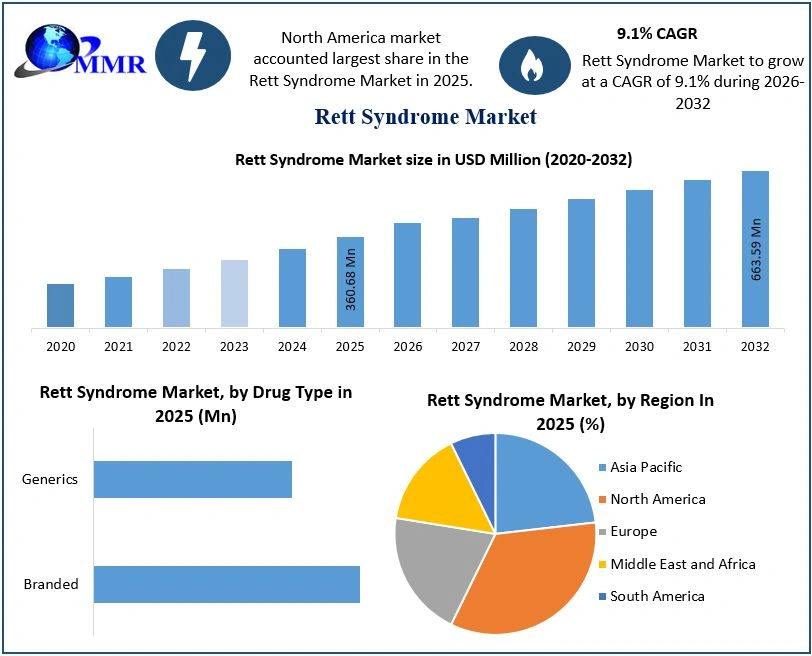
The global Rett Syndrome Market was valued at USD 360.68 million in 2025 and is projected to grow at a compound annual growth rate (CAGR) of 9.1% from 2026 to 2032, reaching approximately USD 663.59 million by 2032. Growth is supported by rising awareness of this rare genetic neurological disorder, improving diagnostic capabilities, and continuing research into treatments that may address its underlying biological causes.
Rett syndrome is most commonly associated with mutations in the MECP2 gene and can affect communication, motor skills, purposeful hand movements, and daily functioning. Although there is no definitive cure, the development of approved medicines has created a commercial foundation for continued investment in treatment and patient support. Opportunities are emerging in gene therapy, RNA-based approaches, precision medicine, improved drug formulations, and multidisciplinary care. Earlier diagnosis and better access to specialist services may also increase the number of patients who receive timely treatment.
* Get Actionable Market Insights: https://www.maximizemarketresearch.com/request-sample/187774/
U.S. Market Trends and Investment in 2025
The United States remained a central market for Rett syndrome treatment development in 2025, supported by regulatory pathways for rare diseases, clinical research infrastructure, and investment by biotechnology companies. In December 2025, the U.S. Food and Drug Administration approved DAYBUE STIX, a dye- and preservative-free powder formulation of trofinetide developed by Acadia Pharmaceuticals. The formulation offers patients and caregivers another option for preparing and administering treatment while retaining the established medicine’s approved indication for adults and children aged two years and older. Separately, Neurogene advanced its investigational gene therapy NGN-401: the first participant entered its Embolden registrational trial in November 2025, following earlier regulatory discussions and clinical development. These developments illustrate investment in both practical treatment improvements and potentially disease-modifying approaches, although investigational therapies still require further evidence and regulatory review.
Market Segmentation: Key Categories
The market is segmented by type, treatment, drug type, dosage form, disease stage, route of administration, end user, and region. The report identifies North America as the leading regional market. However, its publicly available summary does not specify the largest-share category within every other segment, so individual segment leaders and their percentages are not assigned without verified data. The treatment landscape includes medication, physical therapy, occupational therapy, speech-language therapy, and other supportive approaches. Branded medicines are an important part of the commercial landscape following the introduction of an FDA-approved therapy, while dosage and administration options remain relevant to patients with differing needs. Hospitals, specialty clinics, and home-based care all contribute to treatment delivery.
Rett Syndrome Market,Key Players are
North America
1. Acadia Pharmaceuticals Inc. (USA)
2. Anavex Life Sciences Corp. (USA)
3. Neurogene Inc. (USA)
4. Eloxx Pharmaceuticals, Inc. (USA)
5. Biohaven Pharmaceuticals, Inc. (USA)
6. Vyant Bio Inc. (USA)
7. Taysha Gene Therapies, Inc. (USA)
8. Neurolixis Inc. (USA)
9. Biomed Industries (USA)
10. AveXis (USA)
11. Ovid Therapeutics (USA)
12. Marinus Pharmaceuticals (USA)
13. Ionis Pharmaceuticals (USA)
14. Alcyone Therapeutics (USA)
15. Shape Therapeutics Inc. (USA)
16. DepYmed Inc. (USA)
17. Vanderbilt Health (USA)
18. EuMentis Therapeutics Inc. (USA)
Asia Pacific
19. Eisai Co., Ltd. (Japan)
20. Neurotech International Ltd. (Australia)
Europe
21. Neuren Pharmaceuticals Limited (Austria)
22. AMO Pharma Limited (UK)
23. GW Pharmaceuticals / Biogen (UK)
24. Herophilus (Belgium)
Middle East and Africa
25. Prilenia Therapeutics Development Ltd (Israel)
Competitive Analysis: Key Companies and Innovation
The market report lists companies active in the Rett syndrome landscape, including Acadia Pharmaceuticals, Anavex Life Sciences, Neurogene, Taysha Gene Therapies, and Neuren Pharmaceuticals. Publicly available information does not establish a verified market-share ranking for these five companies; they are therefore discussed as notable participants rather than confirmed top-five market-share holders.
- Acadia Pharmaceuticals Inc. commercializes trofinetide under the DAYBUE brand in the United States. Its December 2025 approval of DAYBUE STIX highlights formulation innovation designed to give patients and caregivers greater flexibility.
- Neuren Pharmaceuticals Limited discovered and developed trofinetide before partnering with Acadia for commercialization. Its work demonstrates how biotechnology partnerships can help translate rare-disease research into approved treatment.
- Neurogene Inc. is developing NGN-401, an investigational gene therapy intended to address Rett syndrome through delivery of a functional MECP2 gene. In November 2025, it began dosing participants in the Embolden registrational trial.
- Taysha Gene Therapies Inc. is developing TSHA-102, an investigational gene-replacement approach designed to deliver a functional miniMECP2 gene. Its clinical progress reflects industry interest in one-time genetic treatments, although efficacy and safety must be established through clinical evaluation.
- Anavex Life Sciences Corp. is listed among the companies active in the market. Its inclusion reflects the broader research landscape; a specific Rett syndrome product investment or market share is not asserted here without substantiated current evidence.
Competitive differentiation will depend on clinical outcomes, safety, tolerability, ease of administration, regulatory progress, and the ability to provide meaningful benefits for patients and caregivers.
Regional Analysis: United States, United Kingdom, Germany, France, Japan, and China
United States: The U.S. is a key market because of FDA rare-disease pathways, specialist treatment centers, clinical-trial activity, and the availability of trofinetide. Gene-therapy research and patient advocacy continue to support development.
United Kingdom: The UK benefits from specialist neurological services and rare-disease research networks. Access to innovative medicines depends on regulatory authorization, health-technology assessment, and funding decisions.
Germany: Germany’s established pharmaceutical sector and specialist healthcare infrastructure support diagnosis, treatment, and clinical research. Reimbursement and evidence requirements influence the uptake of new therapies.
France: France’s rare-disease strategy, specialist centers, and research networks provide a framework for coordinated diagnosis and care. Access to new treatments is influenced by national assessment and reimbursement processes.
Japan: Japan has regulatory and policy frameworks for orphan drugs and rare diseases, supporting the development and review of treatments for small patient populations. Local clinical evidence and access arrangements remain important.
China: China’s evolving rare-disease policy environment, expanding healthcare infrastructure, and biotechnology sector create potential opportunities for improved diagnosis and future treatment access. Regulatory approval, affordability, and availability of specialist care will influence market development.
North America is identified as the leading region in the market report. Country-specific market shares for the six countries above are not stated because verified figures were not available in the report summary.
Related Reports:
Neonatal respiratory distress syndrome treatment Market https://www.maximizemarketresearch.com/market-report/neonatal-respiratory-distress-syndrome-treatment-market/211019/
mRNA vaccines Market https://www.maximizemarketresearch.com/market-report/mrna-vaccines-market/213483/
Acute Myeloid Leukaemia Therapeutics Market https://www.maximizemarketresearch.com/market-report/acute-myeloid-leukaemia-therapeutics-market/213386/
Conclusion
The Rett Syndrome Market is positioned for steady expansion as approved treatment options, improved formulations, and investigational genetic therapies broaden the treatment landscape. The strongest opportunities lie in advancing safe and effective therapies, supporting earlier diagnosis, improving access to specialist care, and developing patient-friendly delivery methods. Continued collaboration among pharmaceutical companies, research institutions, regulators, clinicians, and patient organizations will be important. While gene therapy offers significant potential, long-term safety, durable clinical benefit, affordability, and access will determine how effectively innovation translates into better outcomes for people living with Rett syndrome.
About Maximize Market Research
Maximize Market Research Pvt. Ltd. (MMR) is a global market research and consulting firm known for delivering accurate, actionable, and data-driven insights. Our expertise spans diverse industries — including medical devices, pharmaceuticals, technology, automotive, electronics, chemicals, personal care, and consumer goods. We provide services such as market-validated forecasts, competitive intelligence, strategic consulting, and industry impact analysis, helping businesses navigate market complexities and achieve sustainable growth.
Contact Maximize Market Research
MAXIMIZE MARKET RESEARCH PVT. LTD.
2nd Floor, Naval IT Park Phase 3,
Pune-Bangalore Highway, Narhe,
Pune, Maharashtra 411041, India.
📞 +91 9607365656
📧 sales@maximizemarketresearch.com

