


A Smarter E-Invoice Receiving Solution for UAE Businesses
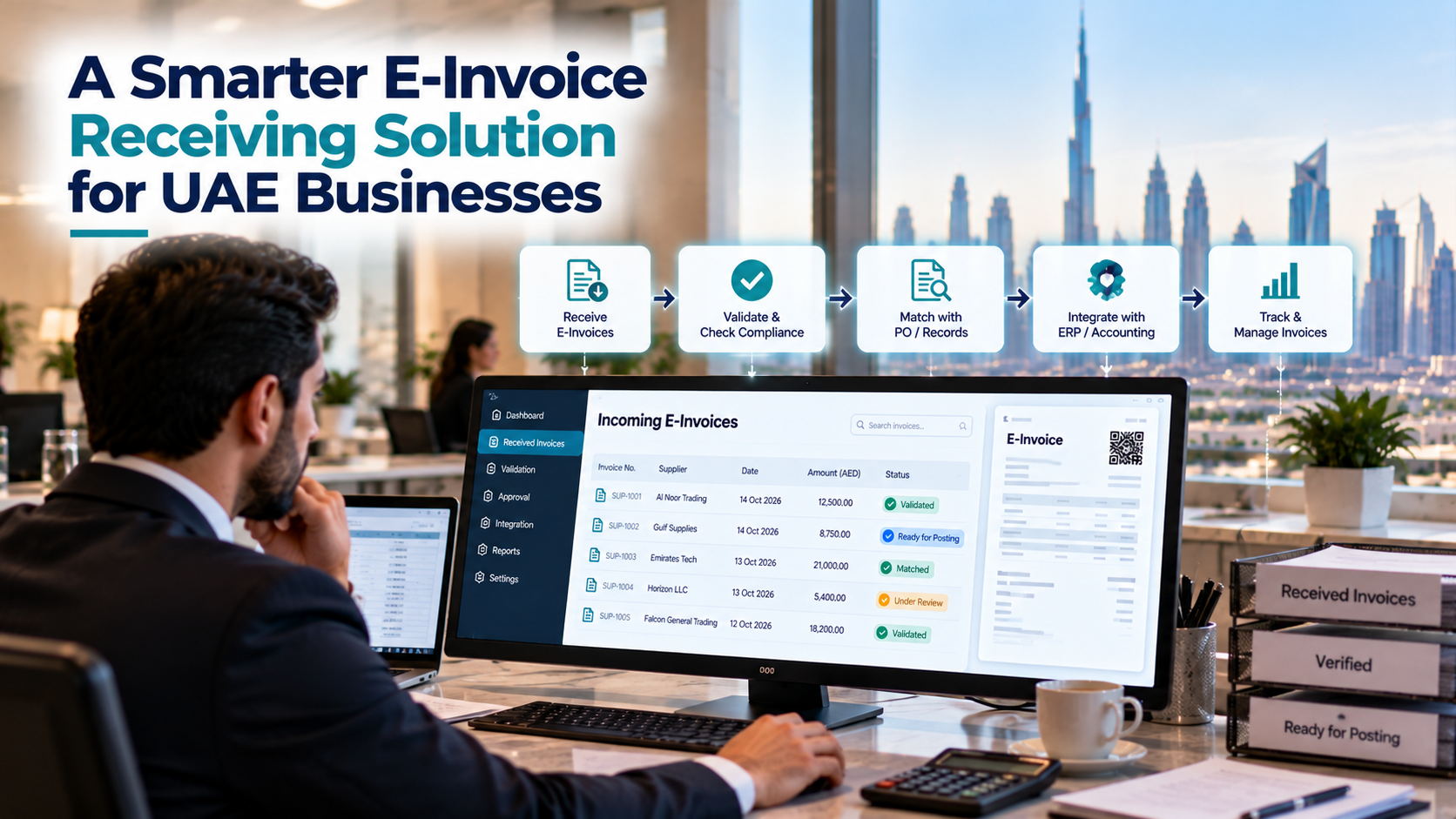
For many businesses, receiving a supplier invoice is only the beginning of the accounts payable process. The finance team may need to check the purchase order, confirm that the goods or services were received, verify the tax details and obtain approval before scheduling payment. When invoices arrive through email, supplier portals and different software systems, keeping everything organised can become difficult.
An E-invoice receiving solution for UAE businesses can help companies prepare for structured electronic invoicing while improving how supplier invoice data is received, checked and processed. The goal is not simply to replace email attachments with digital records. It is to create a more reliable connection between incoming invoices, purchasing activity and accounts payable.
Why Receiving Supplier Invoices Can Become Complicated
Businesses often receive invoices from suppliers with different billing schedules, formats and payment terms. A company might receive one invoice for a regular monthly service, another for a bulk stock purchase and several more for separate deliveries against the same purchase order.
Each invoice needs to be checked before it moves through the payment process. If information is incomplete or does not match the original transaction, the finance team must investigate the difference.
Common challenges include:
- Invoices arriving through multiple channels: Employees may need to collect documents from email accounts, supplier portals and internal systems.
- Missing purchase order references: Finance staff may struggle to identify which department or order an invoice relates to.
- Differences in quantities or prices: The supplier's invoice may not match the agreed purchase order or recorded delivery.
- Duplicate invoices: The same invoice may be submitted more than once, creating a risk of duplicate processing.
- Approval delays: Invoices can remain pending when the responsible manager is unavailable or the approval route is unclear.
These issues can delay payments and make it harder to maintain an accurate view of outstanding liabilities.
What Does an E-Invoice Receiving Solution Actually Do?
An invoice receiving solution helps a business manage incoming invoice information and move it through the appropriate processing workflow. Its exact capabilities depend on the software and integration involved.
For UAE businesses preparing for structured electronic invoicing, it is important to distinguish between receiving a digital document and receiving structured invoice data through the applicable e-invoicing process.
A PDF invoice delivered by email may be readable, but it does not automatically qualify as a structured e-invoice. Businesses should assess whether their receiving process supports the relevant UAE requirements rather than assuming that an electronic attachment is sufficient.
Depending on the implementation, a receiving workflow may help businesses:
- Receive structured invoice data through supported connections.
- Validate invoice information before further processing.
- Match invoices with relevant purchasing and delivery records.
- Route invoices to the appropriate approver.
- Track processing status and identify exceptions.
- Maintain records for accounts payable and reconciliation.
Before selecting a solution, businesses should confirm which of these functions are supported and how they fit into the applicable UAE framework.
Match Supplier Invoices With Purchase Orders and Deliveries
One of the most useful improvements in accounts payable is connecting an incoming invoice to the transaction that created it.
Consider a distributor that orders 1,000 units from a supplier but receives only 800 in the first shipment. The supplier submits an invoice, and the finance team needs to determine whether it relates to the full order or the quantity delivered so far.
If the purchasing system, warehouse records and invoice data are disconnected, employees may need to contact several departments before approving the payment.
A structured workflow can make these checks easier by bringing together the relevant information. Depending on the company's systems, the process may include:
- Identifying the purchase order referenced by the supplier.
- Checking the invoice quantities and prices against the agreed terms.
- Comparing the invoice with the available goods receipt or service confirmation.
- Flagging discrepancies for review.
- Recording the approval or reason for holding the invoice.
Not every invoice will follow a standard purchase-order process. Utility bills, professional services and recurring expenses may require different checks. The receiving workflow should accommodate these differences rather than forcing every invoice into the same approval route.
Improve Data Accuracy Before an Invoice Reaches Accounts Payable
Incoming invoice processing depends on the quality of the information received. Incorrect supplier details, missing references or inconsistent tax information can cause delays even when the underlying purchase is legitimate.
Businesses should establish which invoice fields need to be checked and where the reference information is maintained. Depending on the transaction, these checks may cover:
- Supplier name and relevant identification details.
- Invoice number and invoice date.
- Purchase order or contract reference.
- Product or service descriptions.
- Quantities, unit prices and additional charges.
- Applicable VAT information and invoice totals.
- Payment terms and due dates.
Duplicate detection is another important consideration. A supplier might resend an invoice because the original email was not acknowledged, or an employee might upload the same record twice. The system should help identify potential duplicates before the invoice progresses, with a review process for cases that require human judgement.
Clear supplier master data also makes a difference. If the same supplier is recorded under multiple names in different applications, matching invoices to purchasing and payment records becomes more difficult.
Connect Invoice Receiving With Existing Finance Software
Many businesses already use accounting software or an ERP system to manage purchasing, supplier accounts and payments. An invoice receiving solution should complement that environment instead of creating another disconnected database.
For example, an incoming invoice may need to be matched against a purchase order in the ERP system, checked against warehouse records and then routed for approval. Once approved, the relevant information may need to update accounts payable so the finance team can plan payments and reconcile balances.
Businesses assessing their options can review UAE e-invoicing solutions and implementation approaches to understand how incoming invoice workflows fit into the wider electronic invoicing process.
When evaluating an integration, consider these questions:
- Can invoice data move into the existing accounting or ERP system?
- Which system remains the main record for supplier invoices?
- How are rejected or incomplete invoices returned for correction?
- Can employees see whether an invoice is pending, approved or held?
- What happens if the integration fails temporarily?
- Can the business trace the invoice back to its purchase and delivery records?
The right approach depends on the company's current software, transaction volumes and internal controls. A smaller business may need a straightforward connection, while an organisation with multiple entities and approval levels may require a more extensive workflow.
Give Each Invoice a Clear Approval Path
An invoice can be accurate and still remain unpaid if no one knows who must approve it. This often happens when approval responsibilities are unclear or invoices are forwarded manually between departments.
A well-defined workflow assigns responsibility based on the type, value or business purpose of the expense. For example, a department manager may confirm that a service was delivered, while the finance team checks the accounting and tax information before payment.
A practical approval process should make it clear:
- Who verifies the purchase or service.
- Who reviews financial and tax details.
- Which invoices require additional approval.
- How exceptions are escalated.
- How approval decisions are recorded.
The system should also help staff distinguish between an invoice awaiting approval and one that cannot proceed because information is missing. These situations require different actions and should not be treated as the same status.
Prepare for Exceptions Before Going Live
A receiving solution should be tested against realistic supplier transactions, not just a sample invoice containing perfect data.
Include scenarios such as:
- An invoice with no purchase order reference.
- A difference between invoiced and received quantities.
- A duplicate invoice number or repeated submission.
- Incorrect supplier or tax details.
- A credit note linked to an earlier invoice.
- A delayed response or temporary integration failure.
Testing should confirm that the system identifies problems, directs them to the right person and preserves a record of the decision. Finance employees should participate so they can verify that the workflow supports actual accounts payable practices.
It is also worth reviewing how staff will handle invoices that require manual investigation. Automation should reduce repetitive work, but it should not remove the controls needed to prevent incorrect payments.
Make Supplier Invoice Processing More Reliable
For UAE businesses, an e-invoice receiving solution should help connect incoming invoice data with purchasing, delivery confirmation, approval and payment preparation.
Start by reviewing how supplier invoices are received today. Identify where employees repeat data entry, where approval delays occur and which discrepancies take the longest to resolve. Then assess the solution's integration and validation capabilities against those specific problems.
A well-planned workflow can improve visibility into outstanding invoices, make discrepancies easier to investigate and help finance teams maintain more consistent records. As businesses prepare for structured electronic invoicing, the priority should be a process that fits their existing operations while meeting the applicable UAE requirements.

