


Drip Irrigation Market: Exploring New Trends in Agricultural Water Management
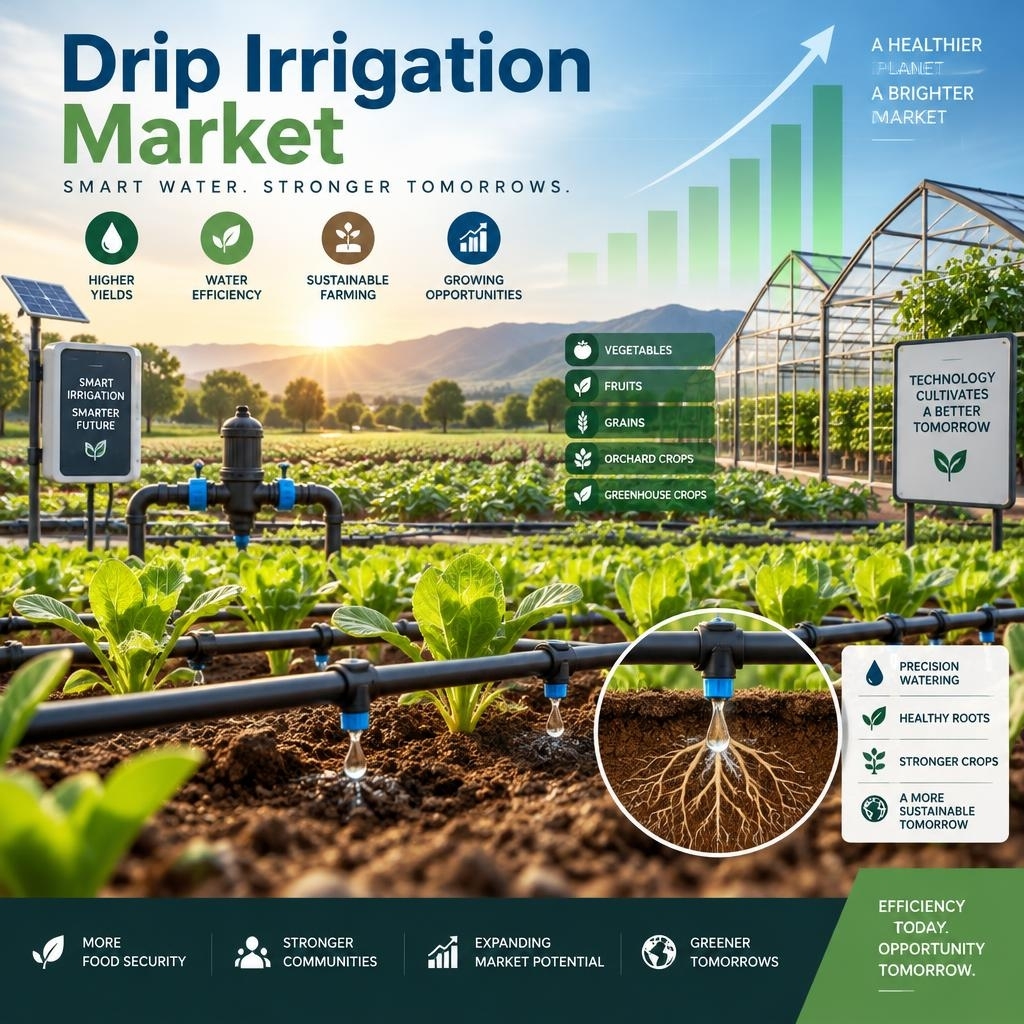
Introduction to the Drip Irrigation Market
The Drip Irrigation Market is gaining importance as agricultural producers increasingly focus on improving water management and supporting sustainable crop cultivation. Water availability is a major consideration in farming, and the need for efficient irrigation practices continues to influence agricultural technology development. Drip irrigation provides a controlled method of delivering water directly to plant roots through specialized pipes, tubes, and emitters. This approach allows farmers to manage irrigation according to crop requirements while reducing unnecessary water distribution across cultivated areas.
The increasing demand for micro drip irrigation technology and efficient agricultural water distribution systems demonstrates the growing interest in modern irrigation infrastructure. These technologies help agricultural producers manage water delivery according to soil characteristics, crop requirements, and field conditions. The market includes different equipment categories, such as drip tapes, emitters, filters, valves, connectors, and automated controllers. As agricultural businesses explore sustainable farming practices, manufacturers are developing innovative solutions that address changing irrigation requirements.
Changing Agricultural Water Management Practices
Water management has become an important part of agricultural planning. Farmers must ensure that crops receive appropriate moisture while managing available water resources responsibly.
Traditional irrigation methods may distribute water across large areas, including locations where it is not immediately required. Drip irrigation provides a more targeted alternative by delivering water near plant root systems.
This method can support better irrigation scheduling and help farmers manage soil moisture conditions. It is particularly relevant for agricultural operations where water availability and distribution require careful planning.
Modern irrigation systems also allow different sections of a farm to receive water according to their specific requirements.
Growing Adoption in Horticulture
Horticulture represents an important application area for drip irrigation systems. Fruit cultivation, vegetable farming, and plantation agriculture require irrigation practices that can accommodate different plant structures and growing conditions.
Fruit orchards can use drip irrigation networks designed around individual trees and their root zones. Vegetable growers can install drip lines along planting rows to support targeted water delivery.
Greenhouse cultivation also benefits from controlled irrigation systems. Growers can manage water distribution according to the characteristics of cultivated plants and growing media.
These applications are encouraging manufacturers to develop flexible equipment that can serve different horticultural environments.
Importance of Irrigation Equipment Quality
The performance of drip irrigation systems depends on the quality and compatibility of their components.
Emitters regulate the release of water and are essential for maintaining consistent distribution throughout the irrigation network.
Drip pipes and tapes transport water across cultivated areas. Their material quality and durability influence installation and maintenance requirements.
Filtration equipment helps prevent unwanted particles from entering the distribution network. Proper filtration is important because clogged emitters can affect irrigation uniformity.
Valves, connectors, and pressure management components also contribute to reliable system operation.
Manufacturers are focusing on improving product durability, ease of installation, and compatibility with different water sources.
Integration of Automation in Irrigation
Automation is becoming increasingly relevant to agricultural water management. Automated controllers can help farmers operate irrigation systems according to planned schedules.
Soil moisture sensors provide information about water availability in the soil. Farmers can use this information to make better irrigation decisions.
Smart irrigation platforms may also incorporate environmental monitoring and weather information.
These technologies can support more responsive irrigation practices and reduce dependence on manual system operation.
The integration of automation with drip irrigation equipment is creating opportunities for agricultural technology companies.
Sustainable Farming and Resource Conservation
Sustainable farming involves managing natural resources responsibly while maintaining suitable agricultural production practices.
Drip irrigation can contribute to water conservation through localized water delivery. When properly designed, it can also help reduce unnecessary wetting of areas between crop rows.
Fertigation is another application that combines irrigation with nutrient delivery. This approach requires suitable equipment and careful management of nutrient concentrations and compatibility.
Farmers can integrate drip irrigation with soil conservation, crop rotation, and other responsible agricultural practices.
Challenges in the Drip Irrigation Industry
Despite its benefits, drip irrigation adoption can involve challenges related to installation, equipment expenses, maintenance, and technical knowledge.
Water quality is particularly important because particles can block emitters and affect system performance.
Farmers may also need professional assistance to design irrigation layouts that suit different soil conditions and crop requirements.
Manufacturers and distributors can address these concerns through technical support, training, and reliable replacement components.
Future Outlook
The Drip Irrigation Market is expected to remain relevant as agricultural producers continue exploring efficient water distribution technologies.
Product innovation, automation, improved filtration, and crop-specific irrigation systems can create opportunities for manufacturers.
The future development of the industry will depend on equipment reliability, accessibility, farmer awareness, and the ability to support different agricultural environments.
Frequently Asked Questions
Q1. What are the latest trends in the Drip Irrigation Market?
Important trends include smart irrigation controllers, precision water management, advanced emitters, improved filtration, fertigation, and sustainable agricultural practices.
Q2. Why is drip irrigation suitable for horticulture?
Drip irrigation allows water to be delivered near individual plant root zones, making it suitable for fruit orchards, vegetable cultivation, greenhouses, and plantation crops.

