


What Fire Safety Systems Are Installed by an Andrology Room Setup Company?
Introduction
Altus Airflow understands that fire safety is an essential part of developing secure and well-organised reproductive healthcare facilities. An Andrology Room Setup Company considers fire detection, alarm systems, emergency exits, fire suppression equipment, and electrical safety while planning specialised laboratory environments. Andrology rooms may contain sensitive instruments, electrical equipment, laboratory materials, and other items that require appropriate fire protection measures. A properly planned fire safety arrangement helps protect laboratory professionals, patients, equipment, and infrastructure while supporting safe daily operations.
Modern laboratory planning focuses on combining fire prevention, early detection, emergency response, and staff safety. Selecting suitable systems according to the room layout, equipment, and identified fire hazards helps create a safer working environment.
1. Why Is Fire Safety Important in Andrology Rooms?
Fire safety is an important consideration in reproductive healthcare laboratories because these spaces may contain electrical instruments, laboratory equipment, chemicals, and specialised storage facilities.
An unexpected fire can damage sensitive instruments, interrupt laboratory activities, and put personnel at risk. Therefore, fire protection should be incorporated into the initial laboratory planning process.
Important objectives of fire safety planning include:
-
Detecting smoke and fire at an early stage.
-
Alerting laboratory personnel during emergencies.
-
Controlling or suppressing fires using suitable systems.
-
Providing safe evacuation routes.
-
Protecting electrical installations and sensitive equipment.
-
Reducing the spread of smoke and fire.
-
Establishing clear emergency response procedures.
A comprehensive fire safety arrangement combines preventive measures, detection technologies, suppression equipment, and evacuation planning rather than depending on a single fire protection system.
2. Fire Detection and Alarm Systems
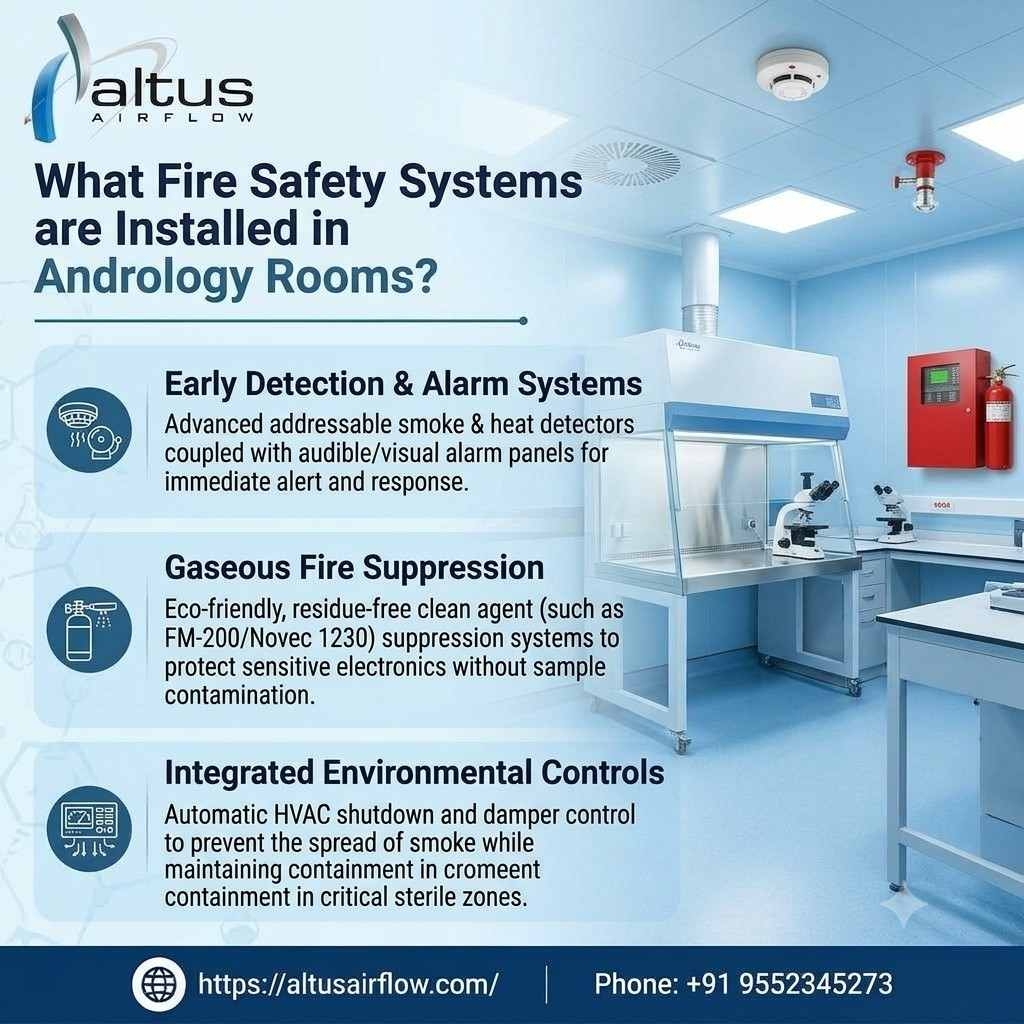
Fire detection and alarm systems are among the most important components of laboratory fire protection. They identify potential fire conditions and alert occupants so that appropriate emergency procedures can begin.
Common fire detection technologies include:
Smoke detectors: These devices identify smoke particles and activate an alarm when the detected concentration reaches the configured threshold. Their selection and placement should consider room conditions, ventilation, and the possibility of nuisance alarms.
Heat detectors: Heat detectors respond to abnormal temperature increases or predefined temperature thresholds. They may be appropriate in locations where smoke detection is unsuitable.
Multi-sensor detectors: These combine different sensing technologies, such as smoke and heat detection, to improve detection performance in suitable applications.
Manual call points: These allow laboratory personnel to activate the fire alarm manually when they identify a fire or emergency.
Audible and visual alarms: Sirens, sounders, and visual indicators notify occupants when evacuation or other emergency action is necessary.
A properly designed fire alarm system should provide suitable detector coverage, clear alarm notification, and integration with other building safety systems where required.
3. Automatic Fire Sprinkler Systems
Automatic sprinkler systems are commonly used in buildings to control or suppress fires during their early stages.
These systems operate when individual sprinkler heads are exposed to the heat generated by a fire. The sprinkler head activates according to its temperature rating and releases water over the affected area.
Important components include:
-
Sprinkler heads.
-
Water supply arrangements.
-
Control valves.
-
Alarm valves.
-
Pipe networks.
-
Pressure monitoring devices.
-
Flow switches.
In laboratory environments, sprinkler planning should consider the room function, ceiling configuration, electrical installations, and applicable fire protection requirements.
Water-based protection may be suitable for many building areas, but sensitive equipment locations and special hazards require careful assessment. Hospitals should not assume that every laboratory requires the same sprinkler arrangement.
The system should be designed and installed by qualified fire protection professionals in accordance with applicable building and fire safety requirements.
4. Fire Extinguishers for Laboratory Safety
Portable fire extinguishers provide an immediate response option for trained personnel when a fire is small and it is safe to attempt extinguishment.
Different extinguisher types are designed for different fire classifications.
ABC dry chemical extinguishers: These are commonly used for fires involving ordinary combustible materials, flammable liquids, and certain electrical equipment, subject to their approved ratings.
CO2 extinguishers: Carbon dioxide extinguishers are commonly considered for certain flammable liquid and energised electrical equipment fires. They do not leave the powder residue associated with dry chemical extinguishers.
Water-based extinguishers: These are intended for suitable Class A combustible material fires and should not be used on energised electrical equipment or incompatible flammable liquid fires.
Wet chemical extinguishers: These are primarily intended for cooking oil and fat fires and are generally relevant to designated kitchen areas rather than ordinary laboratory workspaces.
The correct extinguisher type should be selected through a fire risk assessment. Equipment should be accessible, clearly identified, inspected regularly, and supported by staff training.
Personnel should never attempt to fight a fire when doing so could endanger their safety or delay evacuation.
5. Clean Agent Fire Suppression Systems
Clean agent fire suppression systems may be considered in specialised locations containing sensitive electronic equipment or critical infrastructure.
Unlike conventional water-based suppression, clean agent systems use approved gaseous agents designed to suppress fires without leaving the same type of residue as powder-based extinguishing systems.
Potential applications may include:
-
Dedicated server rooms.
-
Electronic control rooms.
-
Critical equipment rooms.
-
Selected specialised laboratory areas.
Important system components include:
-
Agent storage cylinders.
-
Discharge nozzles.
-
Detection and control panels.
-
Automatic release mechanisms.
-
Warning alarms.
-
Manual release and abort controls, where specified.
Clean agent systems are not automatically necessary in every andrology room. Their suitability depends on the fire hazard, room enclosure, occupancy, equipment requirements, and applicable safety standards.
The design must also consider occupant exposure, evacuation procedures, enclosure integrity, and appropriate discharge safety arrangements.
6. Emergency Lighting and Exit Signage
Emergency lighting and exit signage are essential for helping laboratory personnel evacuate safely during fire incidents or electrical failures.
If the main electricity supply is interrupted, emergency lighting helps maintain visibility along evacuation routes, corridors, and exit areas.
Important safety provisions include:
-
Battery-operated emergency lights.
-
Illuminated exit signs.
-
Clearly marked evacuation routes.
-
Emergency lighting near doors and staircases.
-
Backup lighting for essential circulation areas.
-
Visible emergency instructions.
Exit signs should be positioned where occupants can identify the nearest safe exit without confusion.
Emergency lighting systems should have suitable backup arrangements and undergo periodic functional testing to confirm that they operate correctly during power interruptions.
7. Electrical Fire Protection Systems
Electrical safety is particularly important in andrology laboratories because they may contain microscopes, centrifuges, refrigerators, incubators, computers, and other electrically operated equipment.
Electrical faults, damaged cables, overloaded circuits, and overheating connections can create potential fire hazards.
An appropriate electrical fire prevention strategy includes:
Circuit breakers: These protect electrical circuits against overloads and short circuits.
Residual current protection: Suitable residual current devices help protect against certain electrical leakage faults and reduce electrical hazards.
Surge protection devices: These help protect sensitive electronic equipment from specified transient voltage disturbances.
Proper earthing: Appropriate earthing arrangements help reduce the risk of electrical shock and support electrical safety.
Dedicated electrical circuits: Selected laboratory equipment may require appropriately designed dedicated circuits to prevent overloading and improve electrical distribution.
Thermal inspection: Periodic inspection can help identify overheating electrical connections and components.
Electrical installations should be designed and inspected by qualified professionals according to applicable electrical safety requirements.
8. Fire-Rated Doors and Compartmentation
Fire-rated doors and compartmentation systems help limit the spread of fire and smoke between different areas of a healthcare facility.
In specialised laboratory environments, fire safety planning should consider the relationship between the andrology room, adjoining laboratories, corridors, storage areas, and other hospital spaces.
Important fire compartmentation features include:
-
Certified fire-rated doors.
-
Appropriate fire-resistant wall assemblies.
-
Properly sealed service penetrations.
-
Fire-rated cable and pipe openings.
-
Self-closing door mechanisms where required.
-
Suitable smoke control arrangements.
Fire-rated doors should be selected according to the required fire resistance rating and installed as part of an approved door assembly.
Service openings for electrical cables, ventilation ducts, and plumbing should also receive suitable fire-stopping treatment. This helps maintain the integrity of fire-resistant walls and floors.
9. Chemical Storage and Fire Prevention
Some laboratory environments may contain chemicals, disinfectants, cleaning agents, and other materials that require appropriate storage and handling.
Certain substances, including alcohol-based disinfectants, may be flammable. Therefore, laboratories should identify chemical hazards before finalising their fire safety arrangements.
Important preventive measures include:
-
Storing chemicals according to their compatibility.
-
Keeping flammable materials away from ignition sources.
-
Using approved storage cabinets where required.
-
Maintaining clear chemical labels.
-
Following manufacturer storage instructions.
-
Avoiding unnecessary chemical accumulation.
-
Providing appropriate ventilation.
-
Maintaining accessible safety information.
The laboratory should also establish procedures for handling chemical spills and disposing of potentially hazardous materials.
Chemical storage arrangements should follow relevant fire codes, safety data sheets, and occupational safety requirements.
10. Fire Safety Monitoring and Integrated Control Systems
Modern laboratories can benefit from integrated fire safety monitoring solutions that connect detection devices, alarm panels, and selected building management functions.
A centralised fire alarm control panel receives signals from connected detectors and initiates appropriate alerts when fire conditions are detected.
Depending on the system design, it may also provide information about:
-
Detector activation.
-
Manual call point operation.
-
Fire alarm zone identification.
-
System faults.
-
Power supply status.
-
Alarm communication.
-
Selected ventilation and smoke control interfaces.
Integration with building management systems can help authorised facility personnel monitor relevant building conditions.
However, the fire alarm system should retain its required independent safety functions. Integration must not interfere with fire detection, alarm notification, or emergency operation.
11. Fire Safety Installation and Testing Procedures
Installing fire protection equipment requires coordination between laboratory planners, architects, electrical consultants, and fire safety specialists.
A structured installation process helps ensure that systems are suitable for the laboratory layout and identified hazards.
The process generally includes:
-
Conducting a fire risk assessment.
-
Identifying potential ignition sources and combustible materials.
-
Selecting suitable fire detection technologies.
-
Planning sprinkler and suppression requirements.
-
Identifying appropriate extinguisher locations.
-
Installing emergency lighting and exit signage.
-
Coordinating electrical and fire alarm infrastructure.
-
Testing and commissioning installed systems.
-
Preparing maintenance and emergency response documentation.
After installation, fire alarm devices, detectors, extinguishers, sprinkler systems, and emergency lighting should be inspected and tested according to applicable standards and manufacturer recommendations.
Proper commissioning documentation helps facility managers verify that the installed systems perform as intended.
12. Staff Training and Emergency Evacuation Planning
Fire safety equipment is effective only when laboratory personnel understand how to respond during emergencies.
Staff training should explain how to identify fire alarms, locate emergency exits, report incidents, and follow evacuation procedures.
Important training areas include:
-
Identifying different types of fire hazards.
-
Understanding fire alarm signals.
-
Knowing the location of fire extinguishers.
-
Following designated evacuation routes.
-
Reporting fire incidents promptly.
-
Understanding emergency assembly points.
-
Supporting patient and visitor evacuation where applicable.
Fire drills should be conducted periodically according to hospital emergency preparedness procedures.
Laboratories should also display emergency contact information and evacuation instructions in visible locations.
13. Choosing the Right Fire Safety Arrangement for an Andrology Laboratory
The selection of fire safety systems should be based on the actual laboratory layout, occupancy, equipment, electrical infrastructure, and identified hazards.
A specialised reproductive laboratory may require a combination of detection, alarm, suppression, electrical protection, and emergency evacuation provisions.
A professional Andrology Room Setup Company should coordinate these requirements with the overall laboratory infrastructure plan.
Important considerations include:
-
Room dimensions and ceiling configuration.
-
Location of electrical equipment.
-
Chemical storage requirements.
-
Fire compartment boundaries.
-
Ventilation and smoke control arrangements.
-
Emergency power availability.
-
Accessibility of fire protection equipment.
-
Applicable local fire authority requirements.
The final arrangement should be reviewed by qualified fire protection consultants and approved authorities wherever required. This ensures that the selected systems are appropriate for the facility rather than simply copying a standard arrangement from another laboratory.
Conclusion
Fire safety systems are essential for creating secure and reliable andrology laboratory environments. Fire detection alarms, automatic sprinkler systems, suitable extinguishers, clean agent suppression, emergency lighting, electrical protection, and fire-rated doors all contribute to comprehensive laboratory safety. Proper chemical storage, staff training, routine inspections, and emergency evacuation planning are equally important.
A professionally planned Andrology Room Setup Company should consider fire protection alongside modular interiors, electrical infrastructure, ventilation, and laboratory equipment requirements.
Altus Airflow focuses on specialised modular healthcare and laboratory infrastructure, helping facilities plan organised and technically coordinated environments. Altus Airflow supports the integration of modular interiors, ventilation systems, and essential laboratory infrastructure to meet the functional and safety requirements of modern reproductive healthcare facilities.
Frequently Asked Questions (FAQs)
1. What fire safety systems are installed in an andrology laboratory?
An Andrology Room Setup Company may incorporate smoke detectors, fire alarms, sprinklers, suitable fire extinguishers, emergency lighting, and fire suppression systems according to the laboratory's risk assessment.
2. Why are smoke detectors important in andrology rooms?
They help identify smoke at an early stage and alert laboratory personnel about potential fire incidents.
3. Which fire extinguishers are suitable for laboratories?
ABC dry chemical and CO2 extinguishers may be suitable depending on the fire hazards and equipment present.
4. Are automatic sprinkler systems required in andrology laboratories?
Their requirement depends on building regulations, fire risk assessments, and the applicable fire protection design.
5. What is the purpose of clean agent fire suppression?
It suppresses fires in selected sensitive equipment areas without leaving conventional powder-based extinguishing residues.
Read Our Previous Blog ---------------> Does an Andrology Room Design Company work with government hospitals?

