


Grade Converter: Understanding Grade Conversion Across Systems
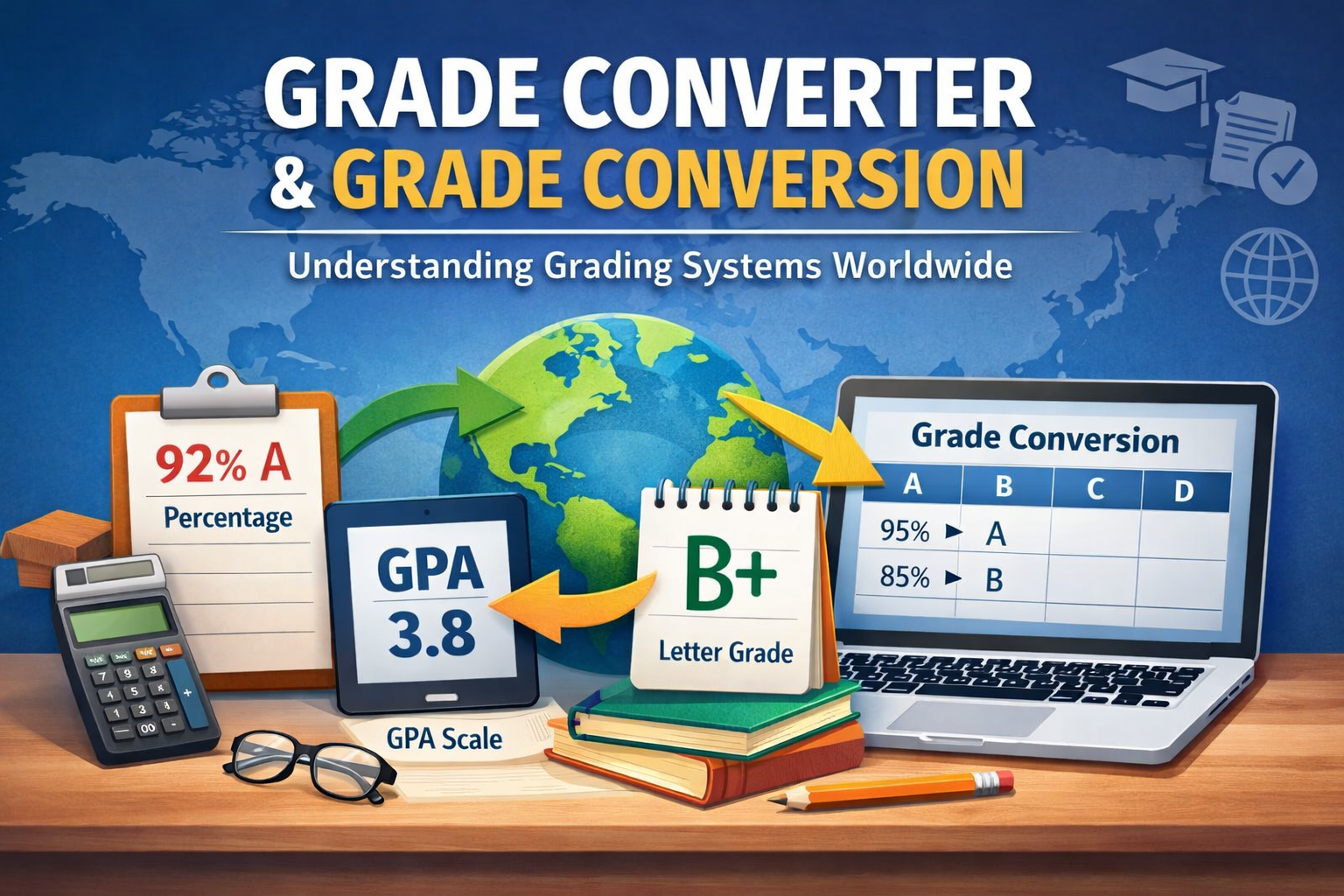
In today’s global academic environment, students often study, transfer, or apply for opportunities across different countries and institutions. Since each institution follows its own grading structure, understanding scores can become confusing. This is where a grade converter plays an important role by helping students and educators interpret academic results accurately.
This article explains what a grade converter is, how grade conversion works, why grade conversions are needed, and how grading system conversion simplifies academic comparisons.
What Is a Grade Converter?
A grade converter is a tool or method used to transform grades from one grading system into another. For example, it may convert letter grades (A, B, C) into percentage scores, GPA values, or international grading scales.
Since educational institutions around the world use different grading standards, grade conversion ensures consistency and clarity when comparing academic performance.
Why Grade Conversion Is Important
Grade conversion is essential for several academic and professional reasons:
-
Applying to international universities
-
Transferring between institutions
-
Understanding foreign transcripts
-
Meeting scholarship or admission criteria
-
Comparing performance across grading systems
Without proper grade conversions, students may misinterpret their academic standing or fail to meet eligibility requirements due to grading differences rather than actual performance.
Common Grading Systems Around the World
Different regions follow different grading systems, making grading system conversion necessary:
Percentage-Based System
Widely used in South Asia and many other regions, grades are expressed as percentages (e.g., 85%, 72%).
Letter Grade System
Common in the United States and Canada, this system uses letter grades such as A, B, C, D, and F.
GPA System
Grade Point Average (GPA) is often calculated on a 4.0, 5.0, or even 10.0 scale.
European Credit Transfer System (ECTS)
Used in Europe, ECTS grades range from A to F but follow different criteria than U.S. letter grades.
Because of these variations, a grade earned in one system does not directly match another without conversion.
How Grade Conversion Works
Grade conversion involves mapping a grade from one scale to another using standardized or institution-specific criteria. For example:
-
A percentage of 90–100% may convert to an A or 4.0 GPA
-
A B grade may translate to a GPA between 3.0 and 3.3
-
An ECTS grade of B might not be equal to a U.S. B
Accurate grading system conversion depends on:
-
The source grading scale
-
The target grading scale
-
Institutional or country-specific rules
Some universities publish their own conversion tables, while others rely on recognized conversion standards.
Manual vs Automated Grade Conversions
Manual Grade Conversion
Manual conversion involves using official tables or charts provided by universities or education boards. While accurate, this method can be time-consuming and confusing for students unfamiliar with multiple grading systems.
Automated Grade Converter Tools
Online grade converter tools simplify the process by automatically calculating converted grades. These tools reduce errors and save time, especially when dealing with multiple subjects or international grading scales.
In many cases, students also use a grade calculator alongside a grade converter to calculate averages or GPAs before converting them into another grading system.
Difference Between Grade Converter and Grade Calculator
Although often used together, these tools serve different purposes:
-
Grade Calculator: Helps calculate final grades, averages, or GPA from individual scores.
-
Grade Converter: Translates an already calculated grade into another grading system.
For example, a student may first calculate their GPA using a grade calculator and then apply grade conversion to convert that GPA into a percentage or international scale.
Who Uses Grade Conversion Tools?
Grade conversions are useful for:
-
Students applying to international universities
-
Transfer students changing institutions
-
Academic counselors and advisors
-
Scholarship committees
-
Employers reviewing academic records
Accurate grading system conversion ensures fairness and transparency in academic evaluations.
Limitations of Grade Conversions
While grade converters are extremely helpful, they do have limitations:
-
Conversion scales may vary by institution
-
Some grades do not have exact equivalents
-
Context such as course difficulty is not always considered
Because of this, universities sometimes evaluate transcripts holistically rather than relying solely on converted grades.
Tips for Accurate Grade Conversion
-
Always check the official conversion policy of the target institution
-
Use reliable grade converter tools
-
Combine grade conversion with official transcripts
-
When unsure, consult academic advisors
Using both a grade calculator and grade converter together can help ensure accurate academic representation.
Conclusion
A grade converter is an essential tool in modern education, helping students and institutions understand academic performance across different systems. Whether you are dealing with grade conversion, handling multiple grade conversions, or navigating grading system conversion, having clarity is crucial.
By using reliable conversion methods and understanding grading differences, students can confidently present their academic achievements anywhere in the world.

