

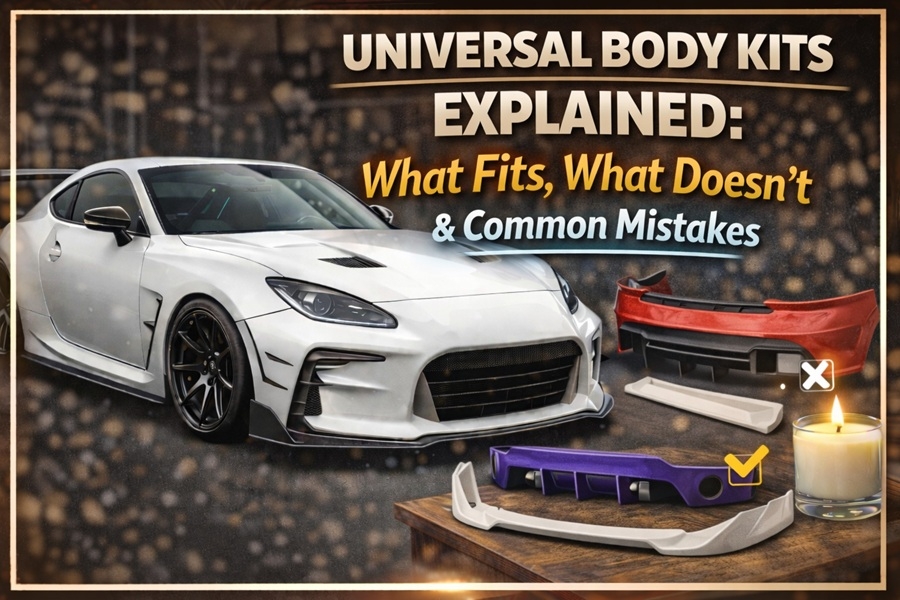
Universal Body Kits Explained: What Fits, What Doesn’t & Common Mistakes
A universal body kit sounds tempting. One kit, many cars. Lower price, easier availability. But the reality is far more complex. While manufacturers advertise these kits as fitting “most compact cars” or “common sedans,” the truth is that no two vehicles share identical bumper shapes, mounting points, or fender contours. Before you buy a universal body kit, understand exactly what fits, what doesn’t, and the costly mistakes to avoid. Overboost breaks it down for you.
What Is a Universal Body Kit?
A universal body kit is a set of exterior panels—typically front lips, side skirts, rear diffusers, or fender flares—designed without vehicle-specific molds. Instead of matching a particular car’s dimensions, these kits come with generic shapes and require cutting, heating, and custom fabrication to install. They are almost always made from flexible materials like polyurethane or fiberglass to allow modification. While the upfront cost is lower, the hidden labor expenses often exceed those of a vehicle-specific kit.
What Fits (Surprisingly Little)
In reality, very few cars accept a universal body kit without major work. The components that have the highest chance of fitting include:
-
Universal side skirts: These are long, straight pieces that can be trimmed to length and attached to most vehicles with adhesive or screws.
-
Universal lip spoilers: Simple rubber or polyurethane lips that bolt under the front bumper. They require cutting to match the bumper’s curve.
-
Universal fender flares: Flexible rubber or ABS arches that can be shaped around wheel wells. They never match perfectly but cover gaps with screws and sealant.
Beyond these, expect significant challenges. Front and rear bumpers labeled as “universal” almost never align with headlights, grilles, or crash bars.
What Doesn’t Fit (Most Things)
A full universal body kit including front and rear bumpers is a recipe for frustration. Here’s why:
-
Mounting points differ: Factory bumpers attach to specific brackets, clips, and holes. Universal bumpers have none of these.
-
Headlight and grille gaps: Even a 5mm difference in headlight shape creates ugly gaps that require custom fiberglass work.
-
Fender width mismatch: Universal front bumpers rarely match the exact width between fenders, leading to overhang or exposed edges.
-
Radiator support interference: Many universal bumpers block airflow or hit the crash bar.
Professional body shops routinely refuse universal bumper installations because customers refuse to pay the 20+ hours of custom fabrication required.
Common Mistakes When Buying a Universal Body Kit
Avoid these frequent errors:
-
Assuming “universal” means bolt-on: It does not. Expect cutting, heating, drilling, and custom brackets. You will need professional help.
-
Ignoring material quality: Cheap fiberglass universal body kit parts crack during modification. Polyurethane is more forgiving but still requires skill.
-
Forgetting paint and prep costs: Paint matching alone costs hundreds. Add body filler to smooth modified edges, and the bill rises further.
-
Skipping test fit: Always test fit before painting. Modify, then paint. Painting first guarantees ruined finish.
-
Overlooking legal compliance: Modified bumpers must retain factory safety features (fog lights, reflectors). A poorly fitted universal body kit may fail inspection.
Overboost’s Advice: When to Choose Universal
A universal body kit makes sense only for experienced DIY fabricators with access to heat guns, sanders, and fiberglass repair kits. For most drivers, a vehicle-specific kit costs less overall once you add professional modification labor. Overboost recommends universal side skirts or lip spoilers as beginner-friendly projects. Leave full bumpers to custom shops.
Conclusion
A universal body kit can work—but only with realistic expectations, serious fabrication skills, and a flexible budget. Most buyers regret the purchase after discovering hidden labor costs. Save yourself the headache: consult Overboost for fitment-verified kits designed specifically for your car.
Frequently Asked Questions (FAQs)
1. Can I install a universal body kit myself at home?
Yes, but only if you have experience with cutting, heating, and mounting. Universal side skirts and lip spoilers are DIY-friendly. Full bumpers require professional fabrication.
2. Will a universal body kit fit my specific car model?
Probably not without modification. “Universal” means it fits no car perfectly. Expect trimming, drilling, and custom brackets to achieve even a decent fit.
3. What is the best material for a universal body kit?
Polyurethane (PU) is best because it is flexible, heat-moldable, and impact-resistant. Fiberglass is brittle and cracks easily during modification.
4. Why do body shops refuse to install universal body kits?
Because the labor required to make a universal bumper fit often exceeds 20 hours. Customers are unwilling to pay that much, so shops decline the job.
5. Does Overboost sell universal body kits?
Overboost specializes in vehicle-specific kits with guaranteed fitment. However, we also offer select universal lip spoilers and side skirts for DIY enthusiasts, along with expert installation guidance.