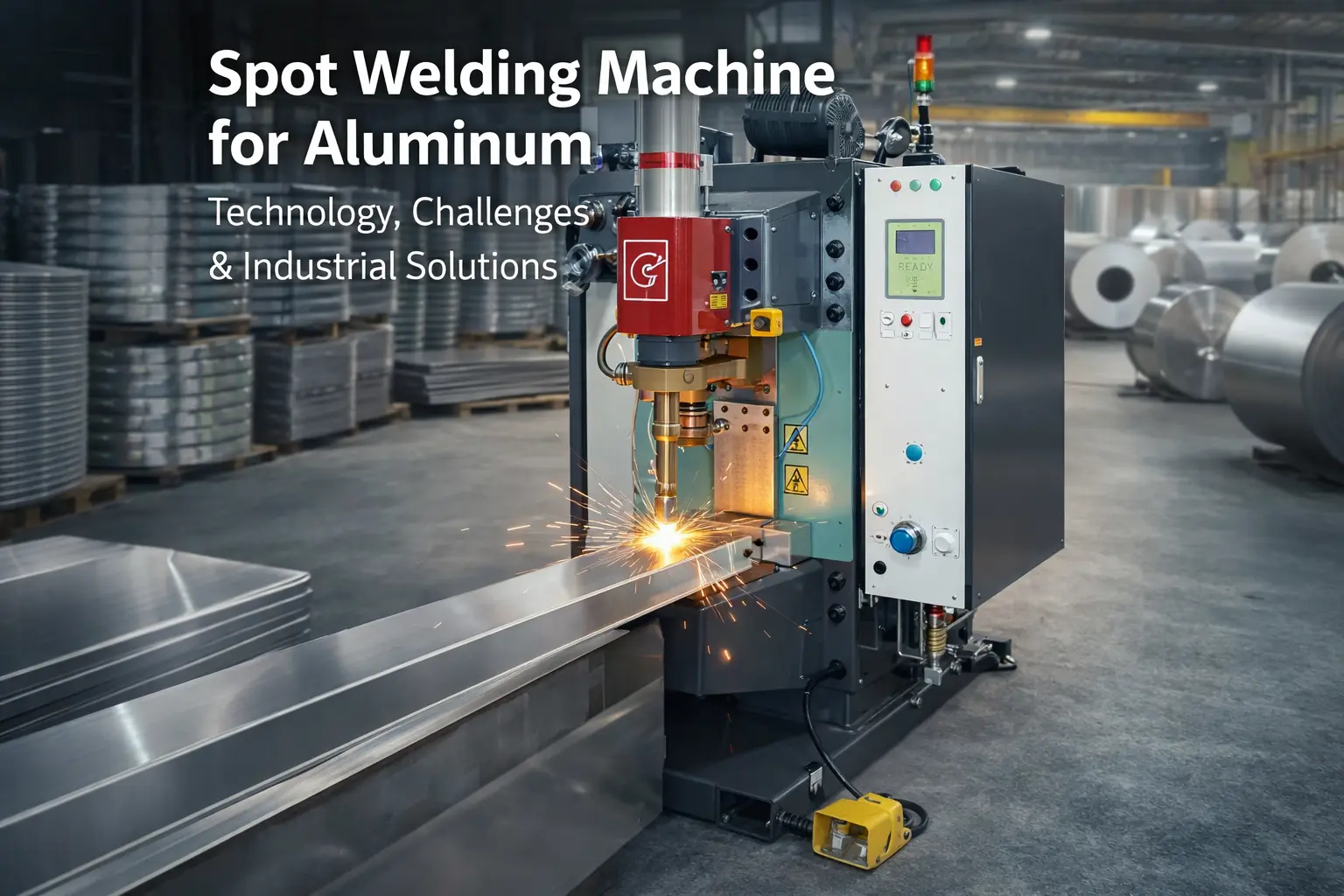
Aluminium has become one of the most important materials in modern manufacturing due to its lightweight structure, corrosion resistance, and high strength-to-weight ratio. However, when it comes to joining aluminium sheets, engineers often face a major challenge: spot weld aluminium effectively and consistently in high-volume production.
For OEMs, automotive manufacturers, and industrial fabricators, achieving reliable aluminium spot welding is not just about selecting the right machine it requires deep control over process parameters, advanced resistance welding technology, and application-specific system design.
In this guide, we explore the principles, challenges, applications, and best practices of aluminium spot welding, and how advanced systems from Heron Welder help manufacturers achieve stable, high-quality welds in demanding production environments.
What is Spot Welding Aluminium?
Spot welding aluminium is a resistance welding process in which two or more aluminium sheets are joined by applying pressure and passing a high electrical current through the contact point.
The heat generated by electrical resistance melts the aluminium interface, forming a fusion weld nugget upon cooling.
However, compared to steel, aluminium behaves very differently in resistance welding due to:
- High electrical conductivity
- Low melting point
- Strong oxide layer on surface
- High thermal conductivity
These properties make aluminium significantly more difficult to spot weld using conventional methods.
Why Aluminium is Difficult to Spot Weld
Understanding the challenges is essential before optimizing any production process.
1. Oxide Layer Formation
Aluminium naturally forms a hard oxide layer (Al₂O₃) almost instantly when exposed to air. This layer:
- Has a very high melting point
- Acts as an electrical barrier
- Reduces current flow efficiency
2. High Electrical Conductivity
Aluminium dissipates current rapidly, making it harder to generate localized heat at the weld point.
3. Heat Dissipation
Because aluminium has high thermal conductivity, heat spreads quickly, requiring:
- Higher current input
- Precise control of welding time
4. Electrode Wear
Aluminium tends to stick to electrodes, causing:
- Faster electrode degradation
- Increased maintenance cycles
- Inconsistent weld quality
How Spot Welding Aluminium Works in Industrial Systems
To successfully spot weld aluminium, manufacturers must use advanced resistance welding systems designed for high-current, short-duration energy delivery.
Key working principles include:
High Current, Short Time Welding
Aluminium requires:
- Very high welding current
- Extremely short welding cycles (milliseconds)
This minimizes heat diffusion and ensures proper nugget formation.
Force-Controlled Electrode Pressure
Consistent pressure ensures:
- Breakdown of oxide layer
- Stable electrical contact
- Reduced expulsion risk
Pulsed Welding Current (MFDC Technology)
Modern systems use Medium Frequency Direct Current (MFDC) technology, which offers:
- Better energy efficiency
- Improved control of heat input
- More stable weld formation
Essential Equipment for Spot Welding Aluminium
To achieve reliable aluminium spot welds in production environments, the following equipment features are critical:
1. MFDC Resistance Welding Systems
MFDC systems are widely preferred because they:
- Deliver stable current output
- Reduce energy loss
- Improve weld consistency on aluminium
2. High-Force Welding Guns
Servo or pneumatic guns provide:
- Precise force control
- Adjustable pressure profiles
- Better repeatability in automation lines
3. Advanced Welding Controllers
Modern controllers allow:
- Real-time monitoring of current, voltage, and resistance
- Adaptive welding programs
- Process data logging for quality assurance
4. Water-Cooled Electrodes
Efficient cooling prevents:
- Electrode deformation
- Excessive wear
- Thermal instability
Industrial Applications of Aluminium Spot Welding
Aluminium spot welding is widely used across multiple industries where lightweight and strength are essential.
Automotive Manufacturing
- Body-in-white assemblies
- EV battery enclosures
- Lightweight structural panels
Aerospace Industry
- Aircraft fuselage panels
- Interior structural components
- Lightweight support frames
Electrical and Energy Systems
- Busbars
- Enclosures
- Conductive assemblies
Consumer and Industrial Equipment
- HVAC housings
- Appliance frames
- Transport equipment panels
Best Practices for Spot Weld Aluminium
To achieve high-quality welds, manufacturers must carefully optimize the entire process chain.
1. Surface Preparation
Proper cleaning is critical:
- Remove oil, grease, and contamination
- Minimize oxide thickness where possible
- Use controlled pre-cleaning systems
2. Optimized Welding Parameters
Key parameters include:
- Current magnitude
- Welding time
- Electrode force
- Cooling cycles
Even small variations can affect weld strength significantly.
3. Electrode Material Selection
Copper alloys such as:
- CuCrZr (Copper-Chromium-Zirconium)
are commonly used due to:
- High thermal conductivity
- Wear resistance
- Stability under high current loads
4. Adaptive Process Control
Advanced systems adjust welding conditions in real-time to:
- Compensate for material variation
- Maintain consistent nugget formation
- Reduce defect rates
5. Monitoring and Quality Control
Inline monitoring ensures:
- Weld consistency verification
- Early detection of anomalies
- Reduced scrap rates
Spot Welding Aluminium vs Steel
Aluminium and steel behave very differently under resistance welding conditions.
| Factor |
Aluminium |
Steel |
| Electrical Conductivity |
High |
Low |
| Heat Requirement |
Higher current |
Lower current |
| Weld Time |
Shorter |
Longer |
| Electrode Wear |
Higher |
Lower |
| Process Stability |
More complex |
More stable |
This comparison highlights why aluminium requires more advanced equipment and tighter process control.
How Heron Supports Aluminium Spot Welding Solutions
Modern industrial production demands more than just a welding machine—it requires a fully integrated solution.
Heron Welder specializes in advanced resistance welding technologies designed for high-performance materials like aluminium.
Their solutions include:
- MFDC spot welding systems optimized for aluminium applications
- Servo-controlled welding guns for precise force application
- Automated welding production lines for OEM manufacturing
- Integrated controllers for real-time process monitoring
- Custom-engineered systems for EV, automotive, and industrial applications
By combining automation with intelligent control systems, Heron enables manufacturers to achieve:
- Higher production efficiency
- Improved weld consistency
- Reduced electrode wear
- Lower operational costs
Frequently Asked Questions (FAQs)
1. Can aluminium be spot welded like steel?
Yes, but it requires higher current, precise control, and specialized MFDC resistance welding equipment due to aluminium’s conductivity and oxide layer.
2. Why is aluminium spot welding more difficult?
Aluminium dissipates heat quickly and forms an insulating oxide layer, making consistent weld formation more challenging than steel.
3. What is the best method for spot welding aluminium in production?
MFDC resistance welding systems with controlled force, short cycle times, and water-cooled electrodes are considered the most effective.
4. What industries commonly use aluminium spot welding?
Automotive, aerospace, EV manufacturing, HVAC systems, and industrial electrical applications commonly use aluminium spot welding.
5. How can weld quality be improved in aluminium spot welding?
Improving surface preparation, optimizing welding parameters, using adaptive controllers, and maintaining electrode condition significantly improves quality.
Conclusion
Spot welding aluminium is a highly technical process that demands precision engineering, advanced control systems, and optimized resistance welding technology. While the material presents challenges such as oxide formation, high conductivity, and heat dissipation, modern MFDC-based systems make stable and repeatable welding achievable in large-scale production.
For manufacturers seeking reliable, high-performance aluminium joining solutions, partnering with an experienced technology provider is essential.
Request a Custom Solution
If you are looking to improve aluminium spot welding performance, increase production efficiency, or develop a fully automated welding line, Heron Welder can support your project with customized industrial solutions tailored to your production needs.
Contact Heron to request a quote or consultation for advanced resistance welding and automation systems.