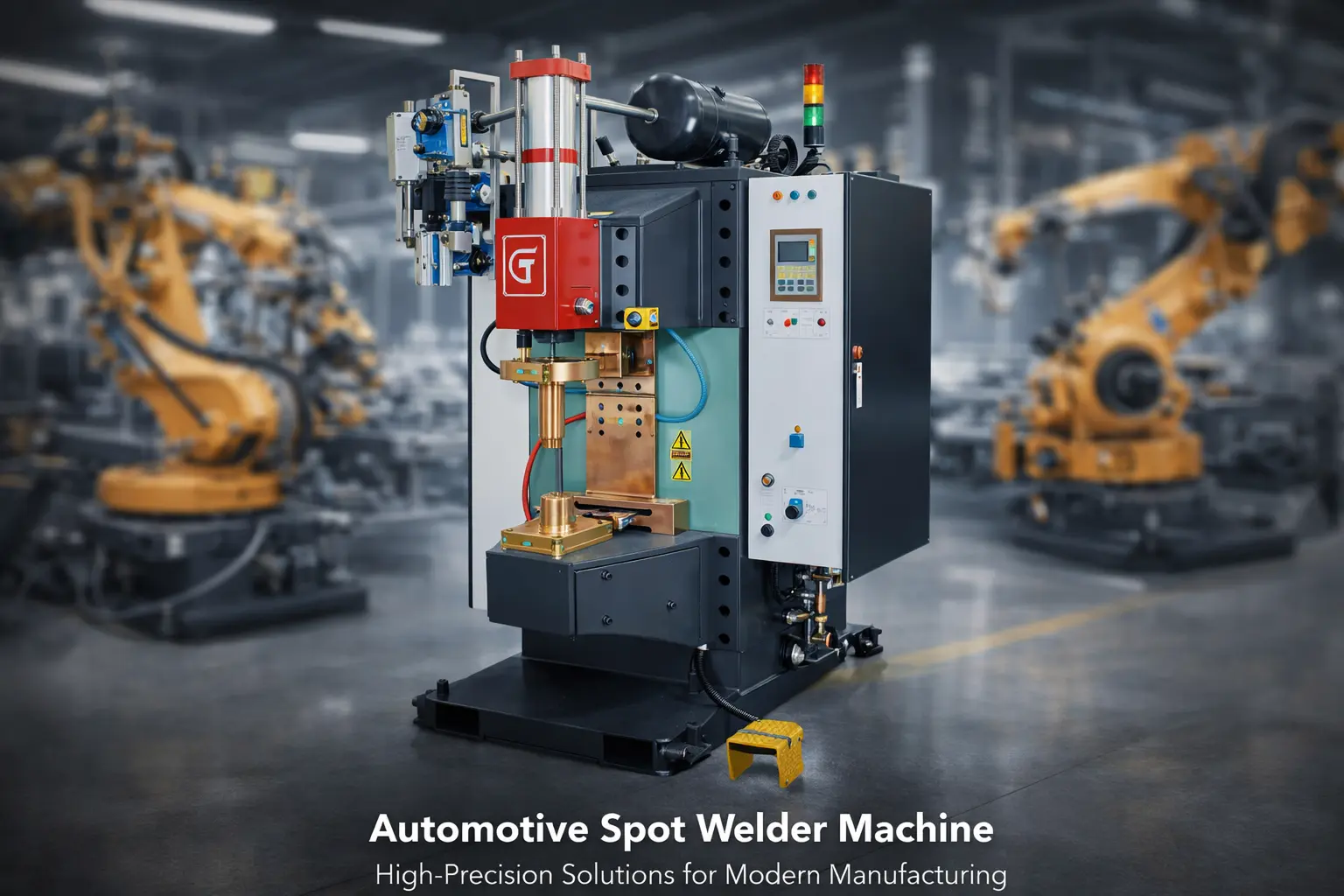
In modern automotive manufacturing, precision, speed, and repeatability define production success. One of the most critical joining technologies enabling this efficiency is the automotive spot welder. From body-in-white (BIW) assembly to structural reinforcements and battery pack manufacturing in EVs, spot welding remains a core process in high-volume vehicle production.
This article explains how automotive spot welders work, their industrial applications, selection criteria, and how advanced welding solutions are transforming automotive production lines. It also highlights how manufacturers like Heron Welder support OEMs and Tier 1 suppliers with high-performance resistance welding and automation systems.
What Is an Automotive Spot Welder?
An automotive spot welder is a resistance welding machine designed to join overlapping metal sheets by applying:
High electrical current
Localized pressure through copper electrodes
Short welding time cycles
The heat generated at the interface melts a small area (weld nugget), fusing the metals together without filler material.
Key Principle: Resistance Heat Generation
The process is based on Joule heating:
H = I² × R × t
Where:
H = heat generated
I = welding current
R = electrical resistance of the material interface
t = time duration
This simple but powerful principle allows fast, clean, and repeatable welds—ideal for automotive mass production.
Why Spot Welding Is Essential in Automotive Manufacturing
Automotive structures consist of hundreds of sheet metal joints that must meet strict strength and safety requirements. Spot welding is preferred because it offers:
1. High Production Speed
Cycle times are extremely short, making it suitable for assembly lines producing hundreds of vehicles per shift.
2. Strong and Reliable Joints
Each weld nugget forms a localized fusion zone with high mechanical strength, critical for crash safety structures.
3. Automation Compatibility
Automotive spot welders integrate seamlessly with robotic arms, enabling fully automated body welding lines.
4. Cost Efficiency
No filler materials, minimal surface preparation, and low consumable costs reduce overall manufacturing expenses.
Types of Automotive Spot Welding Systems
Different production environments require different welding technologies. The most commonly used systems include:
1. AC Spot Welding Systems
Traditional systems using alternating current. Suitable for general automotive sheet metal applications but less precise for advanced alloys.
2. MFDC Spot Welders (Medium Frequency DC)
MFDC systems are widely used in modern automotive factories due to:
Higher energy efficiency
Better weld consistency
Reduced heat distortion
Improved control over different materials
3. Servo Spot Welding Guns
These systems offer precise electrode force control, making them ideal for high-strength steels and mixed material joints.
4. Capacitor Discharge Spot Welders
Used for thin materials and applications requiring extremely short energy bursts.
Automotive Applications of Spot Welding
The automotive spot welder plays a central role in multiple production stages:
Body-in-White (BIW) Assembly
Door panels
Roof structures
Side frames
Floor assemblies
Spot welding ensures structural rigidity and crash resistance.
Chassis and Structural Components
High-strength steels are joined to ensure durability under dynamic loads.
Electric Vehicle Battery Packs
EV production uses spot welding for:
Battery module assembly
Nickel strips and tabs
Aluminum or copper connections
Interior and Secondary Components
Seat frames, brackets, and support structures also rely on spot welding for cost-effective joining.
Key Factors Affecting Spot Welding Quality
For automotive-grade welds, process control is critical. Key parameters include:
Welding Current
Higher current increases heat but must be controlled to avoid burn-through.
Electrode Force
Proper pressure ensures consistent contact resistance and prevents spatter.
Weld Time
Short cycles improve productivity, but insufficient time weakens weld strength.
Material Type and Thickness
Advanced high-strength steels (AHSS) and aluminum require adjusted parameters.
Electrode Condition
Worn electrodes reduce weld quality and increase defect rates.
Common Welding Defects in Automotive Spot Welding
Even in automated systems, defects can occur if parameters are not optimized:
Expulsion (metal spatter due to excessive heat)
Undersized weld nugget
Electrode sticking
Cracking in high-strength steel
Inconsistent weld penetration
Advanced monitoring systems and adaptive controllers are used to minimize these issues in modern production environments.
Automotive Spot Welder vs Other Joining Methods
Spot Welding vs MIG Welding
Spot welding: faster, automation-friendly
MIG welding: better for thick structures but slower
Spot Welding vs Laser Welding
Spot welding: cost-effective, widely adopted
Laser welding: higher precision but expensive and complex
Spot Welding vs Mechanical Fastening
Spot welding: permanent, lightweight joints
Fastening: removable but adds weight and cost
For high-volume automotive production, spot welding remains the most balanced solution in terms of speed, cost, and reliability.
Advanced Trends in Automotive Spot Welding
The automotive industry is evolving rapidly, and spot welding technology is advancing with it.
1. Smart Welding Systems
AI-based controllers adjust parameters in real time to maintain weld quality.
Modern vehicles combine steel, aluminum, and coated materials requiring adaptive welding control.
4. Energy-Efficient MFDC Technology
New-generation MFDC systems significantly reduce power consumption in large-scale plants.
How Manufacturers Choose the Right Automotive Spot Welder
OEMs and Tier 1 suppliers consider several factors:
Production volume requirements
Material types and thickness range
Automation level (manual, semi-auto, robotic)
Energy efficiency targets
Maintenance and electrode lifecycle costs
Integration with existing production lines
A reliable supplier must also provide engineering support, process optimization, and customized system design.
This is where Heron Welder plays a key role by offering tailored resistance welding systems designed for automotive mass production environments.
Why Advanced Spot Welding Solutions Matter for OEMs
In automotive manufacturing, even small inconsistencies can lead to structural failure or costly recalls. Advanced automotive spot welders provide:
Higher weld consistency across production shifts
Reduced downtime through predictive maintenance
Improved quality traceability
Compatibility with Industry 4.0 systems
Enhanced productivity per production line
As automotive design becomes lighter and more complex, welding technology must evolve accordingly.
FAQs About Automotive Spot Welders
1. What materials can an automotive spot welder join?
Automotive spot welders can join mild steel, high-strength steel, stainless steel, and in some cases aluminum with specialized settings and electrodes.
2. How strong is a spot weld in automotive applications?
A properly formed weld nugget can match or exceed the strength of the base material, depending on material thickness and welding parameters.
3. Can spot welding be used in electric vehicle production?
Yes, spot welding is widely used in EV battery packs, structural frames, and electrical connections.
4. What is the difference between MFDC and AC spot welding?
MFDC offers better control, energy efficiency, and weld consistency compared to traditional AC systems.
5. How often do electrodes need replacement?
Electrode life depends on usage, material type, and maintenance practices, but regular dressing is required to maintain weld quality.
Conclusion
The automotive spot welder remains a cornerstone of modern vehicle manufacturing, enabling fast, reliable, and cost-effective joining of sheet metals. With increasing demands for lightweight structures, electric vehicle production, and automation, spot welding technology continues to evolve toward smarter, more efficient systems.
Manufacturers seeking higher productivity, consistent weld quality, and scalable automation solutions can benefit from advanced resistance welding technologies engineered for industrial performance.
For customized automotive spot welding systems, automation integration, or production line optimization, consult Heron Welder to explore tailored solutions designed for modern automotive manufacturing challenges.