


6 Signs Your Business Needs Third-Party Integration Services
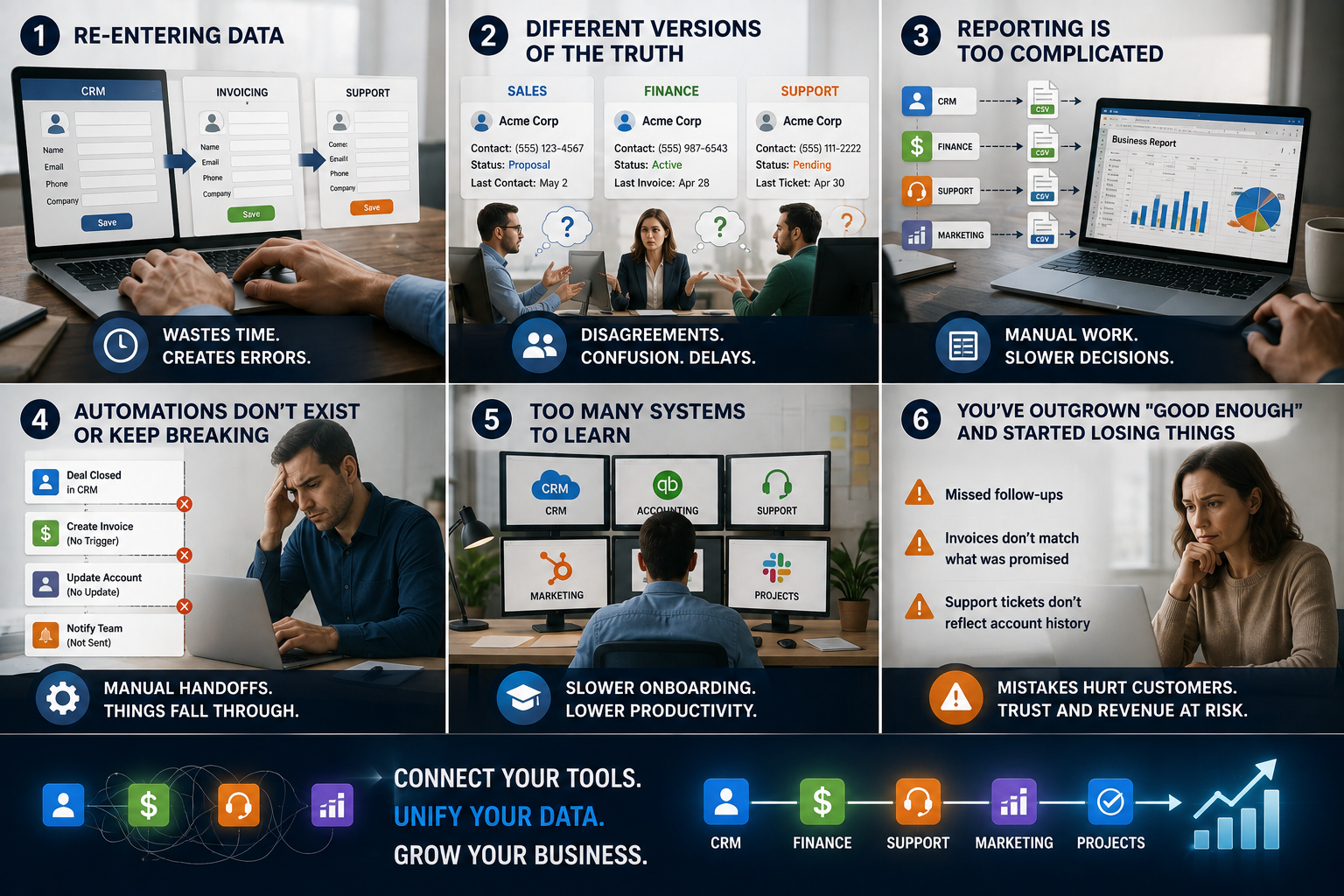
Most businesses don't set out to run on a patchwork of disconnected software. It happens one tool at a time a CRM here, an accounting platform there, a support desk added later each one solving a real problem in isolation, until eventually nobody can say with confidence where the "real" version of a piece of customer data actually lives. Here are six signs that patchwork has started costing more than it's saving.
1. Your Team Re-Enters the Same Data in Multiple Systems
If a new customer's details get typed into your CRM, then typed again into your invoicing tool, then typed a third time into your support platform, you're not just wasting time you're creating multiple opportunities for the same record to drift out of sync with itself. Integration exists specifically to eliminate this kind of redundant manual entry.
2. Different Departments Are Working From Different Versions of the Truth
When sales, finance, and support each pull from their own disconnected system, it's common for each department to have a slightly different picture of the same customer relationship different contact details, different deal status, different history. Disagreements over "whose numbers are right" are often a symptom of a data integration gap, not a communication problem.
3. Reporting Requires Manually Combining Exports From Several Tools
If building a single business report means exporting data from three or four separate platforms and manually combining them in a spreadsheet, that's a strong sign your tools were never designed to work together in the first place and that gap tends to get more painful as the business grows, not less.
4. Automations Keep Breaking or Simply Don't Exist
Businesses running on disconnected tools often end up automating almost nothing between systems, because there's no reliable connection to automate across. A new deal closing in the CRM doesn't automatically trigger an invoice. A support ticket doesn't automatically update the customer's account status. Every handoff between systems becomes a manual task someone has to remember to do.
5. Onboarding a New Employee Means Teaching Them Five Different Systems
When new hires have to learn to log into and manually cross-reference several disconnected platforms just to do their job, that's a real (if often invisible) productivity cost that compounds every time someone joins the team.
6. You've Outgrown "Good Enough" and Started Losing Things
Missed follow-ups, invoices that don't match what sales promised, support tickets that don't reflect a customer's actual account history these are the moments businesses usually notice integration gaps aren't just an efficiency issue anymore, but something actively causing customer-facing mistakes.
None of these six signs mean the individual tools your business is using are wrong choices most businesses land on genuinely good software for each specific function. The gap is almost always in how (or whether) those tools are actually connected to each other. Getting integrations built correctly, so data moves automatically and accurately between systems instead of depending on someone remembering to update it manually, is specialized work that's easy to underestimate until it's attempted which is where experienced API and third-party integration specialists like the team at Zilltech tend to save businesses far more time than the setup itself costs.
The businesses that get the most value from integration work usually approach it the same way: mapping out exactly where data needs to flow and why, before touching any configuration rather than connecting tools reactively, one frustration at a time.

