


From Fitness Tracking to Diagnostics, AI Is Changing Wearable Technology
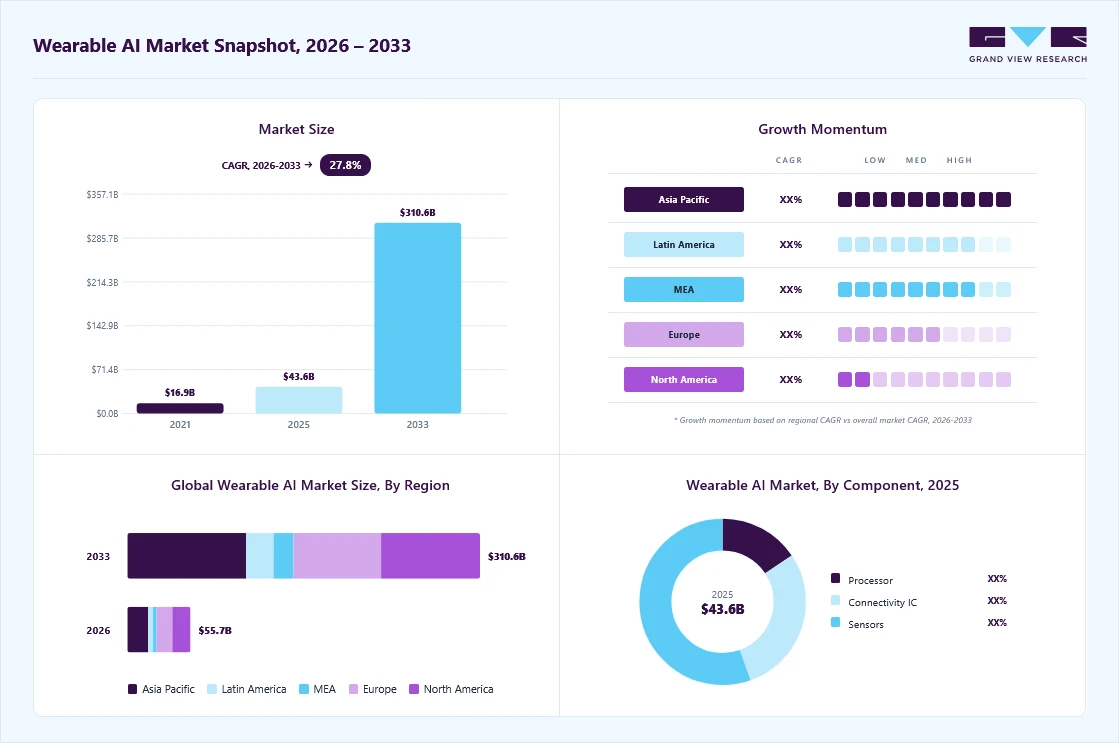
The wearable AI market is developing rapidly as artificial intelligence becomes increasingly integrated into smartwatches, fitness bands, hearables, smart eyewear, and emerging wearable devices. The technology is moving beyond basic activity tracking toward personalized insights, health monitoring, intelligent assistance, and enterprise applications. The market was valued at USD 34.16 billion in 2025 and is expected to grow from USD 43.64 billion in 2026 to USD 270.66 billion by 2033, registering a CAGR of 29.9% from 2026 to 2033.
Key Market Segments & Form Factors
Smartwatches & Fitness Bands: Largest form factor segment, supported by widespread consumer adoption and expanding health and fitness capabilities.
Smart Earwear (Hearables): Growing through AI-enabled audio, voice interaction, health monitoring, and personalized user experiences.
Smart Eyewear & AR Glasses: Emerging through augmented reality, hands-free information access, visual assistance, and enterprise applications.
Emerging Form Factors: Expanding through innovative wearable designs that integrate AI into everyday activities and specialized use cases.
The diversity of wearable form factors is creating a broader ecosystem for artificial intelligence. Instead of concentrating AI capabilities in smartphones and computers, manufacturers are embedding intelligent processing into devices that remain continuously connected to users.
From Tracking to Diagnostics
One of the most important shifts in wearable AI is the transition from simple tracking toward more sophisticated health and wellness capabilities. Earlier wearable devices primarily focused on steps, calories, sleep, and basic activity measurements. AI is now helping transform collected information into personalized insights and actionable recommendations.
AI-powered wearables can analyze patterns in continuously generated data and provide users with more meaningful interpretations. This creates opportunities for applications involving wellness, fitness, preventive monitoring, and personalized health management.
The increasing focus on health and wellness is therefore strengthening demand for intelligent wearable devices. Consumers are looking for products that can provide more than numerical measurements, while technology companies are exploring ways to make wearable data increasingly useful.
Enterprise & Corporate Wellness
Wearable AI is also finding opportunities beyond individual consumers. Businesses are increasingly interested in technologies that can support employee wellness, productivity, safety, and engagement. Corporate wellness programs can use wearable devices to encourage healthier behaviors and provide insights into employee activity.
In enterprise environments, smart glasses and other wearable technologies can support hands-free workflows, remote assistance, training, field operations, and access to digital information. These applications are expanding the potential market beyond conventional fitness and consumer electronics.
Regional Landscape
Regional adoption is influenced by technology infrastructure, consumer awareness, healthcare digitization, disposable income, and the presence of major technology companies. Markets with strong consumer electronics ecosystems are particularly positioned to benefit from the integration of AI into wearable products.
Developed markets are supporting adoption through strong demand for smart devices, connected health technologies, and premium consumer electronics. Meanwhile, emerging markets are creating new opportunities as smartphone penetration, digital services, and awareness of wearable technologies continue to expand.
The growing availability of AI-enabled products across different price categories could further broaden adoption and bring intelligent wearable experiences to a wider consumer base.
Prevalent Market Challenges
· Data Security & Privacy
Wearable AI devices continuously generate sensitive information, particularly when used for health, location, behavioral, and biometric applications. Protecting this information is therefore a major challenge for manufacturers and technology providers.
As wearables become more intelligent and collect increasingly detailed personal information, companies need robust approaches to data security, privacy protection, user consent, and responsible data management. Consumer trust will remain important for sustained adoption.
· Hardware Constraints
Wearable devices face limitations related to size, battery capacity, processing power, connectivity, and heat management. Integrating sophisticated AI capabilities into compact devices can therefore be technically challenging.
Manufacturers must balance advanced functionality with comfort, battery life, affordability, and reliability. Improvements in processors, sensors, energy efficiency, and edge AI capabilities could help overcome some of these limitations.
FAQ’s
1. What trends are shaping the wearable AI market?
The market is being shaped by the shift from basic activity tracking toward AI-powered health insights, personalized experiences, enterprise wellness, smart eyewear, hearables, and emerging wearable form factors.
2. What challenges are affecting the wearable AI market?
Data security and privacy concerns, along with hardware constraints involving battery life, processing power, device size, and heat management, remain important challenges.
Key Wearable AI Companies:
· Samsung Electronics Co. Ltd.
· Meta
· Fitbit, Inc. (Google, Inc.)
· Garmin Ltd.
Explore our dedicated business services:
· Brainshare Consulting – End-to-end business consulting services including Opportunity assessment, GTM support, Competitive intelligence, and Consumer Analytics.
· Custom Research – Get a market intelligence report tailored to your specific requirements and aligned with your business goals.
· Consumer Insights – Capture real, evolving consumer sentiment and behavior to help you make data driven strategies.
· Horizon Databooks – Access the world’s largest portal of Market Reports & Statistics
· Investment Insights – Make investment decisions with data driven insights, powered by domain and technology
· Signal (Pricing Intelligence) - Commodity price intelligence to drives strategic advantage.
About us:
Grand View Research, a market research and consulting company, provides syndicated research reports, customized research reports, and consulting services. Grand View Research database is used by the world's renowned academic institutions and Fortune 500 companies to understand the global and regional business environment. Our database features thousands of statistics and in-depth analysis on 46 industries in 25 major countries worldwide.

