


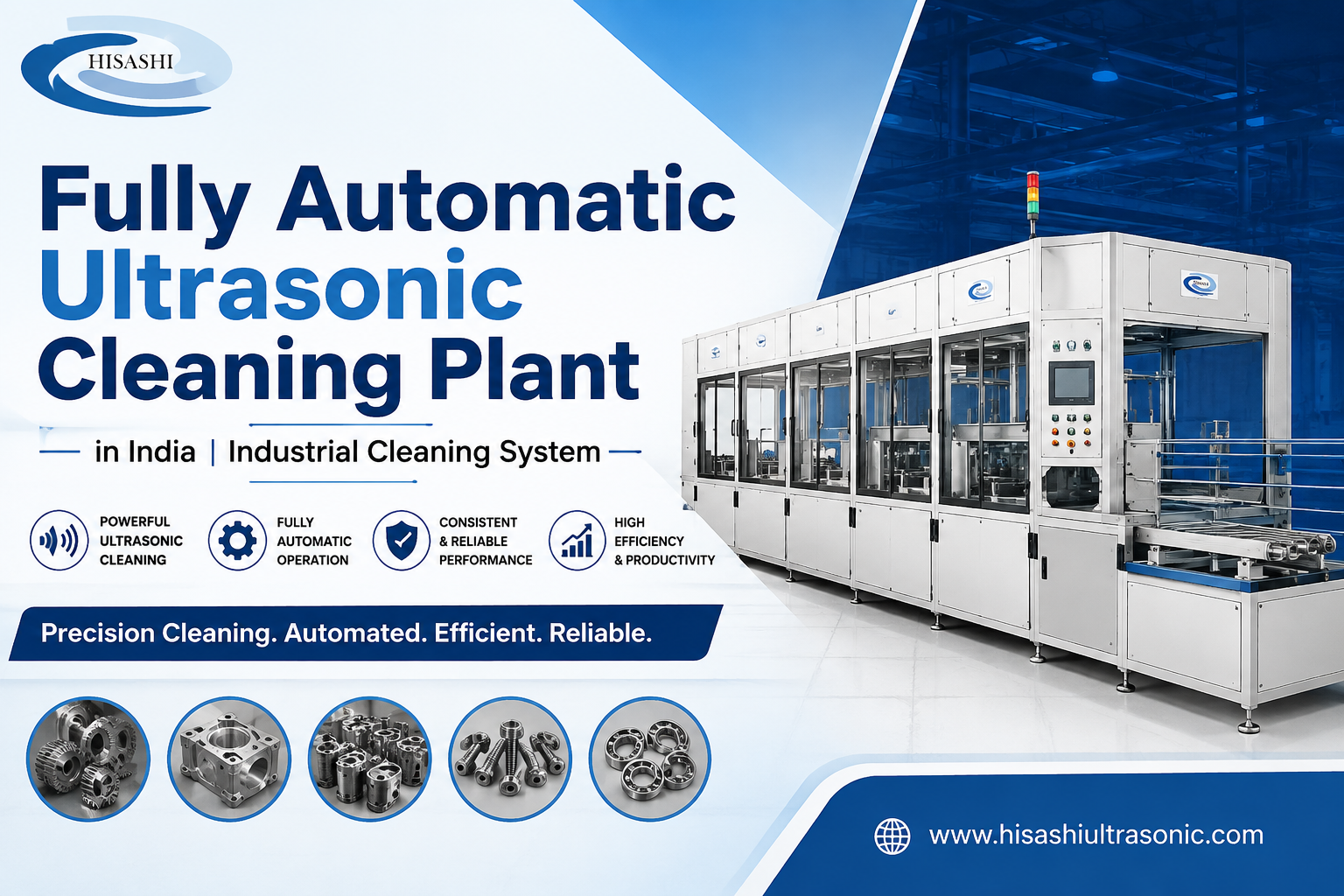
Fully Automatic Ultrasonic Cleaning Plant in India | Industrial Cleaning System
Every machined, moulded or fabricated component carries some trace of the process that made it — machining oil, cutting fluid, coolant residue, carbon, polishing compound, metal fines, or handling grease. Left uncleaned, these contaminants interfere with plating, coating, welding, assembly, inspection and final quality. For manufacturers who cannot afford inconsistent results between batches, cleaning cannot be left to chance or to operator technique alone.
A Fully Automatic Ultrasonic Cleaning Plant addresses this problem directly. It combines ultrasonic cavitation with automated material handling and programmable cleaning cycles to deliver controlled, repeatable and efficient component cleaning with minimal manual intervention. At Hisashi Ultrasonic, we design and manufacture these systems according to component geometry, contamination type, production volume and the specific cleaning process a manufacturer needs — rather than offering a single fixed configuration for every application.
What Is a Fully Automatic Ultrasonic Cleaning Plant?
A fully automatic ultrasonic cleaning plant is an industrial system built around ultrasonic cavitation — the formation and collapse of microscopic bubbles in a cleaning solution when ultrasonic energy passes through it. This cavitation action dislodges contaminants from component surfaces, including areas that are difficult to reach by hand.
What separates a fully automatic system from a standalone ultrasonic tank is the automation layer built around it:
-
Automated material or basket handling that moves components through the process stages without an operator physically transferring each batch
-
Controlled cleaning cycles, with parameters set for the application rather than adjusted manually each time
-
Rinsing stages that remove residual cleaning solution from component surfaces
-
Drying stages to prepare components for the next process step
-
Process repeatability, so the same cleaning result can be reproduced across shifts and operators
-
Reduced operator dependency, which lowers the risk of inconsistent cleaning caused by manual variation
In short, the ultrasonic cleaning technology does the cleaning; the automation ensures it happens the same way, every time.
How Does a Fully Automatic Ultrasonic Cleaning Plant Work?
While the exact configuration of an industrial ultrasonic cleaning system is customized to the application, most fully automatic ultrasonic cleaning plants follow a comparable process flow:
1. Loading
Components are loaded into baskets or fixtures designed for the part geometry and are introduced into the system, either manually at the loading station or through an automated infeed.
2. Ultrasonic Cleaning
Components move into the ultrasonic cleaning stage, where cavitation in the cleaning solution removes oil, grease, coolant residue, carbon and particulate contamination from accessible and hard-to-reach surfaces.
3. Rinsing
Rinsing stages remove residual cleaning solution from the component surface. Depending on the application, a second or cascading rinse stage may be used to achieve the required surface cleanliness.
4. Rust Prevention or Surface Treatment (Where Required)
For ferrous components that will not proceed immediately to the next process, an anti-rust or surface treatment stage can be incorporated to protect the cleaned surface during interim storage or transport.
5. Drying
Drying stages remove residual moisture, leaving components ready for plating, coating, assembly, inspection or packaging without introducing water marks or contamination.
6. Unloading
Cleaned and dried components exit the system for the next stage of production.
The number of stages, tank configuration and automation level within this process can be adjusted based on component requirements — a fully automatic ultrasonic cleaning machine for high-volume automotive components will typically be configured differently from one designed for delicate medical instruments.
Key Features of Our Fully Automatic Ultrasonic Cleaning Plant
-
Automated operation with reduced dependency on manual handling
-
Ultrasonic cleaning technology suited to industrial contamination types
-
Programmable cleaning cycles for process consistency
-
Controlled process parameters across cleaning, rinsing and drying stages
-
Automated component transfer between process stages
-
Multi-stage cleaning configuration, including rinsing and drying as required
-
Industrial-grade construction built for continuous production use
-
Custom tank and basket configuration based on component geometry
-
Consistent, repeatable cleaning performance across production batches
-
Optional advanced monitoring or automation features where the application calls for them
Benefits of a Fully Automatic Ultrasonic Cleaning Plant
For manufacturers evaluating whether to automate their cleaning process, the practical benefits typically include:
-
Consistent cleaning quality across batches, shifts and operators
-
Reduced manual intervention, freeing operator time for higher-value tasks
-
Improved production efficiency through a continuous, structured cleaning flow
-
Repeatable cleaning cycles that reduce variation between production runs
-
Better access to complex geometries, including blind holes and internal cavities
-
Lower dependency on manual cleaning skill and technique
-
Improved process control, supporting quality documentation and traceability
-
Suitability for high-volume production environments
-
Better surface preparation ahead of coating, plating, assembly or inspection
These outcomes depend on correctly matching ultrasonic frequency, power, cleaning chemistry and cycle time to the component and contamination involved — which is why system selection and configuration matter as much as the automation itself.
Precision Ultrasonic Cleaning Systems for Industrial Applications
Many industrial components are not simple shapes. Precision-engineered parts often include blind holes, internal grooves, cavities, fine threads, narrow passages and other complex geometries that are genuinely difficult to clean by hand — an operator's cloth or brush simply cannot reach every internal surface.
This is where Precision Ultrasonic Cleaning Systems are particularly valuable. Ultrasonic cavitation is generated throughout the cleaning solution, allowing it to act on internal and hard-to-reach surfaces in a way that conventional manual cleaning methods cannot consistently replicate. For industries such as CNC machining, aerospace, medical devices and electronics — where component tolerances and cleanliness requirements are strict — this level of access is often the deciding factor in choosing ultrasonic cleaning over manual methods.
Industries That Use Fully Automatic Ultrasonic Cleaning Plants
Automotive
Engine and transmission components, fasteners and machined parts often carry cutting oil, coolant and metal fines that must be removed before assembly, coating or inspection.
CNC & Precision Engineering
Machined components frequently retain cutting fluid, swarf and fine particulate in tight tolerances and internal features, where thorough manual cleaning is difficult to guarantee.
Aerospace
Aerospace components typically demand a high degree of cleanliness and process documentation ahead of inspection, coating or assembly, making repeatable automated cleaning valuable.
Electronics
Electronic components and assemblies can require the removal of flux residue, oils and particulate without damaging sensitive surfaces, calling for carefully controlled cleaning parameters.
Medical & Surgical Instruments
Medical and surgical instruments often require thorough, validated cleaning processes prior to sterilization, where consistency and repeatability are essential.
General Engineering
General engineering components across a range of production environments benefit from consistent removal of oils, grease and processing residues before the next production step.
Metal Components
Metal parts from stamping, forging, casting or machining processes often carry oils, buffing compounds or scale that need to be removed prior to further processing.
Components That Can Be Cleaned
Fully automatic ultrasonic cleaning plants are commonly used to clean components such as:
-
CNC machined components
-
Automotive components and engine parts
-
Precision metal components
-
Bearings
-
Valves
-
Medical and surgical instruments
-
Electronic components
-
Aerospace components
-
General engineering parts
Not every component is automatically suitable for the same cleaning process. The correct cleaning chemistry, ultrasonic frequency, power and cycle parameters depend on the component's material, geometry and the type of contamination involved, which is why system configuration is assessed on a case-by-case basis.
Why Choose Hisashi Ultrasonic?
Hisashi Industries is an experienced manufacturer and supplier of industrial ultrasonic cleaning equipment, working with manufacturers who need dependable, application-specific cleaning solutions rather than off-the-shelf machines. Our approach centres on:
-
Experience designing and manufacturing industrial ultrasonic cleaning systems
-
Customized cleaning solutions built around the component and application, not a fixed template
-
Application-based machine design, from tank and basket configuration to process stages
-
Multi-stage cleaning expertise across cleaning, rinsing and drying
-
A focus on precision cleaning for components with demanding geometries
-
Industrial-grade construction suited to continuous production environments
-
Automation capabilities matched to the required production volume
-
Technical support through the selection and configuration process
-
After-sales support for installed systems
-
Discussion of cleaning trials or sample evaluation where applicable to the application
Customized Fully Automatic Ultrasonic Cleaning Solutions
No two production lines have identical cleaning requirements. That is why Hisashi Ultrasonic approaches every fully automatic ultrasonic cleaning plant as a system to be configured, not a product to be sold off a catalogue page. Customization is considered across:
-
Component size and geometry
-
Type and level of contamination
-
Required production volume
-
Number of cleaning, rinsing and drying stages
-
Ultrasonic frequency and power requirements
-
Rinsing requirements, including single or cascading rinse stages
-
Drying method and requirements
-
Level of automation appropriate to the operation
-
Integration with existing factory layout and production processes
This case-by-case configuration is one of the core strengths of working with an experienced ultrasonic cleaning plant manufacturer rather than adapting a standard machine to fit an unrelated process.
Fully Automatic vs Manual Ultrasonic Cleaning
|
Factor |
Manual Ultrasonic Cleaning |
Fully Automatic Ultrasonic Cleaning Plant |
|
Operator Involvement |
High — operator transfers components between stages |
Low — automated handling between process stages |
|
Process Consistency |
Can vary with operator technique and attention |
Programmable cycles support consistent results |
|
Production Throughput |
Limited by manual handling speed |
Suited to continuous, higher-volume production |
|
Repeatability |
Depends on operator consistency |
Cycle parameters repeat the same way each time |
|
Material Handling |
Manual transfer between tanks |
Automated basket/material transfer |
|
Process Control |
Operator-dependent |
System-controlled parameters across stages |
|
Suitability for Mass Production |
Better suited to low-volume or occasional cleaning |
Designed for sustained, high-volume production |
Neither approach is universally "better" — the right choice depends on production volume, budget, component complexity and how central consistent cleaning quality is to downstream processes such as coating, plating or assembly.
How to Select the Right Fully Automatic Ultrasonic Cleaning Plant
Choosing the right industrial ultrasonic cleaning system starts with understanding the application in detail. Before finalizing a configuration, buyers should consider:
-
Component material — different metals and materials respond differently to cleaning chemistry
-
Component dimensions and weight — these determine tank size and basket/fixture design
-
Contamination type — oil, coolant, carbon, polishing compound or particulate each require appropriate cleaning parameters
-
Production quantity — batch size and daily throughput influence automation level and tank configuration
-
Required cleaning level — cleanliness standards vary by downstream process and industry
-
Number of cleaning and rinsing stages needed to achieve the required result
-
Drying requirements based on the next production step
-
Available floor space for the system within the existing production layout
-
Automation requirements, from semi-automatic transfer to fully automated handling
-
Cleaning chemistry appropriate to the component and contamination
-
Future production requirements, so the system remains suitable as volumes change
We recommend sharing component drawings, contamination details and production requirements before finalizing a system, so the configuration can be matched to the actual application rather than a generic specification.
Frequently Asked Questions
1. What is a Fully Automatic Ultrasonic Cleaning Plant?
It is an industrial cleaning system that uses ultrasonic cavitation together with automated material handling and programmable cleaning cycles to remove contaminants from components with minimal manual intervention.
2. How does an automatic ultrasonic cleaning plant work?
Components move automatically through loading, ultrasonic cleaning, rinsing and drying stages, with cavitation in the cleaning solution removing contamination from component surfaces, including hard-to-reach areas.
3. What types of components can be cleaned?
CNC machined parts, automotive and engine components, bearings, valves, medical instruments, electronic components, aerospace parts and general engineering components are commonly cleaned, with the exact process depending on the component.
4. What contaminants can ultrasonic cleaning remove?
Machining oil, cutting fluid, coolant residue, grease, carbon deposits, polishing and buffing compounds, and fine metal particles are typical contaminants addressed by ultrasonic cleaning.
5. Is a fully automatic ultrasonic cleaning plant suitable for mass production?
Yes. The automated handling and programmable cycles are designed to support consistent, repeatable cleaning across high-volume production runs.
6. Can the cleaning plant be customized?
Yes. Tank configuration, number of stages, basket and fixture design, and automation level can be adapted to the component, contamination type and production volume.
7. What is the difference between ultrasonic cleaning and conventional cleaning?
Conventional manual cleaning depends on operator access and technique, which can vary between batches. Ultrasonic cleaning uses cavitation to act more uniformly across surfaces, including areas manual methods cannot easily reach.
8. Can ultrasonic cleaning reach blind holes and complex geometries?
Ultrasonic cavitation can reach blind holes, grooves, threads and narrow passages, provided the frequency, power and cleaning chemistry are correctly matched to the component and contamination.
9. How do I choose the right ultrasonic cleaning system for my components?
Selection depends on component material, size, contamination type, production volume, required cleaning and rinsing stages, drying needs, floor space and automation requirements. Sharing these details helps in identifying a suitable configuration.
10. Can Hisashi Ultrasonic provide a customized cleaning solution?
Yes. We design fully automatic ultrasonic cleaning plants based on component geometry, contamination type, production volume and process requirements, and can discuss a cleaning trial for specific applications.
Contact Hisashi Ultrasonic for Your Cleaning Requirement
Share your component details and cleaning requirements with Hisashi Ultrasonic to discuss a customized Fully Automatic Ultrasonic Cleaning Plant for your production process.
Whether you are evaluating a fully automatic ultrasonic cleaning plant for the first time or looking to upgrade an existing manual process, our team can help with:
-
Assessing your component cleaning requirements
-
Recommending a customized machine configuration
-
Production-volume and process assessment
-
Cleaning trials and sample testing
-
Automated cleaning plant requirements for new or expanding production lines
-
Multi-stage cleaning process design
Phone: +91 9871013815 Email: info@hisashiindustries.com
Website: hisashiultrasonic.com
Conclusion
For manufacturers who need consistent, repeatable and efficient component cleaning without relying on manual technique, a Fully Automatic Ultrasonic Cleaning Plant offers a practical path forward. By combining ultrasonic cavitation with automated handling and programmable cleaning cycles, these systems help reduce manual intervention, improve process control, and prepare components reliably for coating, plating, assembly or inspection.
At Hisashi Ultrasonic, every system is configured around the component, the contamination and the production volume it needs to serve. If your production process would benefit from a customized, automated ultrasonic cleaning solution, reach out to Hisashi Ultrasonic to discuss your requirements and take the next step toward a more consistent cleaning process.

