


Pharmaceutical Stability Chamber: Types, Specifications, Uses & Benefits
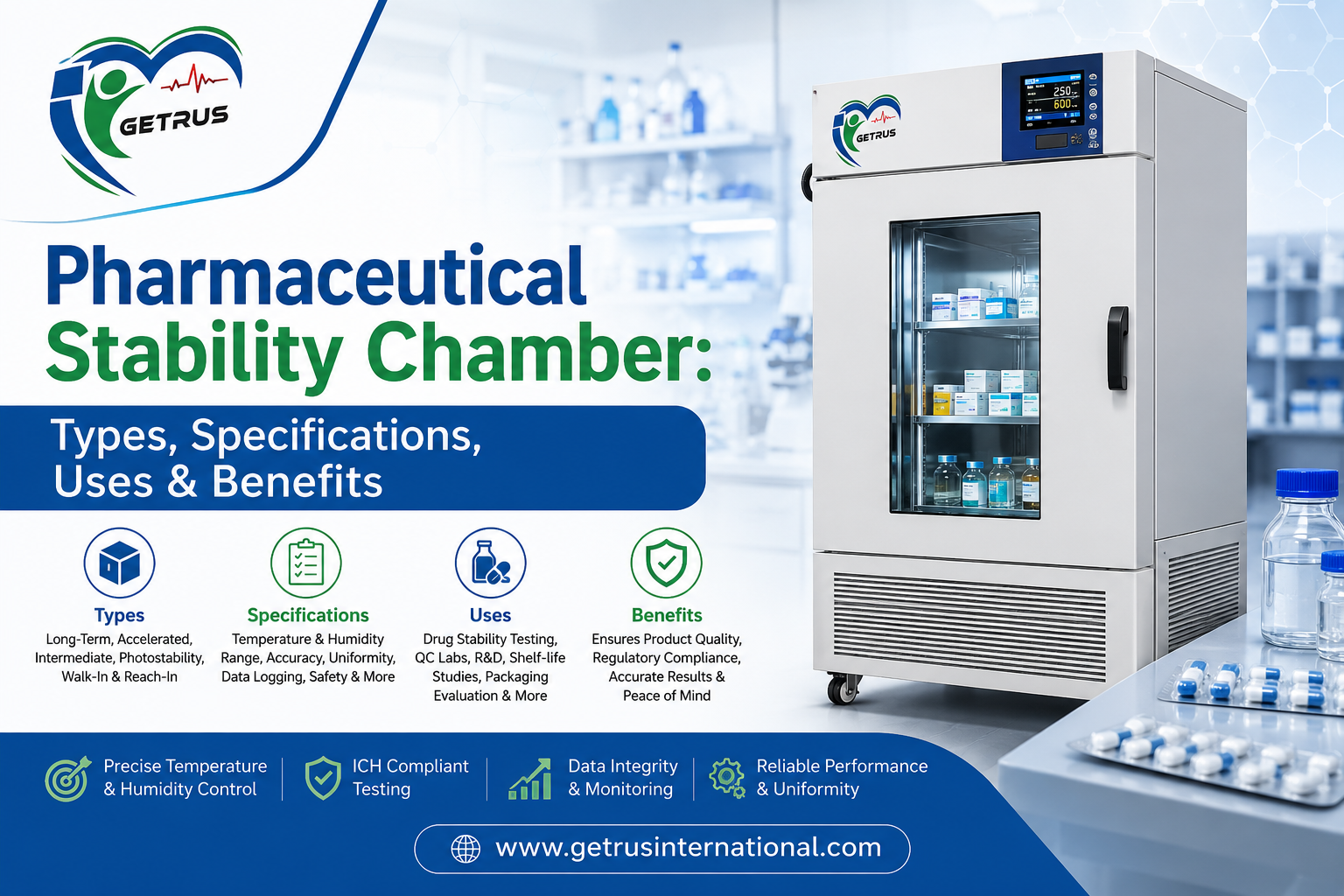
A pharmaceutical stability chamber is one of the most important pieces of equipment in a drug manufacturer's quality ecosystem. It doesn't produce a single tablet, capsule, or vial — yet nothing leaves a pharmaceutical facility for commercial distribution without first passing through one. By holding a formulation at precise, sustained temperature and humidity levels over weeks or months, a stability chamber reveals how a medicine will actually behave in the real world: on a warehouse shelf, inside a delivery truck, or in a patient's medicine cabinet.
For pharmaceutical companies, QC laboratories, R&D teams, and contract research organizations (CROs), the pharmaceutical stability chamber is the tool that turns a formulation into a product with a defined, defensible shelf life. This guide covers the different types of stability chambers available, the specifications that matter when evaluating one, their practical uses across the pharmaceutical industry, and the operational benefits they deliver to a laboratory.
What Is a Pharmaceutical Stability Chamber?
A pharmaceutical stability chamber is a controlled environmental testing unit designed to hold drug products, active pharmaceutical ingredients (APIs), biologics, or packaging materials at a fixed, closely monitored temperature and relative humidity for an extended period. Technicians place samples inside the chamber and withdraw them at scheduled intervals to test for potency, appearance, dissolution, moisture uptake, and impurity formation.
The core purpose is straightforward: find out how a pharmaceutical product degrades under known environmental stress before that product ever reaches a patient. Heat and humidity accelerate chemical reactions such as hydrolysis, oxidation, and moisture absorption — all of which can reduce a drug's potency or alter its physical characteristics. A pharmaceutical stability testing chamber exposes a product to these conditions in a controlled, repeatable way so the resulting data can be trusted.
This is fundamentally different from ordinary storage. A standard warehouse or refrigerator maintains an approximate condition for the purpose of keeping a product usable; a stability chamber maintains an exact, documented, and continuously logged condition for the purpose of generating scientific data. The difference lies in accuracy, uniformity, traceability, and the depth of monitoring — a distinction that becomes critical when that data is later reviewed internally or presented during a regulatory audit.
Because environmental conditions vary so much by climate zone, product type, and dosage form, laboratories rarely rely on a single fixed setting. Instead, a stability chamber — or a bank of chambers — is typically configured to run several different temperature and humidity profiles in parallel, depending on which stability study is underway.
How Does a Pharmaceutical Stability Chamber Work?
A pharmaceutical stability chamber works by combining precision environmental control with continuous monitoring. While designs vary between manufacturers , most stability test chambers rely on the same core components working together:
-
Temperature control system — A refrigeration or heating unit (or both) that raises or lowers the internal chamber temperature to a programmed setpoint.
-
Humidity control system — A humidification unit (often using a water reservoir) and a dehumidification mechanism that work together to hold relative humidity at the required level.
-
Forced-air circulation — Blowers distribute conditioned air evenly across every shelf, so a sample placed near the door experiences the same conditions as one placed at the back of the chamber.
-
Sensors — Calibrated temperature and humidity probes placed at multiple points inside the chamber continuously measure actual conditions.
-
Microprocessor-based controller — A digital controller compares sensor readings against the programmed setpoint and adjusts heating, cooling, humidification, or dehumidification in real time to correct any deviation.
-
Data logging system — Temperature and humidity readings are recorded at set intervals, building an auditable record for the entire duration of the study.
-
Alarm systems — High/low deviation alarms, door-open alarms, and sensor-failure alarms alert lab staff immediately if conditions drift outside the acceptable range, so an excursion doesn't go unnoticed for days.
Together, these systems allow a chamber to hold an exact environmental condition unattended, around the clock, for months or years — something that is simply not achievable with ordinary lab storage.
Types of Pharmaceutical Stability Chambers
Not every stability study calls for the same equipment. Pharmaceutical laboratories typically choose between several distinct chamber types depending on the study protocol, sample volume, and testing timeline. The exact temperature and humidity setpoint used for any of these should always be selected according to the applicable regulatory guideline and the specific stability protocol for the product being tested — the descriptions below are intended as a general orientation, not a substitute for a validated study design.
Long-Term Stability Chamber
A long-term stability chamber is used to generate real-time shelf-life data by holding a product at conditions that approximate normal storage over an extended period, often 12 months or longer. Because the chamber runs continuously for such a long duration, reliability, energy efficiency, and consistent uniformity become especially important. Long-term studies form the backbone of most shelf-life claims, since they reflect how a product genuinely behaves over time rather than a compressed or extrapolated estimate.
Accelerated Stability Chamber
An accelerated stability chamber deliberately exposes a product to elevated temperature and humidity for a shorter period — commonly around six months — to predict long-term degradation behavior more quickly. Pharmaceutical manufacturers rely on accelerated testing early in development, when a faster indication of a formulation's stability profile helps guide packaging decisions and formulation adjustments long before a full long-term study concludes.
Intermediate Stability Chamber
Intermediate testing sits between long-term and accelerated conditions and becomes necessary when a product shows "significant change" under accelerated conditions. Rather than assuming the product is unstable, an intermediate study evaluates it at a moderately elevated condition to determine whether the accelerated result was representative of real-world behavior or simply a product of the harsher test environment.
Photostability Chamber
Some active pharmaceutical ingredients and formulations degrade when exposed to light rather than heat or humidity. A photostability chamber applies controlled, defined light exposure — following the relevant photostability guideline — to assess whether a product needs light-protective packaging, amber glass containers, or specific storage instructions. This is a distinct testing requirement from standard temperature/humidity stability studies and is typically run using dedicated equipment or a chamber fitted with a photostability module.
Walk-In Stability Chamber
For pharmaceutical manufacturers running large-scale studies, testing multiple batches simultaneously, or supporting production-scale quality programs, a walk-in stability chamber provides room-sized capacity. These are effectively small, environmentally controlled rooms rather than cabinets, and are typically used by larger manufacturing facilities and centralized QC departments that need to store significant sample volumes across multiple active studies at once.
Reach-In Stability Chamber
A reach-in stability chamber is the compact, cabinet-style unit most commonly found in laboratory settings. It offers the same precision temperature and humidity control as a walk-in unit but in a smaller footprint suited to R&D labs, smaller QC departments, and facilities with limited floor space. For many pharmaceutical laboratories, reach-in chambers — often deployed as a bank of multiple units set to different conditions — are the practical entry point into stability testing infrastructure.
Pharmaceutical Stability Chamber Specifications
Choosing the right stability chamber means understanding which specifications actually matter for data integrity and regulatory readiness. The table below outlines the general categories a laboratory should evaluate. Exact figures vary by manufacturer and model, so always confirm specifications directly with the equipment supplier before finalizing a purchase.
|
Specification |
What to Look For |
|
Temperature range |
Wide enough to cover long-term, intermediate, and accelerated conditions without operating at the extreme edge of the chamber's capability |
|
Temperature accuracy |
Tight tolerance (commonly in the range of ±0.2°C on well-engineered units) to minimize deviation from setpoint |
|
Temperature uniformity |
Consistent conditions across all shelf positions, not just near the sensor |
|
Humidity range |
Broad enough to support both long-term (~60% RH) and accelerated (~75% RH) study conditions |
|
Humidity accuracy |
Tight tolerance, typically a few percentage points RH, maintained consistently over long durations |
|
Internal construction |
Corrosion-resistant interior, commonly stainless steel, that withstands continuous humidity exposure |
|
Insulation |
Thick, high-density insulation (such as PUF) in a double-walled structure to minimize thermal loss and energy consumption |
|
Air circulation |
Forced-air circulation via blowers for uniform distribution across shelves |
|
Controller |
Digital, microprocessor-based controller with fine-resolution display (commonly 0.1°C readability) |
|
Data logging |
Continuous, timestamped recording of temperature and humidity for audit-ready traceability |
|
Alarm system |
Door-open, high/low deviation, and sensor-failure alarms |
|
Door construction |
Sealed, well-gasketed door — often with an observation window — to minimize condition loss during sampling |
|
Shelves / load capacity |
Adjustable, corrosion-resistant shelving suited to the sample volume of your studies |
|
Power requirements |
Stable power supply appropriate to the chamber size, with backup power strongly recommended for long-duration studies |
|
Safety features |
Over-temperature protection, water-level monitoring, and electrical safety compliance |
|
Calibration |
Chamber and sensors should be calibrated before each study cycle and per the lab's quality system |
|
Monitoring |
Local display at minimum; remote or networked monitoring is increasingly expected for multi-chamber facilities |
When comparing suppliers, it helps to separate three distinct things: what the industry generally expects from pharmaceutical-grade equipment (the table above), what a specific manufacturer's chamber actually offers (which should be confirmed against their published specifications), and what a regulatory guideline requires for the test condition itself — covered next.
Standard Stability Testing Conditions
Regulatory guidance, most notably from the International Council for Harmonisation (ICH), describes a general framework for stability testing conditions. These are widely referenced starting points, not universal requirements — the condition actually used for a given product depends on the applicable ICH guideline (or a region-specific requirement), the dosage form, the intended market, and the approved stability protocol for that product.
|
Test Type |
Typical Temperature |
Typical Humidity |
Typical Duration |
Purpose |
|
Long-term |
25°C ± 2°C |
60% RH ± 5% |
12 months or more |
Real-time, real-world shelf-life data |
|
Intermediate |
30°C ± 2°C |
65% RH ± 5% |
6 months |
Used when significant change occurs under accelerated conditions |
|
Accelerated |
40°C ± 2°C |
75% RH ± 5% |
6 months |
Faster prediction of degradation behavior |
|
Photostability |
Defined light exposure per applicable guideline |
— |
Study-specific |
Evaluates light sensitivity of the product |
A few important caveats: some product categories and climate zones use different reference conditions than the ones shown above, biologics and certain temperature-sensitive products may require refrigerated or frozen study conditions instead, and the final protocol for any product should always be defined by the organization's quality and regulatory affairs teams — not assumed from a general reference table. A pharmaceutical stability chamber's role is to reliably hold whatever condition the approved protocol specifies.
Uses of a Pharmaceutical Stability Chamber
A pharmaceutical stability chamber is used well beyond a single "final test before launch." Typical applications include:
-
Drug formulation development — Testing how new formulations respond to environmental stress early in development, before significant investment in scale-up.
-
Pharmaceutical manufacturing — Supporting batch release and ongoing stability programs required for marketed products.
-
Quality control laboratories — Verifying that both raw materials and finished products continue to meet specification over time.
-
R&D laboratories — Evaluating new APIs, excipients, and formulation approaches under controlled stress conditions.
-
Biotechnology and biologics research — Assessing the stability of temperature-sensitive biological products, often at conditions different from standard small-molecule drugs.
-
Contract research organizations (CROs) — Running stability studies on behalf of pharmaceutical clients as part of outsourced development or testing programs.
-
Generic drug development — Generating comparative stability data as part of establishing bioequivalence and shelf-life claims for generic formulations.
-
Raw material testing — Confirming that incoming APIs and excipients remain within specification under storage-relevant conditions.
-
Finished product testing — Validating shelf life for the product as it will actually reach the patient, including its final packaging.
-
Packaging evaluation — Determining whether a specific bottle, blister pack, or strip provides adequate protection against moisture, oxygen, or light.
-
Shelf-life and expiry-date studies — Establishing the defensible expiry period printed on product labeling.
-
Accelerated stability studies — Generating early degradation signals that inform formulation and packaging decisions well before long-term data is available.
Benefits of Using a Pharmaceutical Stability Chamber
Investing in a dedicated pharmaceutical stability chamber delivers benefits that extend across quality, product development, and laboratory operations:
-
Accurate shelf-life determination — Data generated under precisely controlled conditions gives a defensible basis for expiry dates, rather than an estimate.
-
Reliable, repeatable data — Tight temperature and humidity control means test results reflect the product's actual behavior, not equipment variability.
-
Product quality assurance — Ongoing stability testing helps confirm that a formulation continues to meet its specifications throughout its labeled life.
-
Controlled testing conditions — Studies can be run to the exact parameters defined in a validated protocol, supporting consistency across batches and sites.
-
Support for regulatory documentation — Continuous data logging creates an audit trail that supports internal quality reviews and regulatory submissions.
-
Early identification of degradation — Accelerated testing can flag formulation or packaging weaknesses months before a long-term study would reveal the same issue.
-
Packaging evaluation — Chambers allow direct, side-by-side comparison of how different packaging formats perform under identical stress conditions.
-
Better-informed product development — Formulation scientists can make evidence-based decisions on excipients, packaging, and storage recommendations.
-
Improved quality control consistency — Standardized testing conditions reduce variability between studies run at different times or by different technicians.
-
Reduced testing uncertainty — Precise, uniform conditions reduce the risk that a test result reflects chamber variation rather than genuine product behavior.
-
Continuous monitoring and traceability — Data logging and alarm systems mean any deviation is captured and documented immediately, protecting the integrity of long-duration studies.
Key Features to Look for When Choosing a Pharmaceutical Stability Chamber
For laboratory managers and procurement teams actively comparing manufacturers, the following checklist covers the areas that most influence long-term reliability and total cost of ownership:
-
Temperature and humidity accuracy — Confirm the manufacturer's stated tolerance and ask how it is verified.
-
Uniformity across the chamber — Ask for uniformity mapping data, not just a single-point accuracy figure.
-
Chamber capacity — Match internal volume and shelf configuration to your expected sample load, with some allowance for future study volume.
-
Construction quality — Look for double-walled insulated construction and a corrosion-resistant interior suited to continuous humidity exposure.
-
Insulation performance — Better insulation reduces both temperature drift and energy consumption over long study durations.
-
Air circulation design — Ask how the manufacturer ensures uniform airflow to every shelf position.
-
Controller and display quality — A clear, fine-resolution digital controller makes day-to-day operation and troubleshooting easier.
-
Data acquisition — Confirm logging interval, storage capacity, and export format for audit readiness.
-
Remote monitoring — Networked monitoring is increasingly valuable for labs running multiple chambers or overnight/weekend studies.
-
Alarm notifications — Check whether alarms can be configured to alert staff remotely, not just with an on-unit indicator.
-
Calibration support — Ask what calibration services and documentation the manufacturer provides.
-
Validation support — Manufacturers with experience supporting IQ/OQ/PQ documentation can significantly simplify your qualification process.
-
Backup power considerations — Understand how the chamber behaves during a power interruption and what backup options are recommended.
-
Maintenance and AMC — A structured annual maintenance contract reduces the risk of unplanned downtime during a critical study.
-
After-sales technical support — Responsive support matters most when a chamber is mid-study and something needs urgent attention.
-
Customization options — Larger labs or specialized studies may need non-standard chamber sizes, shelf configurations, or photostability modules.
Pharmaceutical Stability Chamber vs. Standard Environmental Chamber
|
Factor |
Pharmaceutical Stability Chamber |
Standard Environmental Chamber |
|
Primary purpose |
Long-duration drug/biologic stability studies |
General-purpose environmental stress testing (electronics, materials, components) |
|
Temperature/humidity control |
Tightly controlled to pharmaceutical-grade tolerances |
Control range varies widely by application |
|
Accuracy requirements |
High, due to regulatory data integrity expectations |
Application-dependent; not always held to pharma-grade tolerance |
|
Monitoring |
Continuous, with alarm-based deviation detection |
Varies; not always continuous |
|
Data logging |
Standard requirement for audit trail |
Optional depending on use case |
|
Alarm systems |
Standard, covering deviation, door-open, and sensor failure |
Application-dependent |
|
Pharmaceutical applicability |
Purpose-built for drug and biologic testing |
Generally not suited without pharma-specific modification |
|
Regulatory documentation support |
Built around audit and traceability needs |
Not typically designed with pharma audits in mind |
|
Long-duration operation |
Engineered for unattended operation over months to years |
Often designed for shorter test cycles |
The distinction matters because a general-purpose environmental chamber may hold a condition well enough for a short industrial test cycle but isn't necessarily built for the continuous, months-long, audit-traceable operation that pharmaceutical stability testing demands.
Pharmaceutical Stability Chamber vs. Incubator
|
Factor |
Pharmaceutical Stability Chamber |
Incubator |
|
Environmental control |
Temperature and humidity, both tightly regulated |
Primarily temperature; humidity control is often basic or absent |
|
Humidity management |
Dedicated humidification/dehumidification system |
Limited or no active humidity control on standard models |
|
Accuracy |
Pharma-grade tolerance for both parameters |
Generally looser tolerance, adequate for microbiology/cell culture use |
|
Monitoring |
Continuous data logging with alarms |
Basic display; logging and alarms vary by model |
|
Data logging |
Standard for stability-study traceability |
Not always included |
|
Stability-study suitability |
Purpose-built for ICH-aligned stability testing |
Not designed for dual temperature/humidity stability protocols |
|
Intended application |
Drug, biologic, and formulation stability testing |
Microbiological culture, sample incubation, general lab warming |
In short: an incubator is built to hold a temperature for biological or microbiological work, while a stability chamber is built to hold both temperature and humidity, with the accuracy and documentation needed for a defensible pharmaceutical stability study.
Why Choose Getrus International for Pharmaceutical Stability Chambers?
Getrus International has been engineering scientific and laboratory equipment since 2002, and stability test chambers are a core part of that portfolio. As an ISO 9001:2015 certified manufacturer, Getrus builds pharmaceutical stability chambers with a double-walled, insulated structure, stainless steel interiors, digital dual LED controllers, and uniform forced-air circulation — designed to hold the tight temperature and humidity tolerances that ICH-aligned stability studies demand.
A few reasons pharmaceutical companies and laboratories work with Getrus:
-
In-house manufacturing — Chambers are engineered and built by Getrus, not assembled from third-party subsystems, supporting consistent quality control.
-
CE certification — Equipment is manufactured to CE safety and performance standards.
-
Two decades of engineering experience — Over 20 years of experience designing temperature and humidity-controlled laboratory equipment.
-
Precision temperature and humidity control — Chambers are built around the accuracy and uniformity that pharmaceutical stability data depends on.
-
Data logging and monitoring — Digital controllers support the continuous data capture needed for audit-ready documentation.
-
Installation and commissioning support — Getrus assists with getting equipment operational and qualified at your facility.
-
Calibration services — Ongoing calibration support helps labs maintain data integrity across the life of the chamber.
-
Maintenance and AMC options — Structured maintenance programs help reduce the risk of unplanned downtime during long studies.
-
Custom equipment manufacturing — Chamber size, shelving, and configuration can be tailored to a laboratory's specific study requirements.
-
International reach — Getrus equipment is used by pharmaceutical companies, research institutes, and QC laboratories across more than 35 countries.
You can explore the full range on the Stability Test Chambers page, along with related environmental test chambers and humidity test chambers for complementary QC applications.
Applications Across Pharmaceutical and Research Industries
Different types of organizations rely on pharmaceutical stability chambers for slightly different reasons:
-
Pharmaceutical manufacturers use them for both development-stage testing and the ongoing stability programs required to support marketed products.
-
Contract research organizations (CROs) run stability studies on behalf of client companies, often managing multiple simultaneous protocols across a bank of chambers.
-
Biotechnology companies use them to evaluate the stability of biologics and other temperature-sensitive biological products.
-
Research institutes and universities use stability chambers for formulation research, academic studies, and collaborative pharmaceutical development projects.
-
Quality control laboratories use them to verify that raw materials and finished products remain within specification over their intended shelf life.
-
Healthcare and life-science organizations rely on stability data to make informed decisions about storage, handling, and distribution of pharmaceutical products.
How to Select the Right Pharmaceutical Stability Chamber
Choosing the right chamber comes down to matching equipment capability to your actual study requirements:
-
Define your required test conditions — Confirm which combination of long-term, intermediate, accelerated, and photostability conditions your protocols call for.
-
Estimate sample quantity — Understand how many samples, batches, and time-point pulls you'll need to accommodate simultaneously.
-
Size the chamber volume accordingly — Choose reach-in or walk-in capacity based on realistic current and near-future sample loads.
-
Confirm the temperature/humidity range — Ensure the chamber comfortably covers your required setpoints without running at its operational limit.
-
Plan for testing duration — Long-term studies place different demands on energy efficiency and reliability than shorter accelerated studies.
-
Define your monitoring requirements — Decide whether local display monitoring is sufficient or whether remote/networked monitoring is needed.
-
Clarify data integrity requirements — Confirm logging interval, data retention, and export capability align with your quality system.
-
Assess laboratory space — Confirm the chamber's footprint and clearance requirements fit your facility layout.
-
Check power requirements — Plan for the chamber's power draw and consider backup power for uninterrupted long-duration studies.
-
Plan for calibration and validation — Confirm what calibration certificates and validation documentation support (IQ/OQ/PQ) the supplier can provide.
-
Evaluate service support — A responsive service network matters most when a chamber needs attention mid-study.
-
Allow for future expansion — If your testing volume is likely to grow, factor that into your chamber count and capacity decisions now rather than later.
Maintenance and Calibration of Pharmaceutical Stability Chambers
Reliable stability data depends as much on ongoing maintenance as it does on the chamber's original specifications. Good practice includes:
-
Sensor calibration — Temperature and humidity sensors should be calibrated on a defined schedule and verified before each new study cycle.
-
Temperature and humidity verification — Periodic mapping studies confirm that conditions remain uniform throughout the chamber, not just at the sensor location.
-
Preventive maintenance — Scheduled servicing of the refrigeration, humidification, and circulation systems helps prevent unexpected failures.
-
Cleaning — Regular cleaning of interior surfaces and water reservoirs helps prevent contamination and supports accurate humidity control.
-
Door gasket inspection — Worn gaskets allow condition loss every time the door opens, so seals should be checked regularly.
-
Water system maintenance — Humidification reservoirs and lines should be checked and cleaned to prevent scale buildup or blockages.
-
Alarm verification — Alarm systems should be periodically tested to confirm they trigger correctly under simulated deviation conditions.
-
Data logger checks — Confirm the logging system is capturing and storing data correctly, with no gaps in the record.
-
Refrigeration system maintenance — Compressor and condenser servicing helps maintain both performance and energy efficiency.
-
Documentation and records — Maintain a complete calibration and maintenance history alongside your stability data for audit readiness.
Maintenance and calibration intervals should always follow the specific manufacturer's recommendations for your chamber model, as well as your laboratory's own quality management system requirements.
Conclusion
A pharmaceutical stability chamber is far more than a piece of environmental control equipment — it's the foundation of every defensible shelf-life claim a pharmaceutical company makes. By holding precise temperature and humidity conditions consistently over months or years, and by generating continuous, auditable data throughout that period, a stability chamber gives formulation scientists, QC teams, and regulatory affairs departments the evidence they need to bring a safe, reliable product to market.
Whether you're setting up a new QC laboratory, expanding R&D capacity, or upgrading aging stability testing infrastructure, choosing the right pharmaceutical stability chamber — matched correctly to your test conditions, sample volume, and data integrity requirements — is one of the most consequential equipment decisions a laboratory can make.
Getrus International designs and manufactures pharmaceutical stability chambers built for the accuracy, uniformity, and long-duration reliability that ICH-aligned stability studies demand. If your lab is evaluating chamber specifications, capacity, or customization options, our team can help.
Frequently Asked Questions
1. What is a Pharmaceutical Stability Chamber?
A pharmaceutical stability chamber is a controlled environmental testing unit that holds drug products, APIs, or biologics at precise temperature and humidity conditions over an extended period to evaluate how they degrade over time, supporting shelf-life and expiry-date determination.
2. What is a stability chamber used for?
It's used to generate stability data across drug formulation development, quality control testing, packaging evaluation, and ongoing product stability programs, helping laboratories understand how a pharmaceutical product behaves under defined environmental stress.
3. What are the common stability testing conditions?
referenced ICH-aligned conditions include long-term testing (around 25°C/60% RH), intermediate testing (around 30°C/65% RH), and accelerated testing (around 40°C/75% RH), along with photostability testing for light-sensitive products. The exact condition used depends on the applicable guideline and product-specific protocol.
4. What is the difference between long-term and accelerated stability testing?
Long-term testing holds a product near normal storage conditions for 12 months or more to generate real-time shelf-life data, while accelerated testing uses elevated temperature and humidity over a shorter period, typically six months, to predict degradation behavior more quickly.
5. What specifications should I check before buying a stability chamber?
Key specifications include temperature and humidity accuracy and uniformity, internal construction quality, insulation, air circulation design, controller and data logging capability, alarm systems, and available calibration and validation support.
6. What is the difference between a stability chamber and an incubator?
A stability chamber tightly controls both temperature and humidity with continuous data logging and alarm systems suited to pharmaceutical stability studies, while a standard incubator typically focuses on temperature control alone and generally lacks the humidity precision and audit-trail features stability testing requires.
7. How often should a stability chamber be calibrated?
Calibration frequency should follow the equipment manufacturer's recommendations and your laboratory's quality management system, with sensor verification typically performed before each new study cycle in addition to scheduled periodic calibration.
8. Can stability chambers be customized?
Yes. Many manufacturers, including Getrus International, offer customization in chamber size, shelving configuration, and additional features such as photostability modules to match a laboratory's specific study requirements.
9. What industries use pharmaceutical stability chambers?
Pharmaceutical manufacturers, biotechnology companies, contract research organizations, generic drug developers, quality control laboratories, research institutes, and universities all rely on stability chambers for product and formulation testing.
10. How do I choose the right stability chamber for my laboratory?
Start by defining your required test conditions and sample volume, then evaluate chamber capacity, temperature/humidity range, monitoring and data logging capability, calibration and validation support, and the supplier's maintenance and service network before making a final decision.
Get a Quote for Your Pharmaceutical Stability Chamber
Setting up or upgrading your stability testing infrastructure? Getrus International can help you specify the right pharmaceutical stability chamber for your laboratory's requirements.
Reach out to discuss:
-
Chamber specifications and available temperature/humidity ranges
-
Chamber capacity and shelf configuration
-
Custom requirements for your specific stability protocols
-
Pricing and quotation
-
Installation and commissioning
-
Calibration services
-
Maintenance and Annual Maintenance Contract (AMC) options
Contact Getrus International: 📧 Email: info@getrusinternational.com
📞 Phone: +91 9717076743
🌐 Website: www.getrusinternational.com
Explore the full Stability Test Chambers range, or get in touch through our Contact page to request a quotation.

