


How to Choose a DWC Pipes Manufacturer in Ghaziabad
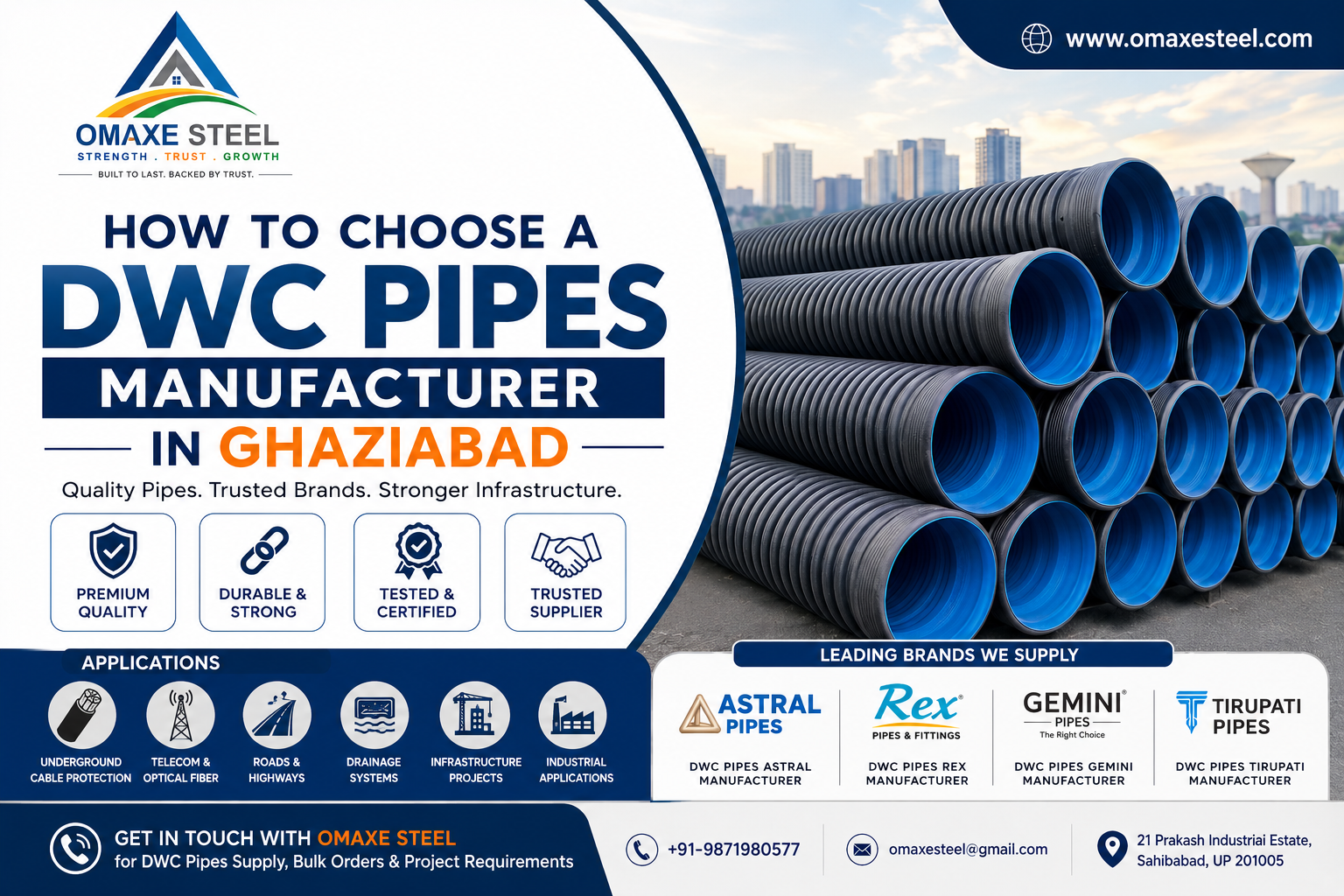
If you've ever had a cable-ducting project stall midway because the pipes on site didn't match the tender spec, you already know why the choice of supplier matters more than the price on the quotation. DWC pipes look similar from the outside — corrugated, black or orange, coiled or straight — but what's inside the wall thickness, the ring stiffness rating, and the batch consistency can make or break an underground cabling, telecom, drainage, highway, or utility project long after the trench has been backfilled.
For contractors, EPC companies, and government project suppliers working in and around Ghaziabad, this decision usually comes down to one question: who can actually be trusted to deliver what the drawing calls for, on time, in bulk, without surprises. This guide walks through what DWC pipes are, why manufacturer quality matters so much, and how to evaluate a supplier before you place an order.
What Are DWC Pipes and Where Are They Used?
DWC stands for Double Wall Corrugated. These are HDPE (High-Density Polyethylene) pipes built with two distinct layers — a corrugated outer wall that spreads and resists soil load and crushing pressure, and a smooth inner wall that lets cables or fluids pass through with minimal friction. That dual-wall structure is what gives DWC pipes their particular advantage: they're light enough to handle easily on site, yet stiff enough to survive years of underground pressure.
Compared with rigid PVC conduit or galvanized iron pipe, DWC HDPE pipes don't corrode, don't crack easily on uneven terrain, and cost less to transport and install over long cable runs. That's why they've become close to a default choice for underground cable protection, optical fiber routing, drainage, and telecom infrastructure work across India.
Why Choosing the Right DWC Pipes Manufacturer Matters
It's tempting to treat DWC pipe as a commodity — buy whatever coil is cheapest and move on. In practice, the manufacturer behind the pipe affects almost every stage of a project.
Wall thickness that's even slightly under spec reduces the ring stiffness class the pipe can actually deliver, which matters enormously once the pipe is under a road, a parking area, or several feet of compacted soil. Dimensional inconsistency between coils causes coupling and joint problems during installation, which slows down laying crews and creates ingress points later. And because these pipes typically go underground for 25 years or more, a batch that fails early means digging up a finished road or cabling run — a cost nobody budgets for.
This is really the core reason a DWC Pipes Manufacturer in Ghaziabad needs to be chosen carefully rather than picked off a price list. The pipe itself is a commodity in name only; the manufacturing and quality-control process behind it is not.
7 Important Factors to Consider Before Choosing a DWC Pipes Manufacturer in Ghaziabad
1. Material quality and HDPE grade. Ask whether the pipe is made from virgin HDPE or a recycled/reprocessed blend. Virgin, UV-stabilized HDPE holds its mechanical properties far better over time, especially for pipe that may sit exposed on site before installation. Recycled-content pipe can look identical on the outside while performing very differently underground.
2. Pipe dimensions and wall thickness. Two pipes of the "same" diameter can have noticeably different wall thickness depending on the manufacturer's tooling and process control. For contractors working to a tender specification, even a small deviation can mean rejected material at inspection — so it's worth asking for a dimensional test report before a bulk order is confirmed.
3. Ring stiffness/load class such as SN4 and SN8. Ring stiffness (SN) rating tells you how much external load the pipe can bear without deforming. SN4 pipes are generally suited to lighter-duty underground cabling, while SN8 pipes are built for higher loads — under roads, in traffic zones, or wherever vehicular pressure is a factor. A manufacturer who can't clearly explain which class fits which application probably isn't testing for it consistently either.
4. Quality testing and industry standards. DWC pipes in India are typically benchmarked against IS 16098 and related standards covering ring stiffness, wall thickness, and joint performance. A manufacturer that batch-tests before dispatch, rather than relying on the brand name alone, is a stronger long-term partner — especially for government and EPC tenders where documentation matters.
5. Brand authenticity and genuine stock. The DWC pipe market has its share of resellers passing off unverified or mixed-source material under a recognizable brand name. For a project where the specification names a particular brand, it's worth confirming the supplier sources directly rather than through a chain of middlemen, since that's usually where quality control breaks down.
6. Manufacturing/supply capacity for bulk projects. A supplier that's fine for a handful of coils may not have the stock depth or logistics to support a multi-kilometre telecom rollout or a government tender with a tight delivery schedule. It's worth asking about typical lead times for bulk orders before you're relying on that answer under deadline pressure.
7. Delivery, technical support, pricing, and after-sales service. Pricing that looks attractive on paper isn't much use if freight costs, delivery delays, or a lack of technical guidance on pipe class selection end up costing more later. A supplier who will talk through diameter and SN class against your actual site conditions — rather than just quoting a price per meter — tends to save contractors from costly mismatches.
Check the DWC Pipe Brands and Specifications Available
Brand alone doesn't determine whether a pipe is right for your project — the combination of brand, diameter, load class, and site conditions does. That said, buyers researching a DWC Pipes Manufacturer in Ghaziabad often want to know how the commonly available brands differ in practice.
DWC Pipes Astral Manufacturer
Astral DWC pipes are frequently specified in government and private cabling tenders where consistent batch-to-batch quality and a recognized, tender-approved brand name are priorities. Buyers should verify the diameter range and ring stiffness class available, and confirm the material is sourced directly rather than through unverified resale channels, particularly when a tender specification names the brand explicitly.
DWC Pipes Rex Manufacturer
Rex DWC pipes are generally associated with a heavier corrugation profile, which some contractors prefer for sites with rougher trench conditions or repeated vehicular loading during construction. Whether Rex is the right fit depends on the balance between site conditions and budget — it's often positioned as a dependable, value-oriented option rather than a premium one, so buyers should confirm the SN class matches their load requirement before ordering.
DWC Pipes Gemini Manufacturer
Gemini DWC pipes come up often in telecom, optical fiber, and cable-routing projects where smooth internal bore and consistent joint tolerance matter for cable-pulling speed on site. For smart-city and fiber-backbone work in particular, buyers should check installation tolerances and confirm the diameter matches the number and type of cables being routed.
DWC Pipes Tirupati Manufacturer
Tirupati DWC pipes are commonly evaluated for projects spread across varied terrain — rocky ground, waterlogged low-lying areas, or mixed soil conditions across multiple sites. Buyers should assess how the pipe's stated ring stiffness holds up against the specific soil and loading conditions of their project, especially for multi-site rollouts where procurement is being standardized on one brand.
Regardless of brand, none of these should be chosen on name recognition alone — matching diameter, SN class, and site conditions to the actual project is what determines whether the investment holds up over its service life.
Applications of DWC Pipes
DWC pipes show up across a wide range of infrastructure work, including underground electrical cable protection, telecom and optical fiber cable networks, highway and road infrastructure, railway and metro projects, smart-city cabling rollouts, industrial plant cabling, drainage and stormwater systems, solar power plant cable routing, and residential or commercial real estate development. The common thread across all of these is a need for a conduit that installs quickly, resists corrosion, and performs reliably underground for decades without maintenance access.
Why Choose Omaxe Steel for DWC Pipes in Ghaziabad?
Once you know what to look for, the search for a DWC Pipes Manufacturer in Ghaziabad usually narrows down to a handful of suppliers who can actually back up their claims with process and documentation. Omaxe Steel, based out of the Sahibabad industrial belt in Ghaziabad, has built its DWC pipe supply around exactly the factors covered above.
The company stocks genuine, directly sourced material as a DWC Pipes Astral Manufacturer, DWC Pipes Rex Manufacturer, DWC Pipes Gemini Manufacturer, and DWC Pipes Tirupati Manufacturer partner, giving contractors a choice of brand and specification without having to deal with multiple vendors. Every batch is checked for wall thickness and ring stiffness before dispatch, which matters for both tender documentation and long-term performance on site.
Being located in Ghaziabad gives Omaxe Steel a practical logistics advantage for projects across Delhi NCR and Uttar Pradesh — shorter lead times and the ability to inspect stock in person before it ships. The team also works directly with contractors, EPC companies, infrastructure developers, and government project executors to match pipe diameter and SN class to actual site conditions, alongside transparent, competitive pricing and support for bulk and repeat orders.
How to Match DWC Pipe Size and SN Class With Your Project
Getting the size and class right comes down to a few practical questions rather than guesswork. How many cables need to run through the duct, and what's their combined diameter? How deep will the pipe be buried, and what's above it — open ground, a footpath, or a road carrying vehicle traffic? What's the soil type, and is there a risk of waterlogging or ground movement?
In simple terms, SN4 pipes are generally adequate for lighter-duty underground cabling away from vehicular traffic, while SN8 pipes are built to handle higher external loads and are the more common choice under roads, industrial yards, or anywhere heavy compaction and traffic pressure come into play. Getting this wrong in either direction either wastes money on unnecessary strength or risks pipe deformation under load — so it's worth discussing your specific site conditions with your supplier rather than defaulting to whatever was used on the last project.
Common Mistakes to Avoid When Buying DWC Pipes
The most common mistake is choosing purely on price per meter without checking whether the ring stiffness class actually matches the application — a cheaper SN4 pipe used where SN8 was required is not a saving, it's a future liability. Close behind that is buying "branded" pipe from an unverified reseller without confirming the source, which opens the door to mixed-quality batches slipping through. Skipping a dimensional or wall-thickness check before a bulk order, overlooking the relevant IS standards a project requires, and failing to confirm delivery timelines against project deadlines round out the mistakes that tend to cause the most trouble later.
Frequently Asked Questions About DWC Pipes
-
What are DWC pipes used for?
DWC pipes are primarily used for underground electrical cable protection, telecom and optical fiber ducting, drainage and stormwater systems, and general underground infrastructure where a lightweight, corrosion-resistant conduit is needed.
-
How do I choose the right DWC pipe manufacturer in Ghaziabad?
Look at material quality, dimensional consistency, ring stiffness testing, brand authenticity, bulk supply capacity, and the level of technical support offered — price alone is a poor basis for comparison.
-
What is the difference between SN4 and SN8 DWC pipes?
SN4 pipes suit lighter-duty applications away from vehicle traffic, while SN8 pipes are built for higher external loads such as those found under roads and industrial yards.
-
Which brands of DWC pipes are available through Omaxe Steel?
Omaxe Steel supplies Astral, Rex, Gemini, and Tirupati DWC pipes, covering a range of ring stiffness classes and diameters for different project needs.
-
Are DWC pipes suitable for underground electrical cables?
Yes, DWC pipes are widely used for underground electrical cable protection because of their corrosion resistance, flexibility, and smooth inner bore for easy cable pulling.
-
How do I select the correct DWC pipe diameter?
Diameter selection depends on the number and size of cables being routed, with some allowance for future cable additions — your supplier should be able to recommend a size based on your cable count.
-
Are DWC pipes suitable for highway and heavy-load applications?
Yes, higher ring-stiffness classes like SN8 are specifically designed to withstand vehicular loading and are commonly used under roads and highways.
-
Can I purchase DWC pipes in bulk for infrastructure projects?
Yes, most established manufacturers, including Omaxe Steel, supply bulk quantities for government tenders, telecom rollouts, and large private infrastructure projects.
Contact Omaxe Steel for DWC Pipes
If you're finalizing specifications for an upcoming project, it's worth getting pipe availability, pricing, and technical guidance sorted before the tender deadline rather than after. Omaxe Steel can walk you through diameter, ring stiffness class, and brand options based on your actual site conditions, and quote for both small orders and bulk project requirements.you can contact us directly.
Phone: +91-9871980577
Email: omaxesteel@gmail.com
Address: 21 Prakash Industrial Estate, Sahibabad, UP 201005

