


Precision Tooth Manufacturing for Motion Equipment
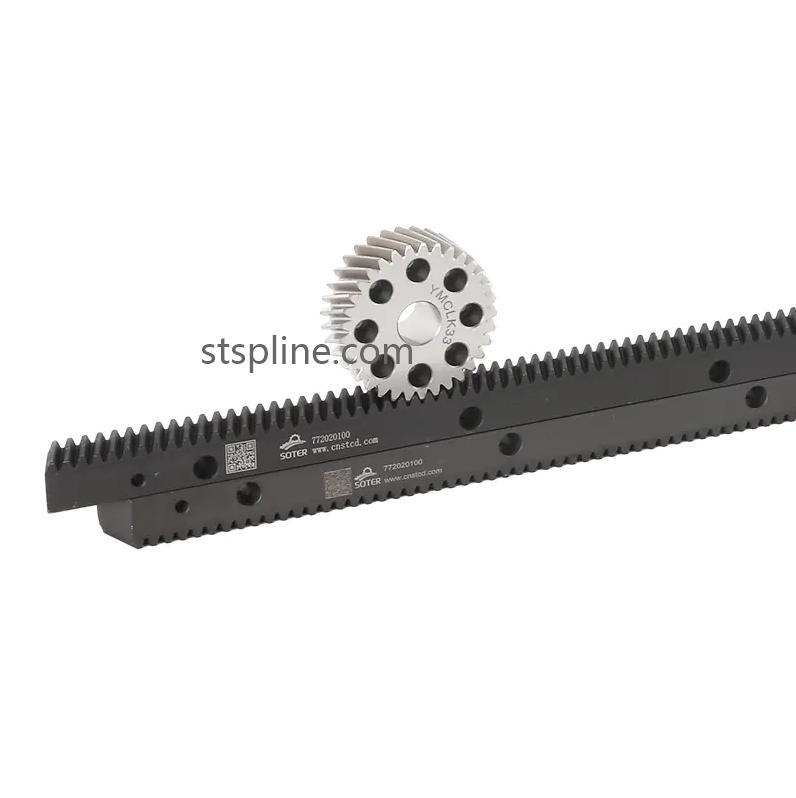
Linear transmission systems depend on the consistent interaction between a rack and its mating pinion. In this environment, Milled Rack components are produced through machining processes designed to establish controlled tooth geometry and a stable working surface. Milling is particularly relevant when manufacturers need accurate tooth formation, repeatable production, and compatibility with industrial motion systems.
The production process begins with appropriate material selection. Steel is widely considered for industrial rack applications because it can provide a useful combination of strength, machinability, and wear resistance. The specific material should be evaluated according to the intended transmission conditions, production method, and surface-treatment requirements. Choosing the material at the beginning of the process helps establish a foundation for subsequent machining and quality-control operations.
Milling technology removes material progressively to form the required tooth profile. Compared with rough shaping methods, controlled milling can provide a defined relationship between tooth spacing, tooth form, and the rack's reference surfaces. Consistency across the full working length is important because the rack may remain engaged with the pinion while the machine moves continuously through its operating range.
Machining accuracy is not limited to the tooth itself. Reference surfaces and mounting areas also contribute to the final installation quality. If a rack is positioned incorrectly on the machine structure, even a carefully machined tooth profile may not deliver the expected engagement. For this reason, manufacturers typically need to control multiple dimensions during production and consider how each reference feature relates to the transmission surface.
After milling, additional finishing operations may be considered depending on the required application. Surface finishing can improve the condition of working areas, while heat treatment may be used when increased hardness or wear resistance is needed. The correct process depends on the selected material and the functional demands of the rack. A balanced manufacturing route aims to preserve dimensional stability while improving the characteristics needed during repeated mechanical operation.
Rack-and-pinion systems are frequently used in equipment requiring rotary-to-linear motion conversion. CNC machines can use this principle for axis movement, while industrial automation systems may integrate racks into gantry structures, transfer equipment, and robotic mechanisms. Laser processing equipment and material-handling machinery can also benefit from a linear transmission arrangement when the mechanical structure requires controlled movement along an extended path.
One advantage of a machined approach is process repeatability. Once the production method has been established, controlled machining can help manufacturers reproduce the same tooth characteristics across multiple components. This is important for equipment builders that need several racks for one machine or repeated production orders for the same equipment platform. Consistency also simplifies replacement planning because compatible components are easier to manage when their manufacturing process is stable.
Installation should remain part of the engineering discussion. Rack sections may require accurate positioning relative to each other when the total travel distance exceeds the length of a single component. Alignment, mounting rigidity, and the relationship between the rack and pinion centerline can influence how smoothly the transmission operates. Proper installation therefore complements machining quality and helps the mechanical system achieve the intended movement characteristics.
For industrial buyers, supplier capability should be evaluated from both manufacturing and engineering perspectives. A suitable manufacturer should be able to understand drawings, production requirements, material considerations, and application conditions. Quality inspection throughout machining can also provide useful assurance that tooth geometry and critical reference features remain within the agreed manufacturing requirements.
The broader purpose of precision machining is to create a dependable mechanical interface rather than simply produce a component with visible teeth. When material selection, milling technology, finishing processes, inspection, and installation are considered together, the rack becomes an integrated part of the machine's motion architecture. This approach is especially relevant for automation manufacturers working with repeatable and coordinated linear movement.
For equipment designers and industrial transmission buyers, Milled Rack technology remains a practical option for producing accurately formed linear transmission components. Careful machining and engineering coordination can help these components integrate with CNC systems, robotic machinery, automated production equipment, and other industrial platforms. Related rack products and manufacturing solutions can be explored at https://www.stspline.com/product/straight-teeth-rack/.

