


F-theta Lens: Precision Optics for Advanced Laser Scanning
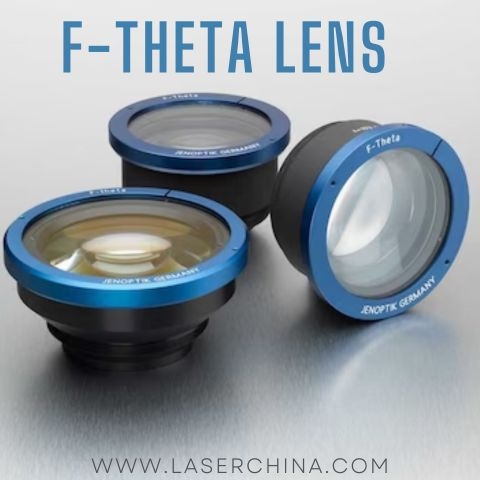
An F-theta Lens is a specialized optical component designed for laser scanning systems, particularly those using galvanometer scanners. Its primary role is to focus and position the laser beam accurately across a flat working surface. Unlike a conventional focusing lens, an F-theta lens is engineered so that the position of the focused laser spot is approximately proportional to the scanning angle, represented by the relationship y = f × θ. This optical design supports accurate and consistent laser movement across the working field.
For modern laser marking, engraving, cutting, drilling, and other precision processes, the quality of the scanning lens has a direct influence on overall processing performance. LaserChina provides optical solutions designed for professional laser applications, helping manufacturers achieve reliable beam positioning and consistent processing results.
How an F-theta Lens Works
An F-theta lens normally works together with an XY galvanometer scanning system. The laser beam is first directed toward scanning mirrors, which rapidly change the beam's direction. The beam then enters the F-theta lens, which focuses it onto the working surface.
The special optical design converts the angular movement produced by the scanning mirrors into controlled movement across the work plane. This helps create a flat focal field and predictable spot positioning across the scanning area.
This combination of galvanometer scanner and F-theta Lens is particularly valuable when a laser system needs to move rapidly while maintaining accurate positioning. It enables manufacturers to perform detailed marking and engraving with excellent repeatability.
Flat-Field Focusing for Consistent Results
One of the most important characteristics of an F-theta Lens is its ability to provide a substantially flat working field. Conventional optical arrangements can produce a curved focal surface, while F-theta scan lenses are specifically designed for laser scanning applications to maintain focus over a flat processing plane.
For laser marking applications, this means the beam can be accurately focused across a defined working area. LaserChina focuses on optical solutions that support stable laser processing, helping businesses achieve clean, precise, and professional results.
Importance of Focal Length
Focal length is an important specification when selecting an F-theta lens. It influences the available scanning field, working distance, and achievable spot characteristics. A shorter focal length is generally associated with a smaller working field and can support detailed processing, while a longer focal length can provide a larger scanning area.
Choosing the appropriate focal length requires consideration of the laser source, scanner aperture, desired marking field, material, and processing requirements. A correctly matched optical system helps the laser operate efficiently while maintaining the desired level of precision.
LaserChina F-theta Lens Solutions
LaserChina offers F-theta scan lens solutions intended for a broad range of laser processing applications. Its F-theta lens range covers applications involving laser marking, cutting, drilling, and engraving, with options designed for different laser wavelengths and system configurations. LaserChina's published product information also highlights flat-field and telecentric F-theta configurations, with wavelength coverage extending from 355 nm to 10,600 nm.
This broad range makes the brand a useful choice for manufacturers looking to match optical components with different laser platforms and production requirements.
Applications in Laser Marking
Laser marking is one of the most common applications for an F-theta lens. Fiber laser marking machines use galvanometer scanners to move the beam rapidly across metal, plastics, coated materials, and other workpieces.
The F-theta optical system helps maintain controlled beam positioning throughout the marking field. This is valuable for applications such as product identification, serial numbers, logos, barcodes, QR codes, industrial labels, and component traceability.
With an appropriately selected F-theta Lens, manufacturers can combine high scanning speeds with precise beam placement, supporting efficient production environments.
Applications in Laser Engraving
Laser engraving requires controlled energy delivery and accurate beam movement. An F-theta lens provides the optical foundation for scanning the beam across the engraving area.
From industrial components to decorative products, the technology can support detailed patterns, text, symbols, and graphics. LaserChina optical solutions can be integrated into laser systems designed for precision engraving, helping businesses achieve consistent results across the working field.
Applications in Laser Cutting and Drilling
F-theta lenses are also used in specialized laser cutting and drilling systems. Their ability to focus a scanned laser beam over a defined field makes them valuable for applications requiring controlled material processing.
In electronics and precision manufacturing, laser scanning can be used for drilling small features and processing components. F-theta optics are also utilized in micromachining and other advanced material-processing applications.
Telecentric F-theta Lens Technology
For applications requiring particularly controlled beam geometry, telecentric F-theta lenses can provide an important optical advantage. Telecentric designs are engineered so the chief rays approach the work surface with controlled angular behavior, supporting precision applications where beam orientation matters.
They can be valuable in demanding manufacturing environments involving detailed micromachining, precision marking, and specialized material processing. LaserChina includes telecentric configurations within its F-theta lens product range, giving manufacturers additional optical choices for specialized systems.
Advantages of Using an F-theta Lens
There are several important benefits associated with a properly matched F-theta Lens:
- High positioning accuracy: Supports precise movement of the laser spot across the working field.
- Flat-field focusing: Helps maintain the focal plane across the intended scanning area.
- Fast scanning capability: Works effectively with galvanometer systems for rapid laser processing.
- Consistent processing: Supports uniform laser marking and engraving results.
- Flexible applications: Suitable for marking, engraving, drilling, cutting, and other laser processes.
- Improved production efficiency: Enables rapid beam movement for demanding industrial workflows.
- Professional optical performance: High-quality optical components contribute to reliable laser system operation.
These advantages make F-theta optics an essential component of many modern laser processing machines.
Choosing the Right F-theta Lens
Selecting the right F-theta Lens should begin with the laser wavelength. Optical coatings and lens materials must be compatible with the wavelength and power level of the laser source.
Next, manufacturers should consider focal length, scanning field, beam diameter, scanner aperture, working distance, spot size, and application requirements. The optical and mechanical specifications of the lens should also match the galvanometer scanner and laser head.
For high-precision systems, telecentricity, optical quality, and field performance may become particularly important. Evaluating these factors together helps manufacturers build a well-balanced laser scanning system.
Why Quality Matters in Laser Optics
The F-theta lens is the final optical component through which the scanned laser beam passes before reaching the workpiece in many common galvanometer marking arrangements. Because it directly influences focusing and beam positioning, its optical quality is an important part of overall system performance.
High-quality optics can support stable beam transmission, accurate focusing, and reliable scanning behavior. LaserChina emphasizes optical solutions for professional laser systems, giving manufacturers access to F-theta lens options designed around different wavelengths and processing requirements.
Benefits for Modern Manufacturing
Modern manufacturing increasingly depends on accurate identification, traceability, customization, and precision processing. An efficient laser scanning system can help manufacturers meet these requirements while maintaining fast production cycles.
By combining a suitable laser source, galvanometer scanner, and high-quality F-theta Lens, businesses can create an optical system capable of accurate and repeatable processing. This makes F-theta technology relevant to industries including electronics, automotive, industrial manufacturing, medical products, jewelry, and precision engineering.
LaserChina for Professional Laser Applications
LaserChina brings together laser equipment and optical components for a wide variety of professional applications. Its F-theta lens solutions are designed to support different laser wavelengths, scanning requirements, and processing applications.
For businesses developing or upgrading laser marking, engraving, cutting, or drilling equipment, selecting an appropriate optical component is an important step toward achieving dependable processing performance. With its range of F-theta solutions, LaserChina provides manufacturers with options for building precision-focused laser systems.
Final Thoughts
An F-theta Lens is much more than a simple focusing component. It is a key optical element that helps transform galvanometer beam movement into accurate laser processing across a flat working field. Its specialized design supports precision, speed, consistency, and efficient scanning, making it essential for many modern laser applications.
From laser marking and engraving to drilling, cutting, and specialized material processing, the right F-theta lens can contribute significantly to overall system performance. LaserChina offers a broad selection of F-theta optical solutions, including flat-field and telecentric designs, helping manufacturers select suitable optics for their particular laser systems and production goals.

