


North America Brain-Computer Interface Market Trends & Growth Outlook 2025–2031
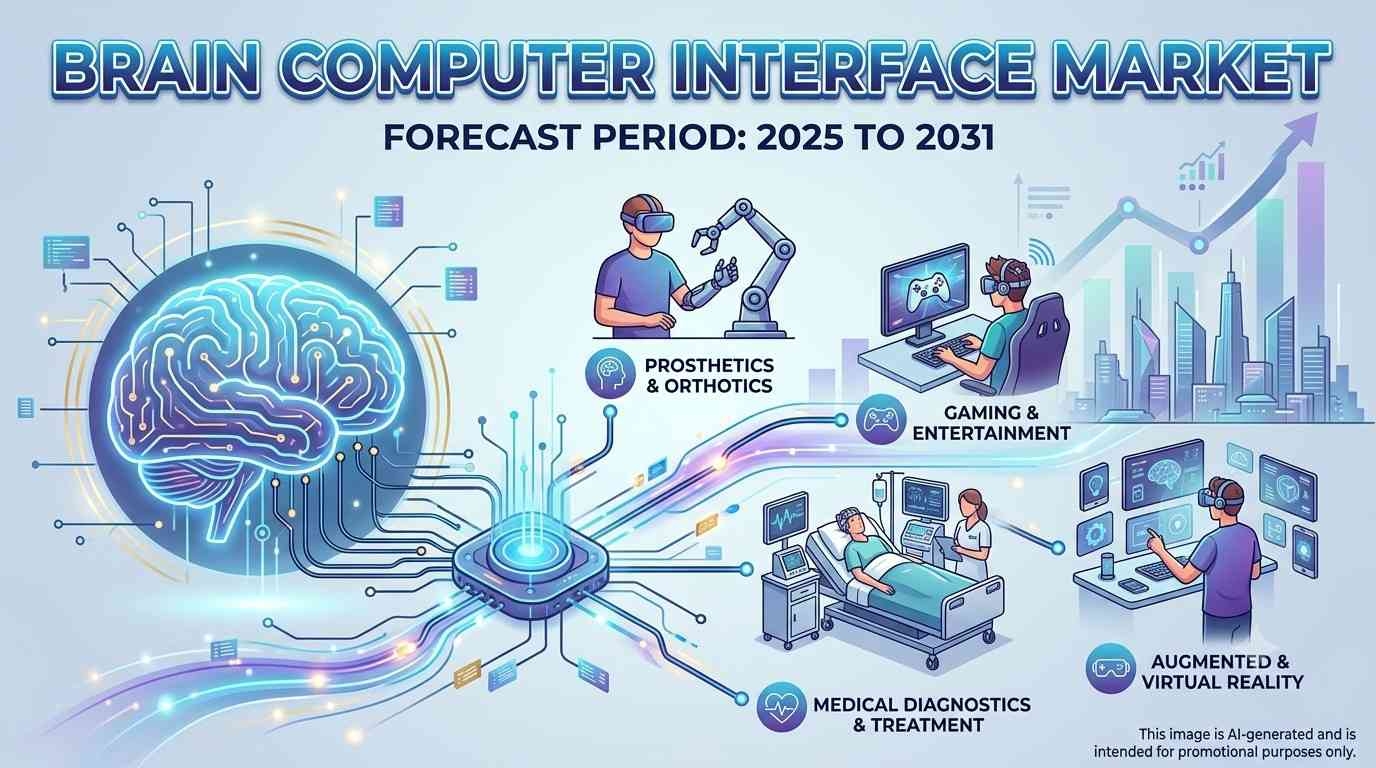
The North America Brain-Computer Interface (BCI) Market is expanding with the growing adoption of advanced neurotechnology across healthcare, research, and assistive applications. The region benefits from strong investments in neuroscience research, increasing development of non-invasive and invasive BCI technologies, and the presence of technology and medical device companies focused on brain-computer interaction.
The Brain Computer Interface market is projected to grow from US$ 1.96 billion in 2023 to US$ 7.23 billion by 2031; it is expected to expand at a CAGR of 16.70% from 2025 to 2031.
What is driving the market?
Rising cases of neurodegenerative diseases, increasing demand for assistive technologies, and rapid advancements in artificial intelligence are the principal growth drivers. Healthcare providers and rehabilitation centers are seeking BCI solutions to restore mobility, communication, and environmental control for patients with neuro-motor conditions such as ALS, stroke, and spinal cord injuries. Outside clinical settings, gaming companies, defense agencies, and consumer tech innovators are integrating BCI for hands-free device control, cognitive monitoring, and immersive virtual environments.
The transition is moving beyond early-stage laboratory prototypes toward clinical deployment and consumer-grade usability. Developers are investing in high-density flexible electrode arrays, low-power signal processors, wireless telemetry, and real-time neural decoding models. Complex surgical risks for invasive systems, regulatory approval timelines, signal attenuation in non-invasive formats, and data privacy concerns regarding neural data remain important constraints.
Which region leads?
North America leads the market, accounting for an estimated 40%–44% share in 2025. Growth is driven by early adoption of neurotechnologies, extensive clinical research funding, strong venture capital presence, and progressive regulatory frameworks for breakthrough medical devices.
Europe holds an estimated 26%–30% share, supported by government-backed research initiatives, robust healthcare infrastructure, and strong academic-industry partnerships. Asia Pacific accounts for approximately 20%–24% of the market but is the fastest-growing region, with a projected CAGR of 18.5%–19.8%. Growth in Asia Pacific is driven by expanding healthcare expenditure, increasing research investments in China and Japan, rising awareness of assistive medical devices, and growing local technological capabilities.
Which segment leads?
Non-Invasive BCI is the leading product segment, representing an estimated 58%–62% of market revenue in 2025. Its position is supported by high safety profiles, lower costs, absence of surgical risks, and growing adoption in neuro-rehabilitation, research, and consumer gaming. However, the Invasive/Partially Invasive segment is forecast to grow at the highest CAGR through 2033, driven by breakthroughs in high-fidelity signal extraction for medical prosthetics.
By end-use industry, Healthcare leads with an estimated 52%–56% share in 2025, reflecting strong clinical applications in neuro-prosthetics, stroke recovery, and communication restoration. Gaming & Consumer Electronics is identified as a high-growth segment, as consumer-grade EEG headsets and spatial-computing integrations gain traction.
Which companies are prominent?
The report identifies Neuralink Corporation, Blackrock Neurotech, Synchron, Precision Neuroscience, Medtronic plc, NeuroSky, g.tec medical engineering GmbH, Kernel, Emotiv, and Brain Products GmbH as prominent market participants.
These companies compete across invasive microelectrode arrays, wearable EEG headsets, neural signal decoding software, and specialized clinical software suites. Strategic differentiation increasingly depends on signal resolution, system latency, surgical safety profiles, long-term implant biocompatibility, software ecosystem integration, and navigating regulatory pathways. The list reflects the report's competitive landscape rather than a revenue-ranked market-share table.
What is changing in 2026? The market is shifting from exploratory trials toward standardized, commercially viable BCI platforms. Devices are increasingly evaluated on long-term signal stability, cyber-security standards for neural data, and seamless integration with external software ecosystems. Regulatory bodies are finalizing tailored approval pathways for adaptive AI-driven brain implants, speeding up transition times from human trials to commercial availability.
Developers are accelerating ultra-flexible thin-film electrodes, sub-dermal semi-invasive formats, advanced AI decoding transformers, and multi-modal sensory feedback systems. Purchasing decisions in healthcare are tied to clinical trial efficacy and reimbursement approvals, creating demand for long-term safety data, bio-ethics compliance, and strategic alliances between neurotech startups and large medical device manufacturers.
What are the major investment opportunities?
The strongest opportunities lie in high-density microelectrode manufacturing, advanced neural signal processing AI, biocompatible encapsulation materials, and non-invasive wearable sensors. Investment in sub-dermal and semi-invasive deployment methods can offer a high signal-to-noise ratio while minimizing surgical complexity and long-term risk.
Additional opportunities include BCI-driven neuro-rehabilitation software, brain-controlled assistive mobility devices, spatial computing integration, and military or industrial human-augmentation platforms. Software-as-a-Service (SaaS) models for neural decoding algorithms and therapeutic diagnostic software may create recurring revenue streams as BCI hardware scales.
Asia Pacific offers attractive expansion potential through rapid healthcare modernization and growing state-backed neurotechnology investments. Investors should prioritize companies combining clinical safety, strong IP portfolios, regulatory progression, and clear commercialization pathways.
The Insight Partners provides comprehensive syndicated and tailored market research services in the healthcare, technology, and industrial domains. Renowned for delivering strategic intelligence and practical insights, the firm empowers businesses to remain competitive in ever-evolving global markets.
• Email: sales@theinsightpartners.com
• Website: theinsightpartners.com
• Phone: +1-646-491-9876

