


Mexico Spreads Market Size Projected to Reach USD 1,386.2 Million by 2034 with a CAGR of 5.19%
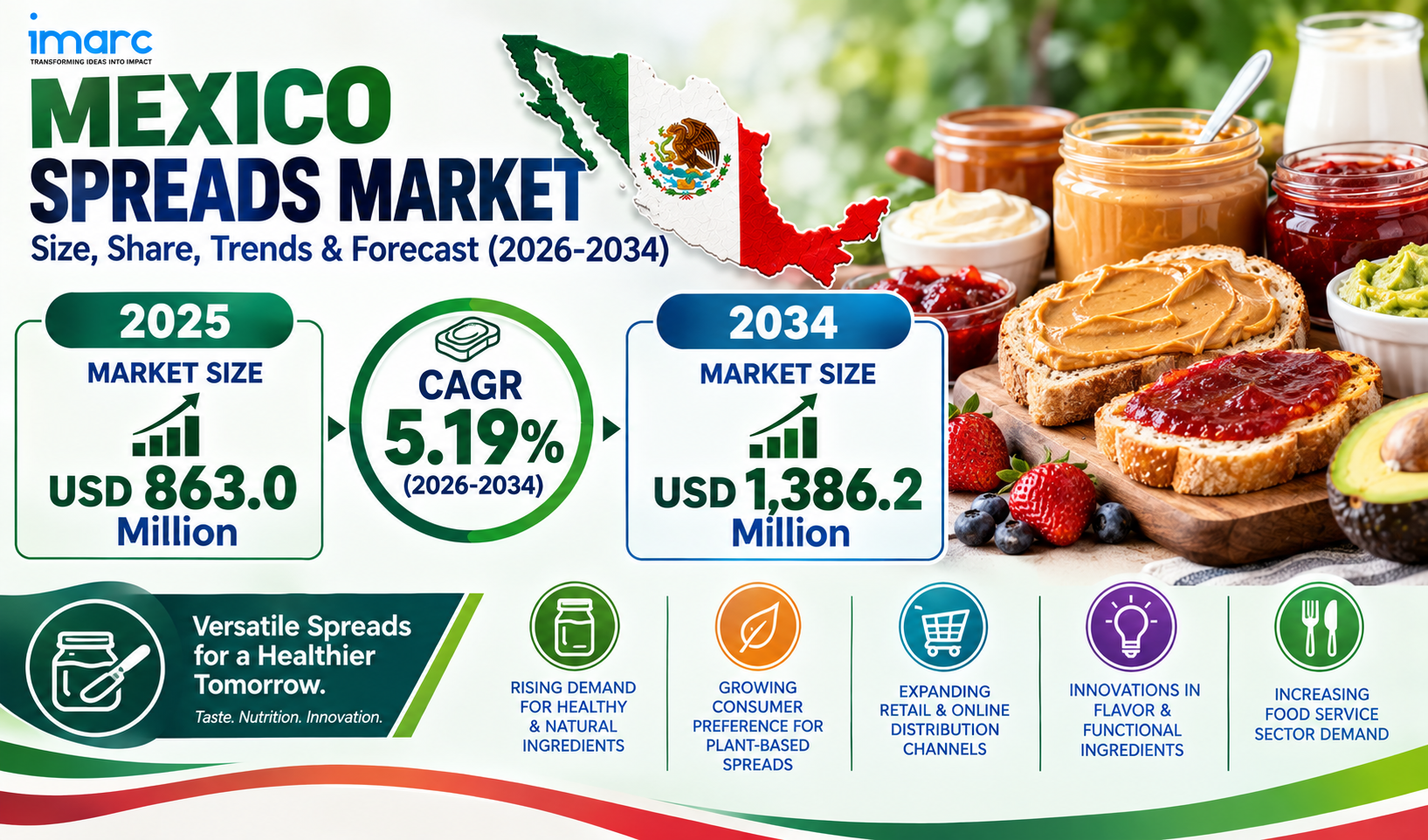
IMARC Group has recently released a new research study titled “Mexico Spreads Market Report by Product Type, Nature, Distribution Channel, End Use, and Region, 2026-2034,” offers a detailed analysis of the market drivers, segmentation, growth opportunities, trends and competitive landscape to understand the current and future market scenarios.
Mexico Spreads Market Size, Growth, and Forecast (2026-2034)
The mexico spreads market share reached USD 863.0 Million in 2025 and is projected to reach USD 1,386.2 Million by 2034, growing at a CAGR of 5.19% during 2026-2034. Rising demand for natural and organic ingredients, growing interest in traditional and global flavors, increased snacking habits, and continuous innovation in product variety and packaging are the primary factors driving the mexico spreads market.
Spreads are semi-solid food products applied to bread, toast, tortillas, and baked goods, or used as ingredients in cooking and baking. The category spans jams and preserves, nut based spreads such as peanut butter, chocolate spreads, savory spreads, and honey based spreads, sold through both retail and commercial channels.
Mexican consumers are becoming more health-conscious while continuing to value flavor, convenience, and familiar tastes. As a result, brands are reformulating products with lower added sugars and simpler ingredients, introducing locally inspired flavors, and expanding their presence in online retail, all of which are reshaping how spreads are produced, positioned, and sold across the country.
Explore Growth Opportunities in the Mexico Spreads Market - Grab Your Sample Report for Evaluation: https://www.imarcgroup.com/mexico-spreads-market/requestsample
Key Trends Driving the Mexico Spreads Market
• Rising demand for natural and organic spreads: The gradual shift toward healthier food choices is supporting the mexico spreads market growth. With about 75% of adults in Mexico overweight or obese and 49% affected by hypertension, consumers increasingly look for products aligned with their well-being goals. This is boosting demand for clean-label spreads made from fruits, nuts, and sweeteners such as stevia and agave, while manufacturers reformulate with lower added sugars and fewer artificial ingredients.
• Product offering innovation: Companies regularly launch new flavors and packaging formats to match varied consumer tastes. Spreads infused with chili, cacao, and tropical fruit are gaining traction as they reflect Mexico’s diverse culinary culture, while functional spreads fortified with vitamins, minerals, or probiotics are attracting interest. Sustainable materials and convenient formats are also improving user experience and appeal to environmentally aware buyers.
• E-commerce and digital engagement: Online channels let consumers browse a far wider range of spreads than local outlets can stock. According to the Mexican Association of Online Sales (AMVO), Mexico’s e-commerce industry grew by 24.6% in 2023, exceeding USD 44 billion in revenue. Brands are using social media, influencer partnerships, sponsored campaigns, and customer reviews to build awareness and purchase confidence.
Mexico Spreads Market Report Segmentation:
The Mexico Spreads Market report provides a detailed segmentation analysis to help businesses identify key growth segments and evolving industry dynamics. The market is categorized based on product type, nature, distribution channel, and end use, offering comprehensive insights across the mexico spreads market.
Product Type Insights:
- Jam and Preserve Spreads: Traditional fruit-based spreads that remain a familiar breakfast staple, increasingly reformulated with less added sugar and natural sweeteners.
- Nut Based Spreads: Covering peanut butter, almond spreads, cashew spreads, walnut spreads, and macadamia spreads, this category benefits from growing interest in protein-rich, natural, and better-for-you options.
- Chocolate Spreads: Indulgent spreads serving household snacking and breakfast occasions, with brands introducing new formats and product variations.
- Savory Spreads: Spreads designed for sandwiches, snacks, and food preparation, supporting demand for versatile and flavorful products.
- Honey Based Spreads: Natural sweet spreads that appeal to consumers seeking simple, minimally processed ingredients.
Nature Insights:
- Organic: Organic spreads are gaining attention as consumers look for transparent labeling, natural sourcing, and cleaner ingredient lists.
- Conventional: Conventional spreads continue to serve mainstream demand through wide availability, familiar brands, and accessible price points.
Distribution Channel Insights:
- B2B: Business-to-business sales supply spreads to food service operators, bakeries, and food manufacturers that use them as ingredients and menu components.
- B2C: Business-to-consumer sales are split between store-based retailing and online retailing. Store-based formats remain central to everyday purchases, while online retailing offers wider selection and convenience.
End Use Insights:
- Household/Retail: Household consumption covers everyday use at breakfast and snack time, driven by health awareness, flavor variety, and convenient packaging.
- Commercial: Commercial demand comes from cafes, restaurants, bakeries, and institutional buyers that rely on spreads for consistent quality and versatile applications.
Regional Insights:
- Northern Mexico: Northern Mexico represents an important regional market for spreads, supported by established retail networks and proximity to cross-border trade.
- Central Mexico: Central Mexico, home to large urban populations, offers a concentrated consumer base and strong modern retail and online shopping penetration.
- Southern Mexico: Southern Mexico reflects growing opportunities as retail access improves and demand for packaged food products broadens.
- Others: Other regions contribute steady demand as spreads reach consumers through expanding distribution networks.
Mexico Spreads Market: Recent News and Developments
- January 2026: McCormick & Company completed the acquisition of an additional 25% ownership interest in McCormick de Mexico from Grupo Herdez, raising its ownership to 75% in a transaction valued at USD 750 million. McCormick de Mexico’s portfolio includes marmalades alongside mayonnaise, spices, mustard, hot sauce, and tea, and the company plans to use its category management and marketing expertise to expand in adjacent categories and increase channel penetration.
- July 2026: Ferrero announced a USD 86 million investment to expand its manufacturing complex in San José Iturbide, Guanajuato, focusing on Nutella and Kinder Chocolate. The project is expected to nearly double installed capacity from roughly 35,000 metric tons to around 70,000 metric tons annually and raise the share of output destined for export from about 40% to between 55% and 60%.
Challenges Impacting the Mexico Spreads Market
Health concerns around sugar consumption and obesity are pushing consumers to scrutinize ingredient lists more closely, which puts pressure on traditional sweet spreads and requires manufacturers to invest in reformulation without compromising taste.
Competition among sub-categories such as jams, chocolate spreads, and peanut butter, together with economic pressures and shifting consumer preferences, can moderate growth and make price positioning difficult for brands.
Investment Opportunities in the Mexico Spreads Market
The mexico spreads market presents compelling investment opportunities supported by its projected growth from USD 863.0 Million in 2025 to USD 1,386.2 Million by 2034. Natural, organic, and reduced-sugar spreads represent a high-value opportunity as health-conscious consumers seek cleaner labels and transparent sourcing.
Functional spreads with added vitamins, minerals, or probiotics, locally inspired flavors, and sustainable packaging offer room for differentiation. Companies that combine product innovation with strong e-commerce and digital marketing capabilities can build strong competitive positions in this expanding market.
Outlook of the Mexico Spreads Market (2026-2034)
The outlook for the mexico spreads market is positive, supported by demand for natural and organic ingredients, growing interest in traditional and global flavors, and ongoing innovation in product variety and packaging. The market is projected to grow from USD 863.0 Million in 2025 to USD 1,386.2 Million by 2034 at a CAGR of 5.19%.
Healthier reformulations, locally inspired flavors, increased snacking, and the expansion of online retail will be the defining trends shaping the mexico spreads market through 2034.
Key Players in the Mexico Spreads Market
The mexico spreads market is served by a mix of global food companies and established Mexican food groups competing on the basis of brand strength, product innovation, and distribution reach.
Ferrero: A global confectionery leader, Ferrero produces Nutella and Kinder products at its San José Iturbide plant in Guanajuato, which supplies Mexico as well as the United States, Canada, and Central America. In 2026, the company announced a USD 86 million expansion to nearly double the plant’s production capacity.
McCormick de Mexico and Grupo Herdez: McCormick de Mexico, a joint venture formed in 1947 with Grupo Herdez, offers marmalades among its condiment and flavor portfolio. McCormick & Company increased its stake to 75% in January 2026, while Grupo Herdez retains 25% and continues to market a broad range of packaged foods, including jams and honeys.
Frequently Asked Questions (FAQs): Mexico Spreads Market
1. What is the current Mexico spreads market size?
The Mexico spreads market size reached USD 863.0 Million in 2025 and is projected to reach USD 1,386.2 Million by 2034, growing at a CAGR of 5.19% during 2026-2034.
2. What are spreads?
Spreads are semi-solid food products applied to bread, toast, and baked goods or used in cooking, including jam and preserve spreads, nut based spreads, chocolate spreads, savory spreads, and honey based spreads.
3. What are the key drivers of the mexico spreads market?
Key drivers include increasing demand for natural and organic ingredients, growing interest in traditional and global flavors, increased snacking habits, and innovation in product variety and packaging.
4. How is the mexico spreads market segmented?
The mexico spreads market is segmented by product type, nature, distribution channel, end use, and region, covering Northern, Central, and Southern Mexico along with other regions.
5. Who are the key players in the mexico spreads market?
Key players in the mexico spreads market include Ferrero and McCormick de Mexico, alongside Grupo Herdez and other domestic and international food companies serving household and commercial customers.
Author IMARC Group
IMARC Group is a global management consulting firm that helps the world's most ambitious changemakers to create a lasting impact. The company provide a comprehensive suite of market entry and expansion services. IMARC offerings include thorough market assessment, feasibility studies, company incorporation assistance, factory setup support, regulatory approvals and licensing navigation, branding, marketing and sales strategies, competitive landscape and benchmarking analyses, pricing and cost research, and procurement research.
Contact Us
IMARC Group,
134 N 4th St. Brooklyn, NY 11249, USA,
Email: sales@imarcgroup.com,
United States: +1-201971-6302

