


Haoba Ventilation Equipment for Industrial Applications
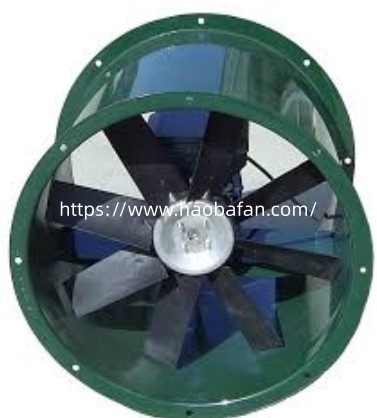
Ducted ventilation systems often require equipment that can move air efficiently while adapting to changes in airflow direction and system resistance. A Mixed Flow Duct Fan combines aspects of axial and centrifugal airflow behavior within a compact fan structure, making this type of equipment useful for applications where air needs to travel through ducts or other controlled pathways. Its practical performance depends on impeller design, housing geometry, motor integration, installation, and system configuration.
The operating principle combines two basic airflow characteristics. Like an axial fan, the air generally moves through the impeller along the fan's central direction. At the same time, the rotating impeller creates a radial component that helps develop airflow movement through the housing. This combination can provide greater flexibility for ducted ventilation compared with a simple open-air circulation arrangement.
Impeller design is central to this operating principle. Blade angle, curvature, spacing, and structural strength influence how air enters the rotating assembly and changes direction as it passes through the fan. Consistent blade manufacturing is important because uneven geometry can affect airflow distribution and rotational balance. The impeller must also maintain sufficient structural stability for continuous operation.
Material selection should reflect the environment where the equipment will be installed. Industrial ventilation systems may be exposed to dust, humidity, temperature changes, or corrosive substances. Manufacturers may select different materials or surface treatments for blades, housings, frames, and mounting components according to these conditions. Proper material selection can support structural durability and reduce premature deterioration.
The housing guides airflow between the impeller and duct connection. Its internal geometry should provide a smooth transition while maintaining sufficient structural rigidity. Poorly matched connections or abrupt changes in the airflow path may create turbulence and additional pressure loss. For this reason, the fan should be considered together with the duct system rather than as an isolated component.
Motor integration also influences equipment stability. The motor needs to provide consistent rotational movement while remaining properly aligned with the impeller and housing. Manufacturing processes should account for mounting strength, heat dissipation, electrical protection, and mechanical coordination. Correct integration can reduce unnecessary vibration and help maintain consistent operation during extended ventilation cycles.
Balancing is particularly important for rotating equipment. An uneven impeller can produce vibration that affects bearings, fasteners, housing components, and connected ductwork. Manufacturing inspection and balancing procedures can help maintain smooth rotation. Stable mechanical operation can also contribute to better noise control and reduce unnecessary stress on surrounding structures.
Noise management requires attention to both fan construction and duct design. Sound may originate from blade movement, motor operation, turbulence, vibration, and housing resonance. A carefully manufactured impeller can help reduce mechanical irregularities, while suitable duct transitions may reduce unnecessary turbulence. Secure mounting and appropriate support can further limit vibration transmission.
Maintenance should include inspection of the impeller, housing, mounting points, guards, electrical connections, and duct interfaces. Dust accumulation may influence airflow and rotating balance, while loose components can create vibration or abnormal operating sounds. Periodic cleaning and inspection can help identify potential problems before they become more significant. Maintenance should always follow the equipment's intended procedures and applicable safety requirements.
Mixed flow designs can be considered for applications such as industrial workshops, commercial buildings, warehouses, agricultural facilities, equipment ventilation, and other ducted air movement systems. The appropriate arrangement depends on the building structure, duct layout, environmental conditions, airflow requirements, and operating schedule.
For procurement teams, a Mixed Flow Duct Fan should be evaluated according to both manufacturing quality and system compatibility. Buyers can consider impeller construction, housing design, motor integration, balancing procedures, material suitability, installation requirements, maintenance access, and technical communication. Evaluating these factors together provides a more practical basis for selecting equipment for a specific duct ventilation project.
Taizhou Haoba Electromechanical Co Ltd. provides ventilation equipment for different industrial air movement applications, and customers can review further product information at https://www.haobafan.com/product/mixed-flow-fan/ when evaluating ducted airflow solutions.

