


BIS Registration for Appliances for Heating Liquids as per IS 302-2-15:2009
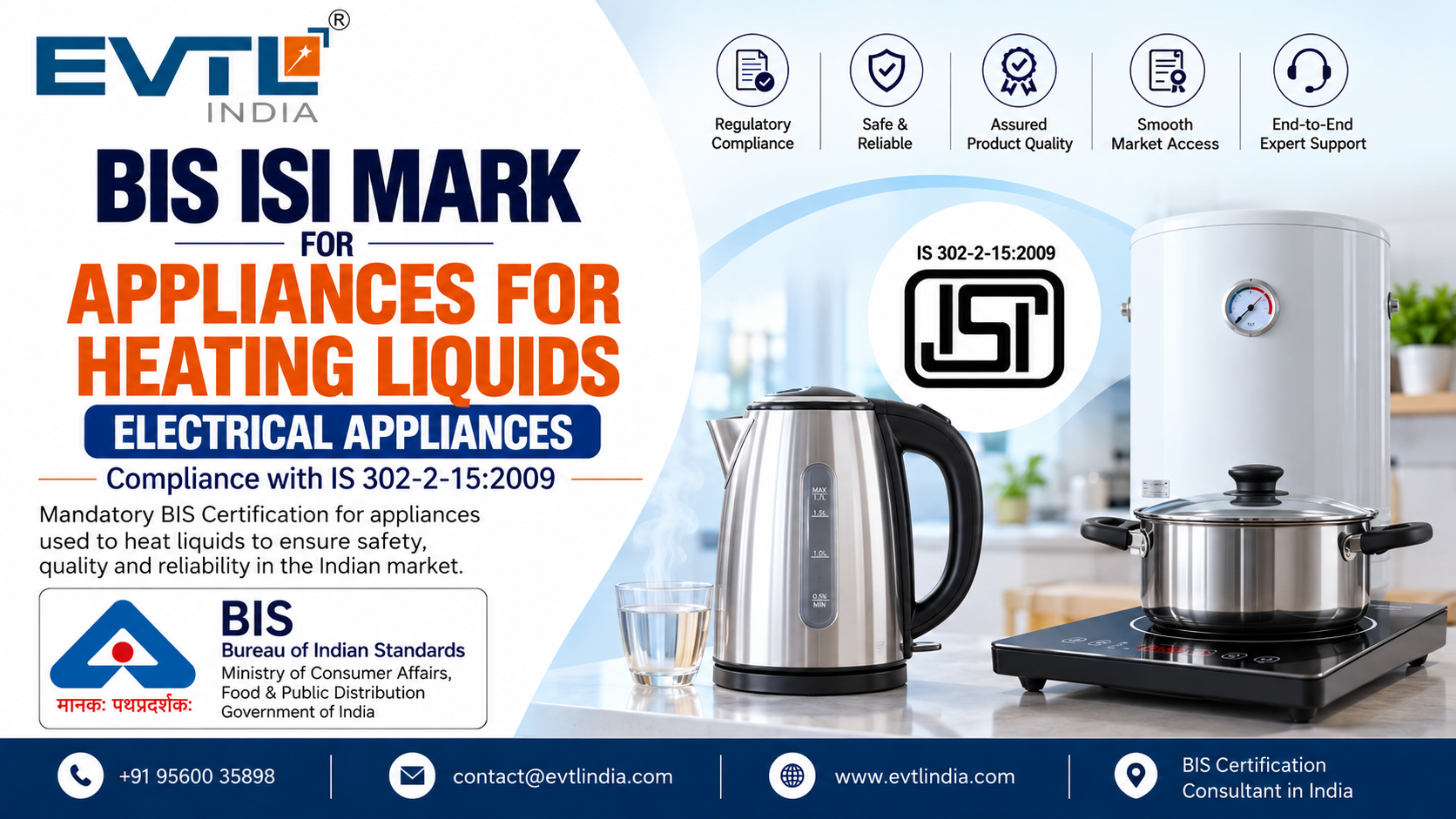
Electrical appliances used for heating liquids are widely used in homes, kitchens, hotels, offices and commercial establishments. Products such as electric kettles, milk heaters, egg boilers, steam cookers, slow cookers and other similar appliances are required to meet applicable electrical safety requirements before they are placed on the Indian market.
For these products, the relevant product-specific Indian Standard is IS 302 (Part 2/Sec 15):2009 – Safety of Household and Similar Electrical Appliances: Part 2 Particular Requirements: Section 15 Appliances for Heating Liquids (First Revision). BIS's current Product Manual for this standard identifies certification under Scheme-I.
An important current update is that the general requirements for household and similar electrical appliances are now covered by IS 302 (Part 1):2024 – Household and Similar Electrical Appliances – Safety: Part 1 General Requirements (Seventh Revision). Current BIS laboratory records show testing facilities referencing IS 302 Part 1:2024 together with the relevant Part 2 standards.
What Is BIS Certification for Appliances for Heating Liquids?
BIS Certification for Appliances for Heating Liquids is the conformity assessment process through which applicable products are evaluated against the relevant Indian Standards and BIS certification requirements.
For this product category, the specific safety requirements are given in IS 302-2-15:2009. The standard works with the applicable general requirements of the IS 302 series.
BIS's Product Manual for IS 302-2-15:2009 was issued under the BIS (Conformity Assessment) Regulations, 2018, Scheme-I and incorporates certification-related information including the product scope, grouping guidelines and Scheme of Inspection and Testing (SIT).
Applicable BIS Standard for Appliances for Heating Liquids
The principal product-specific standard is:
IS 302 (Part 2/Sec 15):2009
Title: Safety of Household and Similar Electrical Appliances: Part 2 Particular Requirements: Section 15 Appliances for Heating Liquids (First Revision).
The current BIS Product Manual available for this standard identifies IS 302-2-15:2009 and states that the Product Manual is used as reference material for certification under Scheme-I. It also records no amendments to the standard in that Product Manual.
Important 2026 Update
For current compliance work, manufacturers should not look at IS 302-2-15:2009 in isolation. BIS has introduced IS 302 (Part 1):2024, titled Household and Similar Electrical Appliances – Safety Part 1 General Requirements (Seventh Revision). Current BIS laboratory records list this 2024 general standard and show testing against relevant Part 2 requirements.
Therefore, the applicable compliance requirements should be checked against the latest BIS certification framework, applicable QCO requirements, IS 302 Part 1:2024 and the relevant Part 2 standard.
Products Covered Under Appliances for Heating Liquids
The scope can cover a range of appliances designed for heating liquids. Current BIS laboratory scope information lists examples including:
-
Milk heaters
-
Electric kettles
-
Appliances for boiling water with rated capacity up to 10 litres
-
Egg boilers
-
Steam cookers
-
Slow cookers
-
Cooking pans
-
Feeding-bottle heaters
-
Wash boilers
-
Yoghurt makers
BIS laboratory information also identifies pressure cookers having a rated cooking pressure not exceeding 140 kPa and rated capacity not exceeding 10 litres within the listed scope of testing for this standard.
However, product classification should not be based only on the product's commercial name. The construction, intended use, rated capacity, electrical characteristics and actual product design need to be considered to determine the applicable standard.
BIS Certification Process for Appliances for Heating Liquids
The BIS Certification Process for Appliances for Heating Liquids generally involves the following stages.
Step 1: Identify the Applicable Standard
First, the manufacturer should determine whether the product falls under IS 302-2-15:2009 and identify the applicable general requirements under IS 302 Part 1:2024.
This is particularly important for products with multiple functions because another Part 2 section may apply depending on the product's principal function and construction.
Step 2: Review Product Construction
The manufacturer should review the product's:
-
Rated voltage
-
Rated power
-
Rated frequency
-
Capacity
-
Heating system
-
Electrical components
-
Controls
-
Protection features
-
Construction
-
Intended application
This information helps determine the applicable testing requirements.
Step 3: Prepare Technical Documentation
The manufacturer should prepare the technical information required for the BIS application and assessment.
Common documents and information may include:
-
Factory details
-
Product specifications
-
Product drawings
-
Circuit diagrams
-
Bill of Materials (BOM)
-
Critical component details
-
Component certificates, wherever applicable
-
Manufacturing process information
-
Quality-control arrangements
-
Product labels
-
User instructions/manual
-
Test-related documents
The exact documentation depends on the product and the BIS application requirements applicable at the time of submission.
BIS Testing Requirement for Appliances for Heating Liquids
BIS Testing Requirement for Appliances for Heating Liquids is determined from the applicable requirements of IS 302 Part 1 and IS 302-2-15, along with the current BIS testing and certification framework.
Depending on the product, testing can address areas such as:
-
Protection against electric shock
-
Power input and current
-
Heating
-
Leakage current
-
Electric strength
-
Moisture resistance
-
Spillage
-
Mechanical strength
-
Stability and mechanical hazards
-
Abnormal operation
-
Construction
-
Internal wiring
-
Components
-
Marking and instructions
-
Applicable EMC-related requirements
Current BIS laboratory records specifically show test entries for marking, protection against electric shock, power input, heating, moisture resistance, spillage, leakage current, electric strength and abnormal operation for this product category.
The exact test programme can differ according to the product design and applicable clauses.
BIS Testing and Current Laboratory Requirements
The BIS Laboratory Information Management System currently lists laboratories with testing facilities for IS 302 Part 2 Section 15:2009. The available scope can vary between laboratories, including specific exclusions for certain clauses or tests.
For example, current laboratory records show exclusions in some laboratory scopes for particular EMI/EMC tests, while other facilities have different testing capabilities. Therefore, manufacturers should verify the current laboratory scope before selecting a laboratory for product testing.
This is important because the existence of a laboratory entry for IS 302-2-15 does not necessarily mean that every test under the standard is available at that laboratory.
BIS Product Manual for Appliances for Heating Liquids
The BIS Product Manual for Appliances for Heating Liquids is an important document for manufacturers applying for certification.
The current Product Manual is:
PM/IS 302-2-15/1/February 2024
It relates to IS 302-2-15:2009 and is intended as reference material for BIS offices, licensees and prospective applicants.
BIS issued a February 2024 communication confirming that the approved Product Manual incorporates the SIT and Grouping Guidelines for IS 302-2-15:2009 and that the incorporated SIT was to be implemented with immediate effect.
Therefore, the Product Manual should be reviewed when preparing the certification application.
BIS ISI Mark for Appliances for Heating Liquids
The applicable certification route for this product is associated with BIS Scheme-I, under which a manufacturer obtains a BIS licence to use the Standard Mark subject to the applicable requirements.
The term BIS ISI Mark for Appliances for Heating Liquids refers to the Standard Mark associated with BIS certification under the applicable product certification scheme.
The manufacturer should not use the BIS Standard Mark merely because the product has been tested. The mark must be used in accordance with the BIS licence and applicable marking requirements.
BIS Registration for Appliances for Heating Liquids
BIS Registration for Appliances for Heating Liquids is a commonly searched term, but manufacturers should distinguish between BIS registration and BIS product certification.
For products covered under the applicable Scheme-I certification framework, the relevant process involves BIS certification/licensing, rather than treating the product as a simple CRS-style registration.
The applicable route should always be confirmed based on the product, Indian Standard and current Quality Control Order requirements.
Scheme of Inspection and Testing (SIT)
The Scheme of Inspection and Testing (SIT) is an important part of the BIS certification framework.
The Product Manual for IS 302-2-15:2009 incorporates SIT and grouping information. The SIT specifies the inspection and testing requirements that the licensee needs to follow for maintaining conformity with the certified product requirements.
Manufacturers should therefore understand the testing frequency, controls and records applicable after obtaining the BIS licence rather than considering certification as a one-time laboratory test.
BIS ISI Mark Consultant for Appliances for Heating Liquids
A BIS ISI Mark Consultant for Appliances for Heating Liquids can support manufacturers during different stages of the certification process.
Consultancy support may include:
-
Identifying the applicable Indian Standard
-
Reviewing product specifications
-
Preparing BIS application documents
-
Coordinating product testing
-
Reviewing test reports
-
Supporting factory documentation
-
Understanding SIT requirements
-
Supporting BIS inspection preparation
-
Assisting with licence-related documentation
-
Supporting post-licence compliance
The consultant can facilitate the process, but the manufacturer remains responsible for ensuring that the product and manufacturing controls meet the applicable requirements.
Conclusion
EVTL India is one of the leading BIS Consultant in India, helping manufacturers obtain their BIS licences hassle-free. Manufacturers and importers dealing with appliances for heating liquids should use the current BIS requirements rather than relying on older general-standard information.
The product-specific standard remains IS 302 (Part 2/Sec 15):2009, while the current general requirements have moved to IS 302 (Part 1):2024. BIS's current laboratory database continues to list IS 302-2-15:2009 for testing and also records testing against the newer IS 302 Part 1:2024 framework.
The certification process should therefore cover standard identification, product classification, technical documentation, applicable testing, BIS application, factory assessment where applicable, SIT requirements and licence/ISI Mark compliance.
For businesses searching for a BIS consultant for Appliances for Heating Liquids, it is advisable to review the product's exact specifications first, because the applicable testing scope and certification requirements can vary according to the product design and current BIS requirements.

