


3D Cardiac Mapping System Market Outlook: Size, Share & CAGR 2026–2034
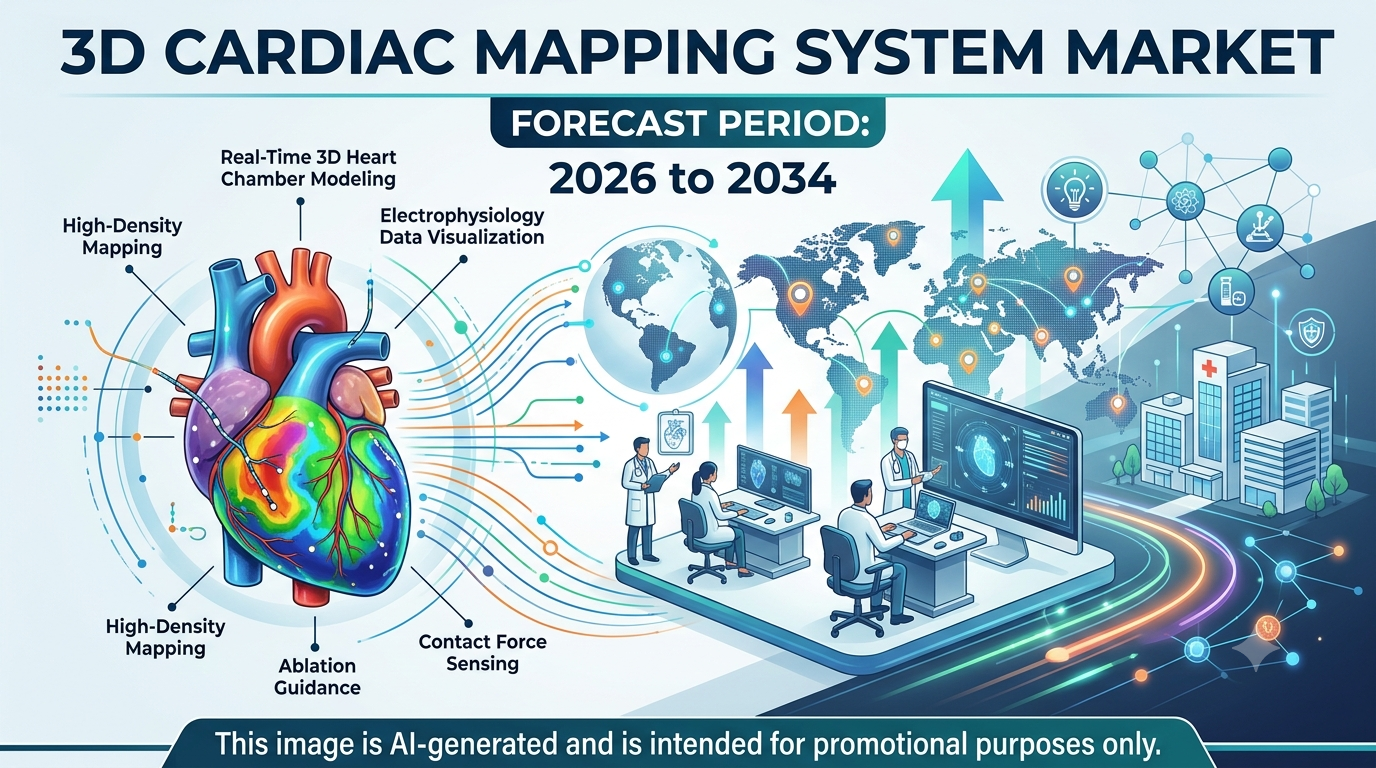
The 3D Cardiac Mapping System Market is developing as hospitals and cardiac care centers increasingly use advanced mapping technologies. These solutions help identify abnormal electrical activity and support precise treatment planning for patients with cardiac rhythm disorders.
The 3D cardiac mapping system market was valued at US$ 1.96 Billion in 2025 and is projected to reach US$ 3.12 Billion by 2034, registering a CAGR of 8.1% during 2026–2034.
What is driving the market?
The rising global burden of cardiac arrhythmias (such as atrial fibrillation and ventricular tachycardia), expanding adoption of catheter ablation procedures, and demand for non-fluoroscopic, high-resolution navigation are the principal growth drivers. Healthcare providers are increasingly required to deliver precise, real-time electroanatomical modeling to guide therapy while minimizing X-ray exposure for both patients and clinical teams. Electrophysiology labs and specialty cardiac centers are seeking systems that integrate contact force sensing, automated signal interpretation, and multimodality image fusion without compromising clinical throughput.
The market transition is moving beyond basic catheter tracking toward intelligent, high-density substrate mapping. Device manufacturers are investing in AI-driven electrogram analysis, high-density multi-electrode catheter integration, open-architecture navigation platforms, and hybrid systems compatible with pulsed-field ablation (PFA). High capital installation costs, expensive single-use mapping catheters, and a global shortage of specialized electrophysiologists remain important constraints.
Which region leads?
North America leads the market, accounting for an estimated 38%–42% share in 2025, supported by early adoption of advanced EP technologies, well-established reimbursement frameworks for catheter ablation, and significant capital expenditure across specialized heart centers.
Asia Pacific is the fastest-growing region with a projected CAGR of 8.6%–9.4%. Growth is propelled by expanding healthcare infrastructure, rising cardiovascular disease prevalence, increasing procedural volumes, and heavy investment in EP lab capabilities across China, India, and Japan. Europe holds an estimated 27%–31% market share, driven by strong clinical adoption of non-fluoroscopic mapping systems and favorable clinical guidelines for arrhythmia management.
Which segment leads?
Electroanatomical Mapping (EAM) Systems is the leading technology segment, representing an estimated 58%–62% of market revenue in 2025. Its dominant position is backed by high diagnostic accuracy, real-time 3D cardiac chamber reconstruction, and widespread integration into gold-standard catheter ablation workflows. The segment is forecast to maintain steady momentum as multi-electrode high-density mapping gains ground.
By end-use facility, Hospitals & Heart Centers lead with an estimated 68%–72% share in 2025, reflecting heavy capital equipment investments, specialized surgical infrastructure, and high volumes of complex arrhythmia interventions. Ambulatory Surgical Centers (ASCs) & Outpatient EP Labs are identified as high-growth end-use segments, propelled by the shift of routine ablation procedures to cost-effective outpatient settings.
Which companies are prominent?
The report identifies Biosense Webster (Johnson & Johnson), Abbott Laboratories, Boston Scientific Corporation, Medtronic plc, Koninklijke Philips N.V., MicroPort Scientific Corporation, Acutus Medical, Biotronik SE & Co. KG, EPMap-System GmbH, and Catheter Precision Inc. as prominent market participants.
These companies compete across electroanatomical mapping platforms, high-density catheters, navigation software, imaging fusion modules, and integrated ablation technologies. Strategic differentiation increasingly depends on mapping speed, spatial resolution, compatibility with emerging ablation modalities (such as Pulsed Field Ablation/PFA), machine-learning algorithm integration, and clinical workflow simplification. The list reflects the report's competitive landscape rather than a revenue-ranked market-share table.
What is changing in 2026?
The market is shifting from isolated 3D mapping equipment toward fully integrated, multi-modality electrophysiology digital ecosystems. Mapping platforms increasingly incorporate AI-powered automated arrhythmia circuit mapping, real-time MRI/CT image overlay, and direct compatibility with non-thermal ablation modalities like Pulsed Field Ablation (PFA). Updated clinical guidelines and regulatory approvals across major markets favor ultra-high-density mapping to shorten procedure times and reduce recurrence rates.
Medical device manufacturers are accelerating the rollout of open-architecture mapping systems, single-shot mapping catheters, and cloud-connected procedural data analytics. Procurement decisions are increasingly tied to clinical efficiency metrics, radiation reduction data, and procedural success rates, prompting closer partnerships between medical technology vendors, clinical electrophysiologists, and hospital networks.
What are the major investment opportunities?
The strongest opportunities lie in high-density rapid mapping catheters, AI-assisted electrogram interpretation, integrated PFA-mapping platforms, and low-cost mapping hardware designed for emerging markets. Investment in software algorithms that automate scar characterization, gap identification, and activation pathway tracing offers clear differentiation and high margin potential.
Additional opportunities include non-invasive ECG-based 3D mapping systems, catheter navigation robotics, and cloud-based EP procedure data management systems. Outpatient EP centers and ambulatory surgical networks represent expanding procurement channels for compact, versatile mapping consoles.
Asia Pacific offers attractive long-term expansion potential as rising healthcare expenditure drives EP lab establishment. Investors should prioritize technologies that reduce total procedure duration, lower radiation exposure, streamline the learning curve for electrophysiologists, and demonstrate clear compatibility with next-generation ablation tools.
The Insight Partners provides comprehensive syndicated and tailored market research services in the healthcare, technology, and industrial domains. Renowned for delivering strategic intelligence and practical insights, the firm empowers businesses to remain competitive in ever-evolving global markets.
• Email: sales@theinsightpartners.com
• Website: theinsightpartners.com
• Phone: +1-646-491-9876

