


Can laminar airflow be integrated into a Modular Ophthalmic Operation Theatre?
INTRODUCTION
Yes, laminar airflow can be integrated into a Modular Ophthalmic Operation Theatre when the system is properly engineered around the surgical application, room layout, HVAC capacity, HEPA filtration, equipment arrangement, pressure relationships, and infection-control requirements. Laminar or unidirectional airflow can provide controlled movement of filtered air across a defined surgical zone and can form part of a broader strategy for managing airborne contamination. Successful integration requires coordination between modular construction, HVAC, filtration, airflow distribution, surgical equipment, electrical services, medical gases, environmental monitoring, and testing.
What Is Laminar Airflow?
Laminar airflow, commonly called unidirectional airflow, is a controlled airflow pattern in which filtered air moves in a predominantly consistent direction through a designated zone.
In an operating theatre, the objective is to control airborne particle movement around the critical surgical area. The system generally works together with HEPA filtration and an appropriately designed air-handling system.
Indian National Guidelines for Infection Prevention and Control describe laminar airflow as HEPA-filtered air delivered in a unidirectional pattern and discuss its use in certain prolonged surgical procedures. The same guidance describes HVAC, pressure, filtration, and airflow control as important components of environmental infection-control measures.
Why Consider Laminar Airflow for an Ophthalmic OT?
Ophthalmic surgery requires precision, controlled environmental conditions, and carefully planned equipment placement. Airborne particles can originate from personnel, clothing, equipment, materials, and normal room activity.
A properly designed airflow system can help:
- Control airflow direction
- Reduce uncontrolled airborne particle movement
- Support contamination-control objectives
- Provide filtered air to a designated critical area
- Coordinate air movement with the surgical layout
- Improve environmental consistency
- Support appropriate pressure relationships
However, laminar airflow should not be considered a substitute for sterilization, cleaning, surgical technique, personal hygiene, or hospital infection-control procedures.
How Is Laminar Airflow Integrated into a Modular Ophthalmic Operation Theatre?
Integration should begin during the planning and engineering stage rather than after the modular OT has already been constructed.
1. Site and Room Assessment
The first step is to assess the proposed OT space.
Engineers may evaluate:
- Room dimensions
- Ceiling height
- Existing HVAC capacity
- Adjacent room arrangements
- Electrical capacity
- Medical gas infrastructure
- Structural conditions
- Door locations
- Existing air-handling equipment
- Ophthalmic equipment requirements
This assessment helps determine whether the existing infrastructure can support the proposed airflow configuration.
2. Customized Airflow Planning
Laminar airflow should be customized according to the intended surgical application.
The design should consider:
- Critical surgical zone
- Air supply locations
- Return-air locations
- Airflow direction
- Airflow velocity
- Room geometry
- Ceiling-mounted equipment
- Personnel movement
- Surgical workflow
- Pressure relationships
A standard airflow unit cannot simply be placed in every OT using the same arrangement. The surrounding room and equipment can significantly influence airflow behavior.
3. HEPA Filtration Integration
HEPA filtration is a central component of many controlled airflow systems.
The filtration arrangement should consider:
- Filter efficiency
- Filter housing
- Sealing
- Pressure drop
- Replacement access
- Filter integrity
- Maintenance requirements
- Airflow volume
NCDC guidance recommends positive-pressure circulation through HEPA filters in operation theatres and states that HEPA filter efficiency should be monitored regularly and filters changed when required.
The filter, housing, ductwork, and terminal arrangement should therefore be treated as one engineered system.
4. HVAC Integration
Laminar airflow cannot be effectively designed in isolation from HVAC.
The HVAC system must be evaluated for:
- Supply-air volume
- Return-air volume
- Fresh-air requirements
- Temperature
- Humidity
- Air changes
- Pressure
- Equipment heat loads
- Filtration stages
Indian infection-control guidance recommends central air-conditioning for operation theatres and identifies an OT temperature range of 18–24°C. It also recommends a ventilation rate of 20 air changes per hour for an OT.
These values should be treated as project guidance and confirmed against the applicable design criteria, clinical requirements, and current regulations.
5. Pressure Relationship
Pressure control helps prevent unwanted airflow from surrounding areas into the cleaner operating environment.
The design can incorporate:
- Positive pressure
- Differential-pressure monitoring
- Air balancing
- Controlled supply and return volumes
- Appropriate door arrangements
- Pressure alarms
NCDC guidance describes pressure gradients as a way of directing airflow from cleaner or aseptic areas toward less-clean areas.
The pressure relationship should be established through engineering calculations and verified after installation.
6. Modular Ceiling Integration
The modular ceiling provides an opportunity to integrate laminar airflow with other OT services.
The ceiling may need to accommodate:
- HEPA filter housings
- Air-supply plenums
- Surgical lights
- Operating microscope supports
- Electrical services
- Medical gas services
- Data connections
- Access panels
Proper coordination is essential because ophthalmic equipment and airflow components can occupy overlapping areas.
7. Operating Microscope Coordination
An ophthalmic operating microscope is often a major consideration when designing the airflow system.
The airflow arrangement should account for:
- Microscope position
- Ceiling support
- Surgical light position
- Operating table
- Surgeon location
- Assistant location
- Patient-monitoring equipment
Large equipment can interrupt airflow and generate turbulence. Therefore, equipment placement should be finalized as early as possible.
8. Ophthalmic Equipment Integration
Other equipment may include:
- Phacoemulsification systems
- Ophthalmic lasers
- Surgical tables
- Patient monitors
- Surgical lighting
- Instrument tables
- Video systems
Each piece of equipment may require electrical, data, structural, or other utility connections.
Integrating these requirements during design prevents later modifications that could interfere with the airflow system.
9. Airflow Velocity and Uniformity
Airflow velocity is an important parameter for a unidirectional airflow system, but there is no single velocity that applies universally to every ophthalmic OT.
The appropriate design depends on:
- Airflow configuration
- Filter arrangement
- Critical-zone dimensions
- Equipment layout
- Room geometry
- Clinical application
- HVAC capacity
ISO 14644-3:2019 includes test methods for unidirectional clean zones, including measurement of airflow velocity and velocity uniformity where applicable.
Therefore, airflow velocity should be specified during engineering and verified after installation.
10. Airflow Direction
Airflow direction should be predictable and consistent with the approved design.
The system should be assessed for:
- Vertical or horizontal airflow configuration
- Supply-air distribution
- Return-air position
- Equipment obstruction
- Personnel movement
- Door openings
- Pressure relationships
ISO 14644-3:2019 provides airflow-direction and visualization test methods for cleanrooms and clean zones.
Airflow visualization can help identify unexpected turbulence or airflow patterns around equipment.
11. Hygienic Modular Construction
The modular OT enclosure should support the airflow and contamination-control strategy.
Important construction features include:
- Smooth wall surfaces
- Non-porous finishes
- Sealed joints
- Hygienic ceiling systems
- Suitable flooring
- Proper coving
- Sealed penetrations
- Easy-to-clean surfaces
NCDC guidance recommends hard, non-porous, smooth OT surfaces.
Good modular construction therefore complements rather than replaces the HVAC and filtration system.
12. Flooring and Wall-to-Floor Junctions
Flooring should withstand frequent cleaning and disinfection.
Potential design considerations include:
- Seamless or minimally jointed flooring
- Epoxy or other appropriate healthcare flooring
- Chemical resistance
- Slip resistance
- Smooth transitions
- Hygienic coving
The wall-floor junction should minimize areas where dust and contaminants can accumulate.
13. Temperature and Humidity Control
A laminar airflow system must operate within a stable environmental environment.
Temperature and humidity can influence:
- Patient comfort
- Staff comfort
- Equipment operation
- Condensation
- Environmental stability
- Airflow characteristics
The HVAC system should therefore be designed to maintain the approved environmental limits while accommodating equipment heat loads.
14. Personnel Movement
Personnel are a significant source of airborne particles in an operating theatre.
The design should minimize unnecessary movement through:
- Controlled access
- Appropriate entry arrangements
- Efficient equipment placement
- Defined workflow
- Adequate storage
- Convenient instrument positioning
NCDC guidance specifically notes that the number of people in an OT and unnecessary door opening should be minimized because these activities can affect contamination and airflow.
15. Environmental Monitoring
Environmental monitoring provides information about whether the OT is operating within defined conditions.
Monitoring may include:
- Temperature
- Relative humidity
- Differential pressure
- Filter pressure drop
- HVAC status
- Air-quality parameters
- Alarm conditions
Digital monitoring systems can display parameters centrally and provide alerts when predefined limits are exceeded.
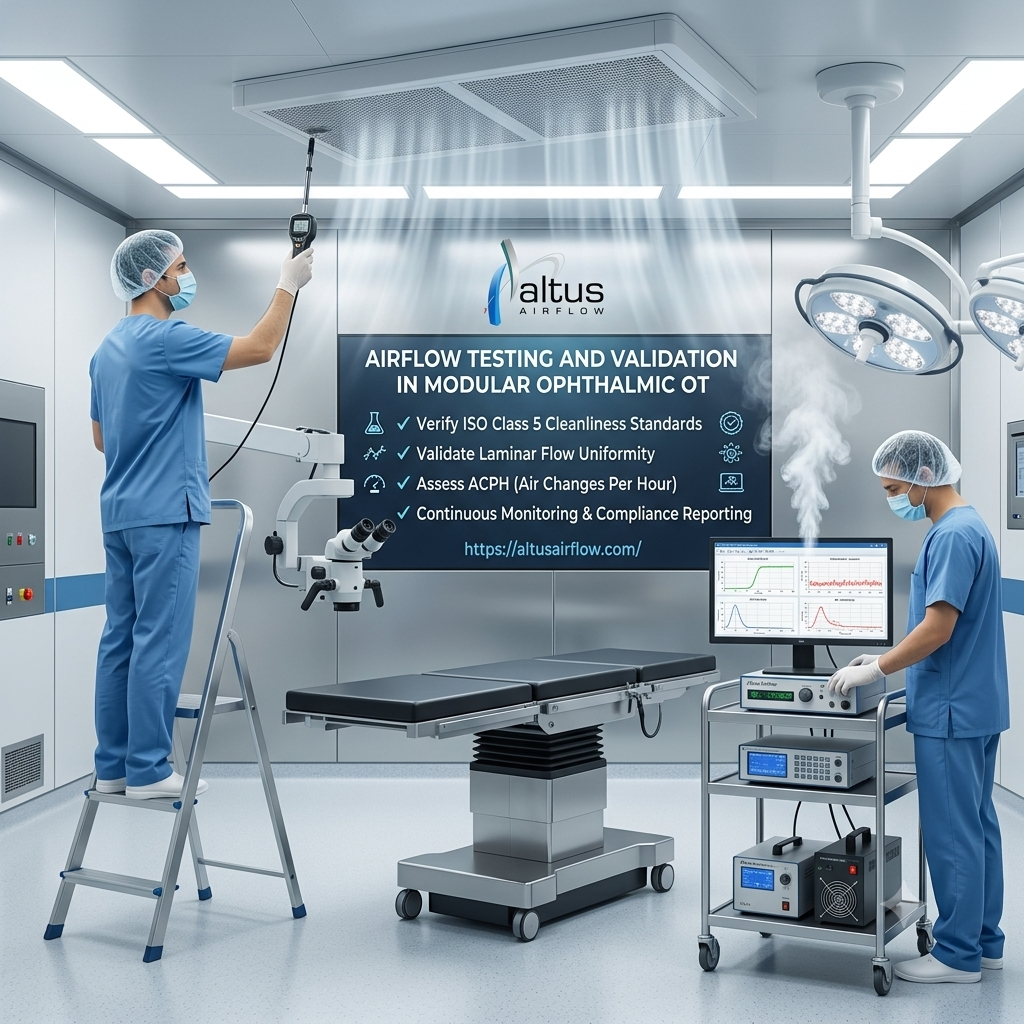
16. Testing After Installation
Installing a laminar airflow system is not enough. Performance should be verified after installation.
Testing may include:
- Airflow velocity
- Velocity uniformity
- Airflow direction
- Airflow visualization
- HEPA filter integrity
- Pressure differential
- Temperature
- Humidity
- Particle concentration where applicable
ISO 14644-3:2019 specifically covers testing for both unidirectional and non-unidirectional cleanrooms and clean zones and includes as-built, at-rest, and operational occupancy states.
17. HEPA Integrity Testing
HEPA filters should be checked for leaks or installation problems where the project specification requires integrity testing.
A proper test programme can help identify:
- Filter-media leakage
- Seal problems
- Housing leakage
- Installation defects
- Bypass paths
Testing should be carried out using an appropriate method and calibrated instruments.
18. Commissioning and Documentation
A complete project should include commissioning documentation.
This may include:
- Approved airflow drawings
- HVAC calculations
- Equipment schedules
- HEPA test reports
- Airflow test reports
- Pressure measurements
- Environmental test records
- Calibration certificates
- Commissioning reports
- Operation and maintenance manuals
Documentation provides a baseline for future maintenance and performance verification.
19. Preventive Maintenance
Laminar airflow performance can change over time because of filter loading, fan deterioration, sensor drift, equipment modifications, and other factors.
Maintenance can include:
- HEPA filter inspection
- Filter replacement when required
- Airflow measurement
- Fan and motor servicing
- Sensor calibration
- Pressure monitoring
- HVAC servicing
- Cleaning
- Control-system inspection
- Periodic performance testing
Maintenance intervals should be based on the equipment manufacturer's requirements, operating conditions, monitoring results, and hospital procedures.
20. Does Laminar Airflow Guarantee Sterility?
No. This distinction is important.
Laminar airflow can support environmental contamination-control objectives, but it does not independently guarantee sterility.
A safe ophthalmic surgical environment also depends on:
- Instrument sterilization
- Cleaning and disinfection
- Staff practices
- Surgical technique
- Appropriate PPE
- Equipment maintenance
- Environmental monitoring
- Infection-control policies
The airflow system should therefore be considered one component of a broader infection-prevention strategy.
Benefits of Integrating Laminar Airflow
A properly engineered system can offer several potential benefits:
- Controlled airflow direction
- Better filtration of supplied air
- Reduced uncontrolled airborne particle movement
- Improved environmental consistency
- Support for contamination-control measures
- Better integration with surgical equipment
- Improved monitoring
- Defined testing criteria
- Easier maintenance planning
The actual performance depends on design quality, installation, commissioning, operation, and maintenance.
Common Integration Mistakes
Hospitals should avoid:
- Installing laminar airflow without evaluating HVAC capacity
- Ignoring equipment obstruction
- Failing to test airflow
- Using unsuitable filter housings
- Neglecting pressure relationships
- Poor ceiling coordination
- Ignoring maintenance access
- Failing to document commissioning
- Assuming one airflow velocity suits every application
- Treating laminar airflow as a guarantee of sterility
A multidisciplinary engineering approach can prevent many of these problems.
How to Select the Right Integration Partner
Hospitals should assess a provider's experience in:
- Ophthalmic operation theatres
- Modular OT construction
- HVAC engineering
- HEPA filtration
- Laminar airflow
- Medical gases
- Electrical integration
- Surgical equipment coordination
- Environmental monitoring
- Testing and commissioning
- Preventive maintenance
The project scope should clearly identify who is responsible for design, supply, installation, testing, validation, documentation, and post-handover support.
Future-Ready Ophthalmic OT Design
Modern ophthalmic OTs can incorporate digital environmental monitoring, automated HVAC controls, remote alarms, energy-management systems, and predictive maintenance.
Future designs should also allow for:
- Equipment replacement
- Additional utilities
- HVAC upgrades
- Monitoring expansion
- Maintenance access
- Technology upgrades
Planning these requirements at the beginning can reduce the need for disruptive modifications later.
Conclusion
Laminar airflow can be successfully integrated into a Modular Ophthalmic Operation Theatre when it is treated as part of a coordinated environmental-control system rather than as a standalone product. Effective integration requires appropriate HVAC capacity, HEPA filtration, airflow distribution, pressure management, hygienic modular construction, equipment coordination, environmental monitoring, testing, commissioning, and preventive maintenance. The final configuration should be based on the clinical application, approved engineering criteria, hospital infection-control requirements, and applicable standards. Altus Airflow provides specialized modular healthcare infrastructure solutions with engineered airflow, HVAC integration, and project-specific OT planning.
Frequently Asked Questions
1. Can laminar airflow be integrated into a Modular Ophthalmic Operation Theatre?
Yes, a Modular Ophthalmic Operation Theatre can incorporate laminar or unidirectional airflow when the HVAC system, HEPA filtration, ceiling, equipment layout, pressure relationships, and clinical requirements are properly coordinated.
2. Why is laminar airflow used in a Modular Ophthalmic Operation Theatre?
Laminar airflow in a Modular Ophthalmic Operation Theatre can provide controlled movement of filtered air through a designated zone and support strategies for managing airborne particulate contamination.
3. Does a Modular Ophthalmic Operation Theatre require HEPA filtration?
A Modular Ophthalmic Operation Theatre using a controlled laminar airflow system generally incorporates appropriate HEPA filtration as part of its air-treatment strategy. Indian infection-control guidance recommends HEPA filtration for OT air and regular monitoring of filter performance.
4. Can laminar airflow be added to an existing Modular Ophthalmic Operation Theatre?
A Modular Ophthalmic Operation Theatre may be upgraded with laminar airflow if the existing ceiling, HVAC capacity, electrical infrastructure, structural support, room layout, and pressure strategy can accommodate the modification.
5. What airflow parameters should be tested in a Modular Ophthalmic Operation Theatre?
Testing a Modular Ophthalmic Operation Theatre may include airflow velocity, uniformity, airflow direction, visualization, pressure differential, HEPA integrity, temperature, humidity, and particle concentration where applicable. ISO 14644-3 provides relevant cleanroom test methods.
Read Our Previous Blog------>What standards and certifications should Laminar Airflow System Manufacturers follow?

