


Significant Beneficial Owner (SBO): Section 90 Compliance Guide
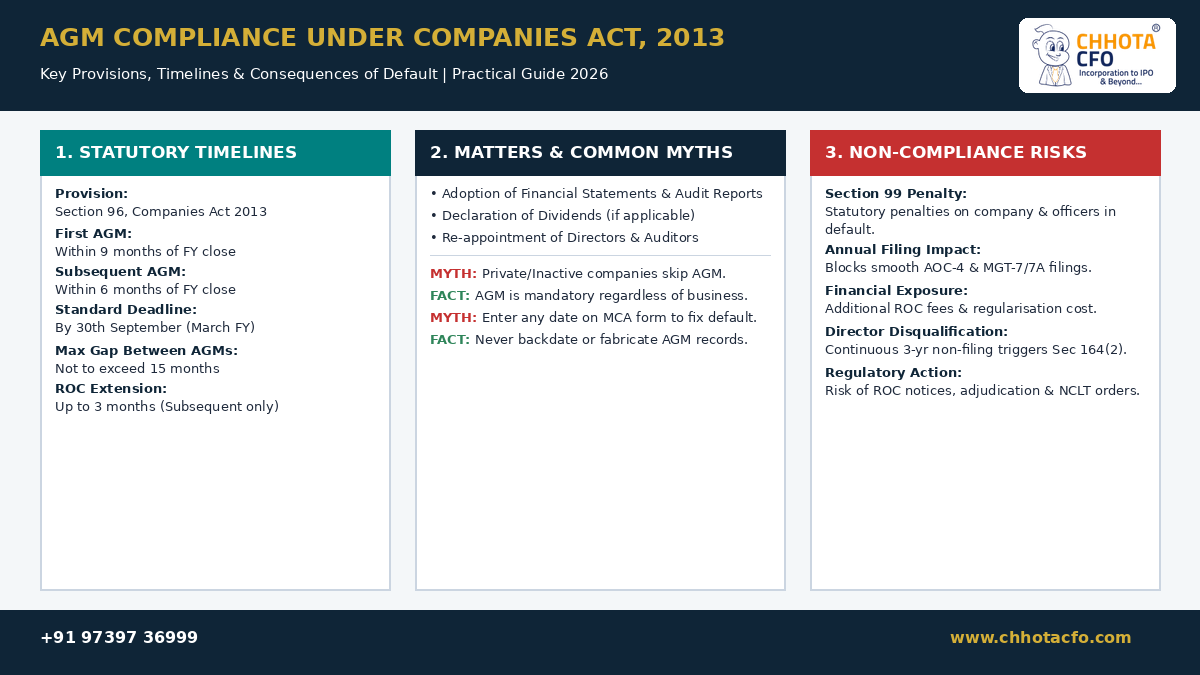
An Annual General Meeting (AGM) is a statutory corporate governance requirement under the Companies Act, 2013. It gives members an opportunity to consider the company’s financial performance, statutory reports, and other matters requiring shareholder approval.
Failure to hold an AGM within the prescribed timeline is a common ROC compliance issue and may result in penalties and related compliance consequences.
Need Help With AGM Compliance?
The following tabular guide provides a practical overview of AGM requirements.
1. AGM – Key Statutory Requirements
|
Particulars |
Requirement |
|
Primary Provision |
Section 96 of the Companies Act, 2013 |
|
Purpose of AGM |
To provide members an opportunity to consider financial statements, Board’s Report, Auditor’s Report, dividend and other applicable matters. |
|
Applicability |
Generally applicable to companies other than an OPC, subject to applicable exemptions. |
|
First AGM |
To be held within 9 months from the close of the first financial year. |
|
Subsequent AGM |
To be held within 6 months from the close of the financial year. |
|
Maximum gap |
The gap between two AGMs should generally not exceed 15 months. |
|
Financial year ending 31 March |
The AGM is ordinarily required to be held by 30 September. |
|
First AGM extension |
No extension can be granted by the Registrar of Companies. |
|
Extension for subsequent AGM |
ROC may extend the AGM period by up to 3 months for special reasons. |
|
Is ROC extension automatic? |
No. The company must obtain the applicable extension from the ROC. |
2. Matters Generally Considered at the AGM
|
Matter |
Requirement / Explanation |
|
Financial Statements |
Members consider and adopt the financial statements of the company. |
|
Board’s Report |
Placed before the members for consideration. |
|
Auditor’s Report |
Considered along with the financial statements. |
|
Dividend |
Declaration of dividend, wherever applicable. |
|
Directors |
Appointment, reappointment, or other director-related matters, wherever applicable. |
|
Auditors |
Matters relating to statutory auditors, wherever applicable. |
|
Other Business |
Other ordinary or special business permitted under the Companies Act. |
3. What Happens If the AGM Is Not Held?
|
Issue |
Consequence |
|
Failure to hold AGM |
Constitutes a statutory default under the Companies Act, 2013. |
|
Penalty |
Section 99 provides for penalties against the company and every officer in default, subject to the applicable statutory provisions. |
|
Annual filing impact |
May complicate annual ROC filings. |
|
Additional financial exposure |
Delayed statutory filings may result in additional fees and/or penalties. |
|
Multiple-year default |
Can result in accumulated ROC compliance issues requiring year-wise regularisation. |
|
Director-level risk |
Prolonged annual filing defaults may result in director disqualification under Section 164(2), where the statutory conditions are satisfied. |
|
Regulatory action |
Depending on the circumstances, the company may face ROC, adjudication, or tribunal-related proceedings. |
4. AGM Default vs. Annual Filing Default
|
Particulars |
AGM Default |
Annual Filing Default |
|
Nature |
Failure to conduct AGM within the prescribed period |
Failure to file prescribed annual forms within the statutory timeline |
|
Relevant provisions |
Sections 96 and 99 |
Applicable provisions governing annual filing |
|
Typical filings involved |
AGM records and related compliance |
AOC-4, MGT-7/MGT-7A, as applicable |
|
Penalty / Additional Fee |
Penalty under applicable provisions |
Additional filing fees and other applicable consequences |
|
Director impact |
AGM default alone does not automatically disqualify directors. |
Continuous non-filing for 3 financial years may trigger Section 164(2), subject to its conditions |
5. Does AGM Compliance Apply to Private Companies?
|
Question |
Position |
|
Is AGM applicable to a private limited company? |
Yes, generally. |
|
Does being a closely held company provide an automatic exemption? |
No. |
|
What if shareholders and directors are the same persons? |
The statutory AGM requirement does not automatically disappear. |
|
What if the company has no business? |
Lack of business activity does not automatically exempt the company from AGM compliance. |
|
What if the company is inactive? |
The company should continue statutory compliance unless it obtains an appropriate legal status, such as dormant status, or is lawfully struck off. |
6. Can the AGM Deadline Be Extended?
|
Details |
Position |
|
First AGM |
Extension by ROC is not available. |
|
Subsequent AGM |
ROC may extend the period by up to 3 months for special reasons. |
|
Automatic extension |
No. |
|
Best practice |
Apply for and get the applicable extension before the original AGM deadline expires. |
7. What If the Company Has Missed Its AGM?
|
Step |
Action Required |
|
1. Identify the default |
Determine the financial year for which the AGM was not held. |
|
2. Check MCA records. |
Review company master data and filing history. |
|
3. Review financial statements. |
Confirm that financial statements and related reports are available. |
|
4. Check audit status |
Verify the statutory auditor and related compliance. |
|
5. Review annual filings. |
Identify pending AOC-4, MGT-7/MGT-7A, and other applicable filings. |
|
6. Determine consequences |
Assess applicable penalties, fees, and other regulatory exposure. |
|
7. Regularise |
Follow the legally appropriate procedure to conduct the pending AGM and complete outstanding compliances. |
|
8. Maintain records |
Ensure proper notices, attendance records, minutes, and statutory registers are maintained. |
8. What If AGMs Are Pending for Many Years?
If a company has missed AGMs for many financial years, undertake a year-wise compliance review.
|
Area to Review |
Documents / Information |
|
Financial statements |
Balance Sheet, Statement of Profit & Loss, and Notes |
|
Audit |
Auditor’s Report and Auditor Appointment Status |
|
Board compliance |
Board’s report and board meeting records |
|
AGM |
Notices, attendance records, and minutes |
|
Annual filings |
AOC-4, MGT-7/MGT-7A, and other applicable filings |
|
Statutory registers |
Register of Members and other applicable registers |
|
Directors |
Current director status and DIN compliance |
|
MCA records |
Master data and filing history |
|
Regulatory matters |
ROC notices, adjudication orders, or Tribunal proceedings, if any |
Important: Conducting one AGM does not necessarily cut all historical defaults. Each pending year should be reviewed separately and regularised, as applicable.
9. Can a Company File AOC-4 and MGT-7 Without Holding the AGM?
This area requires careful handling.
|
Situation |
Recommended Approach |
|
AGM held |
File applicable annual forms based on the actual AGM and prescribed timelines. |
|
AGM not held |
Determine the appropriate statutory procedure before completing the filings. |
|
AGM overdue |
Assess the default and applicable regularisation process. |
|
Incorrect AGM date |
Do not provide a fictitious date merely to complete an MCA filing. |
|
Backdated AGM |
Avoid creating retrospective or inaccurate corporate records. |
A company should never fabricate AGM minutes or enter an incorrect AGM date merely to regularise an MCA filing.
10. Can the Tribunal Direct a Company to Hold an AGM?
Yes.
Under Section 97, where a company fails to hold its AGM under Section 96, the Tribunal may, on an application by a member, call or direct the calling of an AGM.
The Tribunal may also issue directions on how the meeting should be called and conducted.
This demonstrates that AGM compliance is a statutory obligation and not merely an internal administrative formality.
11. AGM Compliance Checklist
|
Compliance Activity |
Status |
|
Financial statements approved by the Board |
☐ |
|
Auditor’s Report available |
☐ |
|
The board’s report was prepared. |
☐ |
|
AGM notice prepared |
☐ |
|
AGM notice dispatched within the prescribed timeline |
☐ |
|
AGM held within statutory timeline |
☐ |
|
AGM minutes prepared and maintained |
☐ |
|
Statutory registers updated |
☐ |
|
AOC-4 filed within the prescribed timeline |
☐ |
|
MGT-7/MGT-7A filed within the prescribed timeline |
☐ |
|
Auditor-related compliance completed |
☐ |
|
MCA Master Data reviewed |
☐ |
|
Previous years’ AGM compliance reviewed |
☐ |
|
Pending ROC notices reviewed |
☐ |
Common AGM Compliance Mistakes
|
Mistake |
Why It Is a Problem |
|
“We are a private company, so an AGM is not required.” |
Private companies are generally subject to AGM requirements. |
|
“The company has no business, so AGM is unnecessary.” |
Inactivity does not automatically cut statutory obligations. |
|
“We can enter any AGM date in the MCA form.” |
MCA filings must reflect the actual legal position. |
|
“One AGM will resolve all previous defaults.” |
Historical defaults must be addressed separately from regularisation. |
|
“We will wait until ROC sends a notice.” |
Delay can increase financial and regulatory exposure. |
|
“We can prepare backdated minutes.” |
False or retrospective records may create more serious compliance issues. |
Key Takeaway
An AGM is not merely an ROC formality. It is an important statutory corporate governance need under the Companies Act, 2013.
Failure to hold an AGM may result in:
- Statutory penalties;
- Annual filing complications;
- Accumulation of ROC defaults;
- More compliance costs; and
- Potential director-level consequences where the statutory conditions for disqualification are satisfied.
For companies that have already missed an AGM, the appropriate approach is to undertake a year-wise compliance review, identify all pending filings and defaults, assess the applicable consequences, and install a proper regularization plan.
A company may be inactive, but its statutory compliance obligations do not automatically become inactive.

