


LSF vs FEMA Compounding: What Should You Do? | Chhota CFO
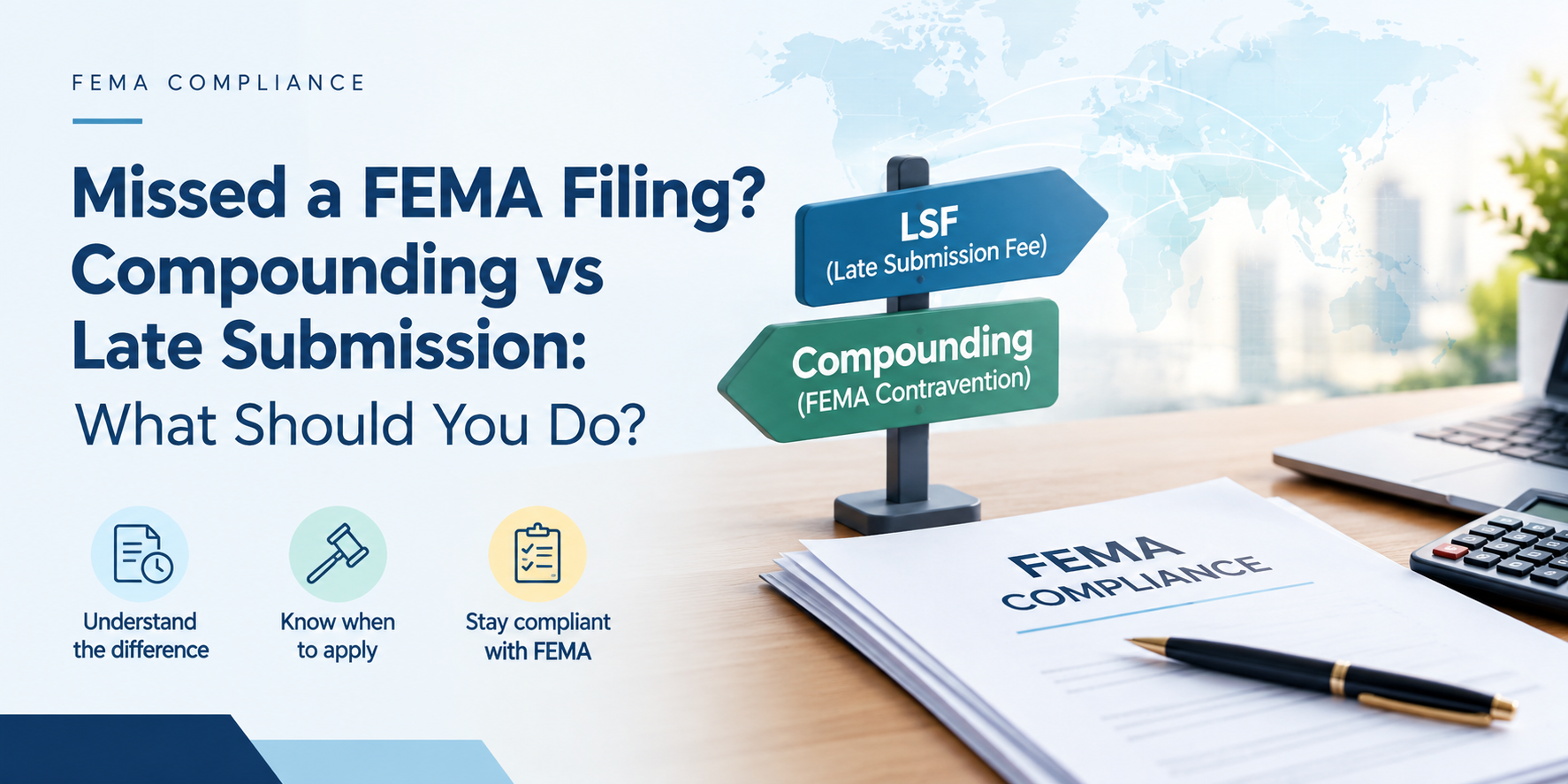
Missed a FEMA reporting deadline? Don’t immediately assume that you need compounding. The first step is to identify whether the issue is a specified reporting delay, a substantive FEMA contravention, or both.
For businesses looking to understand financing options and make informed financial decisions, Chhota CFO provides professional accounting, taxation and financial advisory support.
For Indian companies receiving foreign investment, making overseas investments, raising ECBs or having foreign assets and liabilities, FEMA compliance involves multiple reporting requirements.
A missed filing can create uncertainty, particularly when the company later plans to raise funds, undertake an M&A transaction, transfer shares or undergo investor due diligence.
The important question is:
Should you pay Late Submission Fee (LSF), apply for compounding, or take another regulatory action?
The answer depends on the nature of the default and the specific FEMA framework applicable to the transaction.
Need help choosing the right financial approach for your business?
Chhota CFO can help you understand your options and plan the right financial strategy for your business. Get in touch with our experts today.
1. LSF vs Compounding: What Is the Difference?
|
Particulars |
Late Submission Fee (LSF) |
FEMA Compounding |
|
Purpose |
Addresses specified delays in FEMA reporting |
Regularises eligible contraventions under FEMA |
|
When applicable? |
Only where the applicable FEMA framework provides for LSF |
Where an eligible FEMA contravention has occurred |
|
Typical issue |
Delay in filing/reporting |
Breach of FEMA provisions, rules or regulations |
|
Process |
Payment of prescribed LSF and completion of reporting |
Formal compounding application and regulatory process |
|
Is it automatic for every delay? |
No |
No |
|
Does it cover substantive violations? |
Not necessarily |
May cover eligible contraventions |
|
Key consideration |
Whether LSF is specifically available for that reporting requirement |
Nature and eligibility of the contravention |
RBI’s FEMA framework provides a compounding mechanism under Section 15 of FEMA, 1999 for eligible contraventions. RBI also provides LSF mechanisms for specified delayed reporting requirements.
For businesses seeking professional guidance, working with a chartered accountant in Bangalore can help evaluate the financial and compliance aspects of different options.
2. What Is FEMA Compounding?
Section 15 of FEMA, 1999 provides for compounding of certain contraventions.
|
Point |
Explanation |
|
What is it? |
A regulatory mechanism for dealing with eligible FEMA contraventions |
|
Authority |
The competent authority prescribed under the FEMA framework |
|
Trigger |
Contravention of FEMA or rules/regulations made under FEMA |
|
Process |
Application, examination of the contravention and determination of the compounding amount |
|
Outcome |
The contravention is regularised subject to the applicable compounding order and compliance |
In simple terms:
Contravention → Compounding application → Regulatory examination → Compounding order → Compliance with order
The RBI maintains a specific framework and FAQ for FEMA compounding.
FEMA and RBI compliance services
3. What Is Late Submission Fee?
LSF is a mechanism available for specified delays in FEMA reporting.
It is important to understand that LSF is not a general penalty or universal remedy for every FEMA violation.
|
Question |
Position |
|
Is LSF available for every FEMA filing? |
No |
|
Is LSF available for specified reporting delays? |
Yes, where prescribed |
|
Does paying LSF automatically cure every FEMA violation? |
No |
|
Should the underlying transaction also be reviewed? |
Yes |
For example, RBI provides an LSF mechanism in relation to delayed FLA Return reporting, subject to the applicable framework.
4. Which FEMA Areas Commonly Create Compliance Issues?
|
FEMA Area |
Common Compliance Issue |
What Should Be Checked? |
|
FDI |
Delay in reporting foreign investment |
Applicable reporting form, allotment/transfer details and valuation |
|
FC-GPR |
Delay in reporting issue of shares to non-residents |
Allotment date, valuation, documents and reporting timeline |
|
FC-TRS |
Delay in reporting transfer of shares |
Transfer details, parties, consideration and reporting |
|
Return filed after due date |
Applicability, reporting period and LSF availability |
|
|
ODI |
Delayed overseas investment reporting |
Investment structure, UIN/ODI filings and supporting documents |
|
APR / Overseas Reporting |
Delay in annual reporting |
Overseas entity details and applicable reporting requirements |
|
ECB |
Delayed ECB reporting |
Loan terms, ECB filings and LSF provisions |
|
Share Transfer |
FEMA reporting not completed |
Resident/non-resident status and applicable pricing/reporting rules |
|
Foreign Subsidiary |
Historical FEMA filings incomplete |
Investment, funding, annual reporting and exit documentation |
The applicable FEMA provisions can depend on the date and nature of the transaction.
5. A Delayed Filing Is Not Always the Same as a FEMA Contravention
Consider the following:
|
Situation |
Initial Question |
|
Filing submitted late |
Is LSF specifically available for this reporting delay? |
|
Filing completely missed |
What reporting requirement applies and can it still be completed? |
|
Incorrect information reported |
Does the error create a separate FEMA issue? |
|
Transaction itself breached FEMA conditions |
Is there a substantive contravention requiring further action? |
|
Both transaction and reporting are non-compliant |
Each issue needs to be separately examined |
Therefore, the company should not simply ask:
“How much is the penalty?”
The better question is:
“What exactly is the FEMA default, and what regulatory mechanism applies to it?”
6. Practical Decision Table
|
Step |
Question |
Action |
|
1 |
What transaction occurred? |
Identify FDI, ODI, ECB, FLA or other FEMA transaction |
|
2 |
What reporting requirement applied? |
Identify the relevant FEMA regulation/circular |
|
3 |
Was the filing merely delayed? |
Check whether LSF is available |
|
4 |
Is there a substantive violation? |
Examine whether a FEMA contravention has occurred |
|
5 |
Is LSF applicable? |
Follow the prescribed LSF mechanism |
|
6 |
Is the matter an eligible contravention? |
Examine the compounding route |
|
7 |
Are other FEMA issues involved? |
Regularise each issue through the applicable mechanism |
|
8 |
Is the transaction required for a future corporate event? |
Complete FEMA regularisation before fundraising/M&A/due diligence where appropriate |
7. Example: Delayed FLA Return
Suppose an Indian company is required to file its FLA Return but misses the prescribed reporting deadline.
The company should not automatically assume that a compounding application is required.
|
Question |
Assessment |
|
Is the company required to file FLA? |
Determine based on its foreign assets/liabilities |
|
Was the return filed late? |
Identify the period of delay |
|
Is LSF prescribed? |
Check the applicable RBI mechanism |
|
Are the underlying figures correct? |
Verify books and foreign investment records |
|
Is there any separate FEMA violation? |
Review the underlying transaction |
|
Next step |
Complete the applicable reporting/regularisation process |
This illustrates why identifying the exact nature of the default is the first step.
8. Example: Foreign Investment With Multiple Issues
Consider an Indian company that received foreign investment but:
- delayed the applicable reporting;
- did not maintain complete valuation documentation; and
- has an issue relating to the terms of the transaction.
Here, the company should not assume that payment of an LSF, if available for the reporting delay, resolves every issue.
|
Issue |
Separate Review Required? |
|
Reporting delay |
Yes |
|
Valuation compliance |
Yes |
|
Transaction terms |
Yes |
|
Foreign investor eligibility |
Yes |
|
Pricing guidelines |
Yes |
|
Other FEMA conditions |
Yes |
One transaction can therefore contain more than one compliance issue.
9. What Documents Should Be Collected?
Before approaching the AD bank, RBI or other competent authority, the company should prepare a complete transaction file.
|
Document |
Purpose |
|
Board resolutions |
Establish approvals |
|
Share certificates / securities records |
Verify investment/allotment |
|
Share subscription or transfer agreement |
Establish transaction terms |
|
Valuation report |
Examine pricing compliance |
|
Bank statements |
Verify receipt/payment of consideration |
|
Foreign investor details |
Establish investor status |
|
FEMA forms and acknowledgements |
Establish reporting history |
|
AD bank correspondence |
Track regulatory communication |
|
Financial statements |
Verify accounting treatment |
|
Shareholding pattern |
Verify ownership |
|
Previous FEMA filings |
Identify historical compliance |
|
Details of delay |
Establish timeline and circumstances |
10. Why Historical FEMA Defaults Matter
A FEMA issue that appears minor today can become important when the company undertakes a major transaction.
|
Future Event |
Why FEMA Compliance Matters |
|
Fundraising |
Investors may conduct FEMA due diligence |
|
Share transfer |
Historical reporting may need to be reviewed |
|
M&A transaction |
Legal due diligence may identify FEMA defaults |
|
Foreign investment |
Existing non-compliance may affect transaction planning |
|
Overseas expansion |
Historical ODI compliance may be reviewed |
|
Exit by investor |
FEMA documentation may be required |
|
Banking transactions |
AD banks may require supporting documentation |
Therefore:
Do not wait for a fundraising or M&A transaction to discover an old FEMA default.
11. Common Mistakes Companies Make
|
Mistake |
Why It Can Be a Problem |
|
Treating every delay as a compounding matter |
LSF may be available for specified reporting delays |
|
Assuming LSF cures everything |
Substantive FEMA violations may remain |
|
Looking only at the missed form |
The underlying transaction may also require review |
|
Using an outdated FEMA checklist |
Regulations and reporting mechanisms can change |
|
Ignoring historical defaults |
They may surface during due diligence |
|
Filing without checking transaction documents |
Incorrect reporting can create further complications |
|
Assuming the AD bank can resolve every contravention |
Some matters may require a separate regulatory process |
12. LSF or Compounding — The Key Difference
The distinction can be remembered simply:
|
LSF |
Compounding |
|
Think specified reporting delay |
Think eligible FEMA contravention |
|
Available only where prescribed |
Subject to the FEMA compounding framework |
|
Reporting-focused |
Contravention-focused |
|
Prescribed fee mechanism |
Formal regulatory process |
|
Not available for every FEMA filing |
Not required for every reporting delay |
Not sure which option is right for your business?
Our experts at Chhota CFO can help you evaluate the financial implications and choose an approach that supports your business goals. Talk to Chhota CFO today.
13. What Should a Company Do After Discovering a FEMA Default?
A practical approach is:
Identify the transaction
↓
Identify the applicable FEMA provision
↓
Determine the exact nature of the default
↓
Check whether LSF is available
↓
Check whether any substantive FEMA contravention exists
↓
Complete the applicable reporting/regularisation process
↓
Maintain complete supporting records
↓
Review historical FEMA compliance before the next transaction
This approach helps ensure that a company does not treat a complex FEMA issue as merely a delayed filing.
Conclusion:
A missed FEMA filing should not automatically lead to the conclusion that compounding is required.
The first step is to understand the nature of the default.
If the issue is a specified reporting delay for which an LSF mechanism is available, the company should follow the applicable LSF process.
If the matter involves an eligible FEMA contravention, the compounding mechanism may need to be examined.
And where the underlying transaction itself has FEMA-related issues; those should be reviewed separately.
The key takeaway is:
LSF and compounding are not interchangeable. The correct FEMA regularisation route depends on the specific transaction, reporting requirement and nature of the default.
For companies with foreign investment or overseas transactions, a periodic FEMA compliance review can help identify historical issues before they become obstacles during fundraising, M&A, restructuring or investor due diligence.
How Chhota CFO Can Help
FEMA compliance issues can involve more than a missed filing. Chhota CFO can help businesses review their FEMA reporting history, identify applicable regularisation requirements, organise supporting documents and assess the appropriate compliance route for reporting delays or eligible contraventions.
Need help reviewing a FEMA compliance issue? Contact Chhota CFO for professional assistance.

