


Supported Ball Mechanisms for Industrial Flow Control
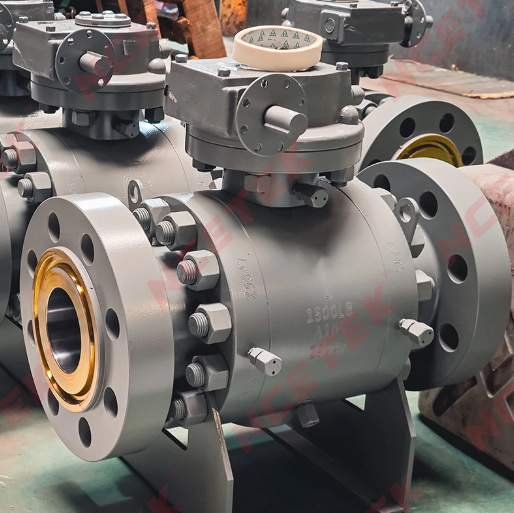
Large industrial pipelines can expose valves to substantial pressure, mechanical loads, and repeated operating cycles. A Cast Steel Trunnion Mounted Ball Valve combines a cast steel body with a supported ball structure, providing a configuration designed around the mechanical requirements of many large-scale pipeline systems. Reliable operation depends on coordinated engineering of the body, trunnion supports, ball, seats, stem, sealing components, and operating mechanism.
Cast steel construction allows manufacturers to produce complex valve body geometries while accommodating different internal passages and pipeline connection arrangements. The casting process is followed by machining of critical areas that determine assembly accuracy. Internal cavities, seat pockets, stem openings, connection surfaces, and support interfaces require controlled dimensions so that the completed components fit together correctly.
The trunnion-mounted structure is a key feature of this valve configuration. The ball is supported at designated points rather than being allowed to move freely within the body. This arrangement can reduce the amount of mechanical load transferred through the seats and can influence the operating torque required to rotate the ball. Such characteristics can be valuable when valves are used in larger pipeline systems, although the exact design should correspond to the pressure, temperature, size, and application requirements.
Seat design remains essential even with mechanical ball support. The seats need to establish controlled contact with the ball and provide the required isolation characteristics. Different seat materials and configurations may be selected according to the process medium, temperature range, pressure conditions, and expected operating cycles. Chemical compatibility is particularly important for process systems where aggressive fluids may affect sealing materials over extended service periods.
The stem transfers movement from the operating mechanism to the ball, making stem design another important engineering consideration. Accurate machining of the stem and its interfaces helps provide predictable operation. Depending on the application, the valve may be operated manually or connected to pneumatic, electric, or hydraulic actuation equipment. The actuator should be appropriately matched with the valve's operating requirements.
Manufacturing quality control should extend from the initial casting through final testing. Cast components can be inspected for surface and structural conditions before machining. Critical dimensions should then be verified during production and after machining. During assembly, technicians need to confirm the correct positioning of the trunnion supports, ball, seats, stem, and sealing elements.
Completed valves can undergo pressure and leakage testing according to applicable specifications and project requirements. Body testing provides information about structural integrity, while closure testing evaluates sealing performance. Operational testing can also confirm that the ball rotates correctly and that the operating mechanism functions as intended. Maintaining inspection records provides useful traceability for industrial equipment.
The valve configuration can serve applications across oil and gas, petrochemical processing, power generation, gas processing, industrial utilities, and other process industries. However, application conditions vary considerably. Fluid composition, operating pressure, temperature, pipeline size, installation environment, and operating frequency should all be considered before final valve selection.
Installation planning is equally important for large pipeline equipment. Adequate space may be required for lifting, actuator installation, inspection, and future maintenance. Pipeline alignment should be controlled to minimize unnecessary external loads on the valve body and connections. Suitable supports may also be necessary depending on the pipeline arrangement and equipment weight.
Maintenance requirements should be considered throughout the valve lifecycle. Operators can establish inspection procedures for operating mechanisms, stem sealing areas, connections, and actuator components. Accurate documentation of valve materials, configuration, and testing results can make future servicing more efficient and help identify appropriate replacement components.
For demanding pipeline projects, Cast Steel Trunnion Mounted Ball Valve selection should integrate body construction, supported ball mechanics, seat technology, stem design, manufacturing accuracy, testing, and installation requirements. A coordinated production process helps ensure that these elements work together as an integrated flow control solution. Additional industrial valve configurations can be reviewed at https://www.ncevalve.com/product/ when evaluating equipment for process and pipeline applications.

