


Teaching a New Technician to Read Grove Crane Hydraulics
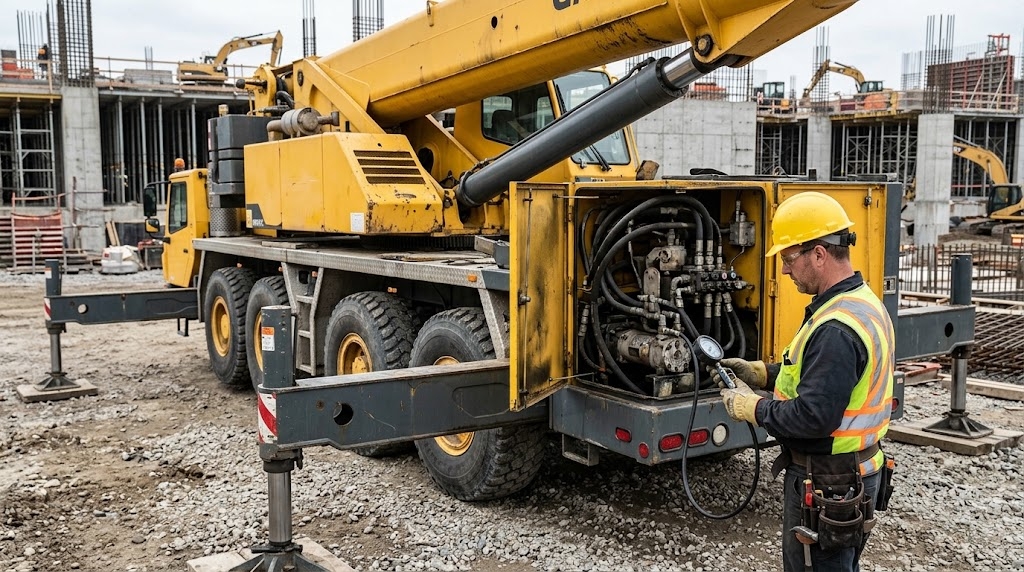
The hardest part of hydraulic troubleshooting is not the mechanics. It is the reasoning. Any competent technician can pull a valve or swap a seal. Knowing which valve to pull and which seal to swap is the skill that separates someone who fixes cranes from someone who replaces parts.
Grove all-terrain cranes are a good place to learn that skill, because their hydraulic faults are consistent. The same handful of causes appear repeatedly, presenting in a small set of recognizable ways. A new technician who learns to read those patterns develops judgment faster than one who learns by trial and error.
What follows is the conversation I would have with someone starting their first season on Grove all-terrain equipment.
Start With the Simplest Explanation
When an operator calls and says the boom will not extend, resist the urge to think about pumps, valves, and cylinders. Think about fluid first. Specifically, think about whether there is enough of it and whether it is clean.
Low reservoir level starves the pump, and a starved pump sounds and behaves exactly like a worn one. This is the single most common misdiagnosis in hydraulic work, and it costs shops thousands every year. Check the sight glass with the boom retracted. Thirty seconds of your time.
Filters are the next simplest explanation. An element loaded with debris restricts flow progressively, and restriction shows up at the furthest actuators first. On Grove all-terrain cranes, that means the boom cylinders. Pull the element, hold it against the light, and replace it if there is any doubt. The filter is almost never the whole story, but it is the cheapest thing to rule out.
Only when fluid and filtration check out should you start thinking about the pump. Place a flow meter on the outlet and compare the reading against the rating plate. Below spec means replacement. At spec means the problem is downstream, in the spool valves that meter fluid to the extension cylinders. Varnish and debris narrow those passages over time, and the symptoms are indistinguishable from pump wear unless you measure. Technicians who carry Grove crane parts on their trucks can test a valve by substitution, which eliminates guesswork entirely. Those who do not should build a relationship with a crane parts supplier who stocks all-terrain hydraulic components, because the alternative is waiting days for delivery while the crane sits idle.
Drift Has Only Two Causes
This is worth memorizing. Load drift — a hook that settles while the controls sit at neutral — comes from exactly two places: counterbalance valves or cylinder seals. There is no third option that matters in the field.
Counterbalance valves hold the load by sealing the cylinder port when control pressure disappears. Contamination on the seat breaks that seal slowly, and the load descends at a rate proportional to how much contamination is present. Remove the valve, inspect the seat under good light, and clean it. Many technicians are surprised at how often this resolves the problem entirely.
If the seat shows scoring or pitting, do not try to rehabilitate it. You are looking at a surface machined to seal against thousands of pounds per square inch. Once its geometry is compromised, the leak path stays open no matter how thoroughly you scrub. Fit a new valve, verify the pressure rating matches the original, and move on.
When the valve stack tests clean, open the cylinder. Piston seals separate the pressure chamber from the return chamber, and they wear predictably with heat and operating hours. Once they leak, the cylinder cannot hold regardless of what you do upstream. Rebuild means disassembly, bore inspection, and new seals. Match the kit to your model year precisely — seal profiles changed across Grove's production runs, and the wrong kit will not seal under load. Always stage the correct components before opening anything. An exposed cylinder on a job site is an open invitation for contamination.
Heat Is a Symptom, Not a Problem
New technicians tend to treat overheating as a fault in itself. It is not. Heat is the visible result of something else going wrong, and your job is to find that something else.
Bypass flow is the usual source. When a relief valve is stuck open or set below its rated pressure, fluid recirculates through a restriction without doing useful work. That recirculation converts pressure into heat, and temperature climbs accordingly. Gauge the circuit and compare against the specification plate. The numbers will tell you within minutes whether the relief valve is responsible.
The cooling path is the second place to look. Cooler cores foul with dust and organic debris in field conditions, and a fouled core cannot reject heat effectively. Fan motors lose speed as they age, reducing airflow below design capacity. Wash the cooler fins and check fan speed with a tachometer. These checks take almost no time and frequently resolve the complaint on their own.
Fluid volume is the third variable, and the one people forget. A reservoir below the marked level has less thermal capacity, so heat concentrates faster under sustained load. Check the sight glass daily. Also note that a heat problem appearing after a recent repair may indicate something was installed with the wrong specification. Sourcing through a crane parts supplier who confirms fitment by serial number protects against that outcome.
Erratic Movement Has a Testing Order
When an operator reports jerky crane behavior, three causes are possible. Test them in order of cost, from free to expensive.
Air in the circuit costs nothing to test. Bubbles compress under pressure where fluid does not, causing cylinders to lurch rather than glide. Cycle each cylinder through its full stroke several times with the hook unloaded. If the jerkiness disappears, you are done. If it persists after a thorough bleed, move to the next possibility.
Proportional valves are the second candidate and cost a few minutes of cleaning to evaluate. These valves meter flow in response to electronic joystick input, and contamination disrupts that metering. Clean with solvent and dry compressed air. If the solenoid coil or controller electronics have failed, the valve needs replacement. No field workaround exists for a dead coil, and attempting one wastes more time than it saves.
Fluid condition is the third cause and the one most commonly skipped. Water in hydraulic oil changes its pressure-transmission properties. Silt-sized particles act as an abrasive inside every precision surface they reach. Draw a sample into a clean jar and examine it in daylight. Milky means water contamination. A gritty feel means suspended particulate. Either result warrants an immediate fluid and filter change before any further work, because contaminated fluid will compromise whatever you install next.
What You Install Matters as Much as What You Diagnose
This lesson takes the longest to internalize. A perfect diagnosis followed by an incorrect part produces a crane that fails again — and a customer who questions your judgment.
Grove all-terrain cranes operate under circuit-specific pressure ratings and dimensional tolerances. A valve that fits the same port but was engineered for a rough-terrain machine will not hold up under the loads a GMK-class crane generates. Sealing surfaces are machined to precision that does not tolerate approximation, and the consequences appear under pressure.
OEM parts represent the reference standard when the timeline allows. When it does not, qualified aftermarket alternatives exist — but the word qualified is doing real work in that sentence, and not every option meets the bar. Ask for specification sheets rather than verbal assurances.
A crane parts supplier working in this space understands cross-references, supersession history, and the difference between all-terrain-rated components and general-duty items. That knowledge prevents the expensive cycle of installing a part, watching it fail, and ordering again. Take the time to build that relationship before you need it. Well-matched Grove crane parts install once and stay installed.
Prepare before the call. Model designation, serial number, and any casting numbers from the removed component should be in front of you. Grove's lineup — the GMK4100L, GMK5130, GMK6300L, and others — spans decades of distinct hydraulic architectures. Complete information on the first call eliminates the callbacks that stretch a repair across additional days.
The Best Repairs Never Get Made
The cheapest hydraulic fix is the one you prevent. Filters changed on schedule, fluid sampled at regular intervals, hoses inspected at every service visit — this is the work that keeps cranes out of the shop.
An element run past its service life passes more debris with every additional hour, and that debris ends up in the components that cost the most to replace. Oil analysis reveals wear trends weeks or months before visible symptoms appear. Hose blisters, cracks, and abrasion points are visible well before failure — if anyone walks around the machine and looks.
Cleanliness during service is the habit most often skipped and most often responsible for repeat failures. Cap every fitting the moment it is opened, because the debris that scars a valve seat never announces its arrival. Operator discipline matters too. Crews who avoid holding boom functions against relief valves generate less heat and extend the life of every component in the circuit.
Hydraulic troubleshooting rewards patience, sequence, and honest diagnosis. Start simple, measure before you assume, and install only what matches the machine. The crane will stay productive, and the operator will trust the next call they make to you.

