


How Enterprise-Grade Gojek Clone App Architecture Enables Business Scalability?
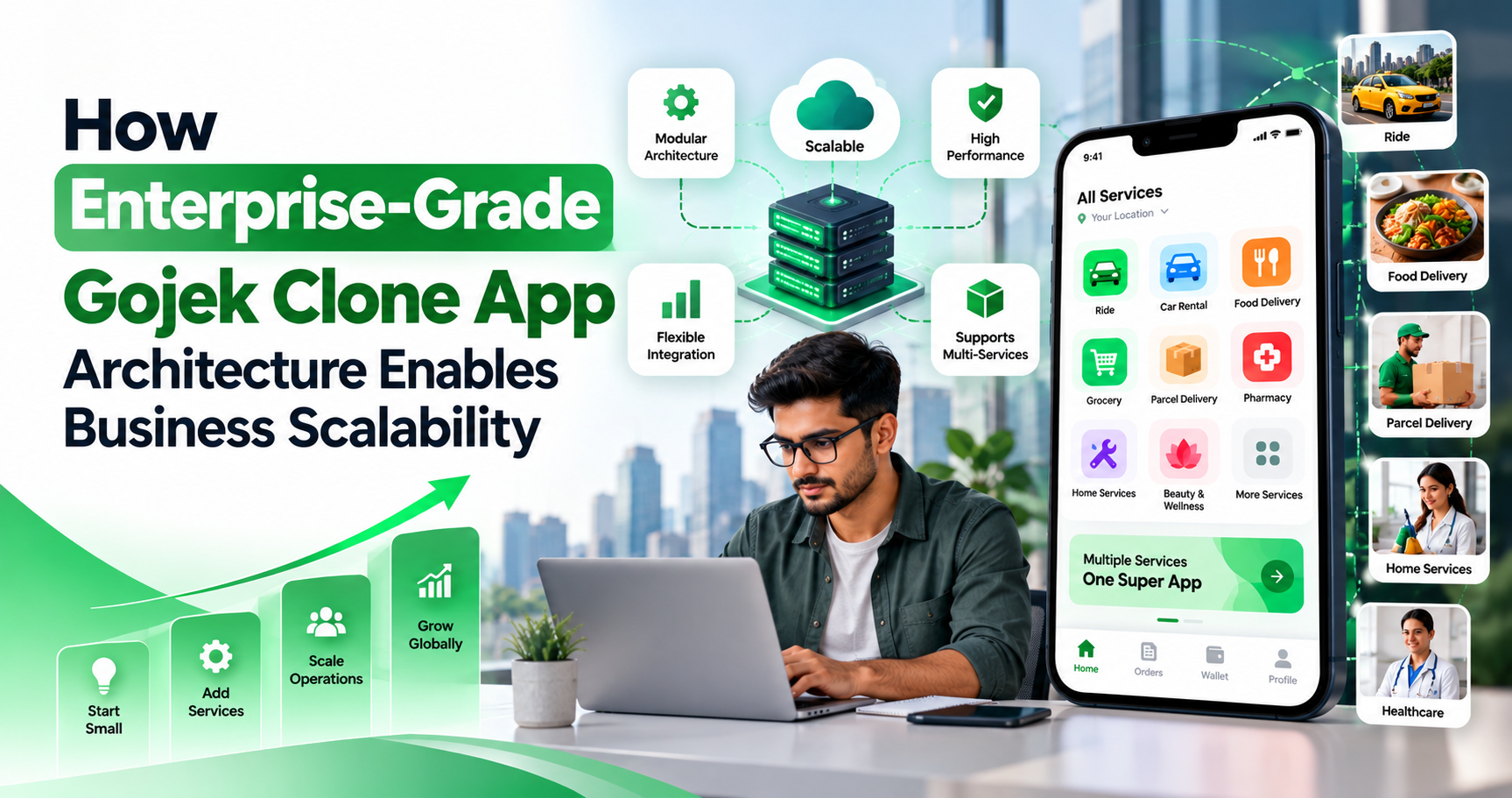
Businesses are increasingly adopting multi-service platforms to meet customer needs through a single digital experience. Instead of managing separate applications for transportation, food delivery, grocery shopping, and home services, entrepreneurs can bring these services together in one platform. This approach creates new opportunities for customer engagement, service expansion, and long-term business growth.
However, launching a multi-service platform is only the first step. Businesses must also ensure that their applications can handle growing user activity, increasing service demand, and expanding operational requirements. A platform that works well for a small customer base may struggle when more users, service providers, and locations are added.
This is where an enterprise-grade Gojek Clone App becomes relevant. It provides a foundation for businesses that want to launch a branded super app with multiple on-demand services while preparing for future expansion.
For startups, established enterprises, and digital service providers, understanding scalability is essential before choosing a platform. The right solution should support business growth, maintain a consistent customer experience, and simplify the management of multiple services.
What Is a Gojek Clone App?
A gojek clone app is a customizable, multi-service application inspired by the business model of Gojek. It allows entrepreneurs and companies to bring different on-demand services together under one brand.
Depending on business requirements, the platform can include services such as:
- Taxi and ride-hailing services
- Food ordering and restaurant delivery
- Grocery and essential-item delivery
- Handyman and home maintenance services
- Courier and parcel delivery
- Beauty, wellness, and other local services
Customers can access available services through a single application, while service providers manage requests through dedicated interfaces. Administrators oversee operations, service availability, customer accounts, and business activities through a centralized management system.
A Gojek Clone Script provides a starting point for launching this type of platform. Businesses can customize its branding, service categories, workflows, and business rules according to their target market.
For organizations planning long-term expansion, an enterprise-grade solution should do more than combine services. It should make it practical to introduce new offerings, support additional locations, and manage growing operational complexity.

How Enterprise-Grade Architecture Supports Scalability
Scalability refers to a platform's ability to accommodate increasing demand without significantly reducing performance, reliability, or service quality. In a multi-service business, this involves handling growth across customers, service providers, transactions, locations, and service categories.
An enterprise-ready gojek clone app supports this objective through several important capabilities.
1. Modular Service Management
A multi-service business does not always expand every category at the same time. An operator might launch ride-hailing first, introduce food delivery later, and add home services when sufficient demand develops.
A modular approach allows individual service categories to be managed and expanded without unnecessarily disrupting the entire platform.
For example, a business can introduce grocery delivery in selected locations while continuing to operate its existing taxi and food delivery services.
This flexibility helps businesses respond to market demand and prioritize expansion based on customer needs.
2. Support for Growing User Activity
As a platform attracts more customers, it must accommodate increased registrations, service requests, notifications, payments, and provider activity.
An enterprise-grade platform should be designed to handle changing workloads and allow capacity to grow as demand increases.
This is especially important for businesses operating across multiple cities or serving customers during periods of high demand. Maintaining reliable access helps protect customer confidence and reduces the risk of operational disruption.
A scalable gojek clone app should therefore be evaluated on its ability to support expected growth rather than only its performance during an initial launch.
3. Multi-Location Expansion
Geographic expansion introduces new operational requirements. Different cities may have different service availability, provider networks, delivery zones, and local business rules.
A scalable platform should allow administrators to configure service areas, manage local providers, and control which services are available in each location.
For instance, a company could offer taxi bookings and food delivery in one city while introducing only taxi services in a newly launched market.
This approach helps businesses expand gradually without requiring them to treat every location as an entirely separate operation.
4. Centralized Administration
Managing multiple services through disconnected systems can create unnecessary complexity. Enterprise-grade platforms address this challenge by bringing essential operational activities into a centralized management environment.
Depending on the solution, administrators may be able to manage customers, service providers, bookings, orders, promotions, service categories, and performance reports from one place.
Centralized administration improves visibility and helps business teams maintain consistent processes across different service categories.
It also supports better decision-making because managers can review operational information without switching between unrelated applications.
5. Reliable Third-Party Integrations
Multi-service applications often depend on external providers for payments, maps, location tracking, notifications, identity verification, and other capabilities.
As a business expands, these integrations become increasingly important to its daily operations.
A scalable platform should support reliable integrations and provide practical ways to monitor failures, handle service interruptions, and maintain essential customer workflows.
Businesses should also evaluate whether integrations can be configured for different regions and service categories. This becomes particularly useful when entering markets with different payment preferences or operational requirements.
Key Features That Enable Business Growth
When evaluating a gojek clone app, businesses should focus on features that support both customer convenience and operational efficiency.
1. Unified Customer Application
A single application allows customers to discover and use multiple services without installing separate apps for each category.
Features such as service discovery, saved addresses, booking history, digital payments, notifications, and customer support help create a consistent experience.
A unified experience can also encourage repeat usage by making additional services easier to discover.
2. Dedicated Service Provider Applications
Drivers, delivery partners, restaurants, and other service providers have different operational needs.
Dedicated provider interfaces can help them manage requests, update availability, review earnings, track completed jobs, and communicate with customers where applicable.
Clear workflows help reduce confusion and support more efficient service delivery as the provider network grows.
3. Flexible Service Configuration
Businesses need control over the services they offer and the markets they serve.
A flexible platform should allow authorized teams to configure service categories, operating areas, availability, commissions, and relevant business rules.
This capability is particularly useful for entrepreneurs who want to test new service categories before making them available across their entire operating area.
4. Real-Time Tracking and Notifications
Real-time status updates help customers understand what is happening with their bookings and orders.
Depending on the service, tracking can show a driver's location, delivery progress, or a provider's arrival status. Notifications can inform customers about booking confirmations, status changes, and completed transactions.
These features improve transparency and help customer support teams respond to questions more effectively.
5. Analytics and Performance Reporting
Business growth requires informed decisions. Reporting tools can help managers monitor order volumes, completed bookings, active providers, customer engagement, and service performance.
For example, if grocery orders increase in one location while taxi demand remains stable, managers can use this information to review provider availability and future expansion priorities.
Performance reports make it easier to identify opportunities, understand operational challenges, and allocate resources more effectively.
Business Opportunities and Use Cases
A multi-service platform can support several business models. The most suitable approach depends on customer demand, local competition, provider availability, and the company's long-term objectives.
Startups Entering the On-Demand Market
Entrepreneurs can use a gojek clone app to introduce a branded service platform without building every capability from the beginning.
A startup may begin with one or two categories, validate demand, and expand its offering as customer adoption improves.
This approach allows the business to focus on market research, provider partnerships, customer acquisition, and service quality.
Established Businesses Expanding Their Services
Companies already operating in transportation, delivery, or home services can explore additional categories through a unified platform.
For example, a taxi operator could introduce courier services or partner with local restaurants to expand its customer offering.
The objective is to build on existing operational strengths while creating additional opportunities for customer engagement.
Local Marketplaces and Regional Operators
Regional businesses can use multi-service app development to bring local providers and customers together in a single digital marketplace.
A regional operator might offer food delivery, grocery shopping, beauty services, and home maintenance in selected cities.
The platform can help standardize essential processes while allowing service availability to reflect local demand.
Enterprises Building a Super App
Large organizations may want to consolidate several service offerings under one digital brand.
Super app development can support this strategy by bringing customer access, transactions, service discovery, and account management into a connected experience.
However, enterprises should define clear priorities before launching numerous categories. A focused rollout is often easier to manage than introducing many services simultaneously without sufficient operational support.
Read More: How a Gojek Clone App Works: Full User and Admin Flow
How to Build a Super App Like Gojek
Businesses planning to build a super app should approach the project as a long-term product strategy rather than simply combining multiple services in one application.
Step 1: Identify the Target Market
Research customer requirements, competitor offerings, provider availability, and underserved service categories. Select services that address clear market needs.
Step 2: Define the Business Model
Determine how the platform will generate revenue. Potential models include service commissions, delivery fees, subscriptions, provider plans, and promotional placements, depending on the business model and applicable regulations.
Step 3: Prioritize Essential Services
Start with the categories that offer the strongest initial opportunity. Confirm that the business can maintain provider availability, service quality, and customer support before expanding.
Step 4: Choose a Scalable Platform
Evaluate the platform's flexibility, reliability, integration capabilities, administrative controls, and support for future expansion.
A Gojek-like app should accommodate new services and locations without making routine business management unnecessarily complicated.
Step 5: Launch, Measure, and Expand
Begin with a defined market, measure customer adoption and operational performance, and use the findings to guide future improvements.
This phased approach helps businesses identify problems early and make expansion decisions based on measurable results.
Why Businesses Choose a Super App Development Company
Selecting the right technology partner is an important decision for businesses planning to enter the multi-service market.
An experienced super app development company can help translate business requirements into a practical product plan, identify essential capabilities, and configure the platform around the intended operating model.
Businesses should evaluate potential partners based on several factors.
- Customization flexibility: The ability to align branding, service categories, workflows, and business rules with specific requirements.
- Scalability readiness: Support for growing user activity, additional service categories, and geographic expansion.
- Integration capabilities: Compatibility with the payment, mapping, notification, and other services required by the business.
- Administrative control: Tools for managing customers, providers, transactions, and operational performance.
- Security and reliability: Appropriate access controls, data protection measures, monitoring, and dependable service operation.
- Ongoing support: Assistance with maintenance, platform improvements, and changing business requirements.
A suitable partner should also explain the solution's existing capabilities, customization limitations, and expansion requirements clearly.
For businesses considering a gojek clone app, these discussions help establish realistic expectations and reduce the risk of selecting a platform that cannot support future objectives.
Conclusion
Enterprise-grade architecture plays an important role in helping multi-service businesses manage growth, expand into new markets, and maintain consistent customer experiences. Modular service management, flexible location settings, centralized administration, reliable integrations, and performance reporting can all contribute to a more scalable operation.
A gojek clone app offers entrepreneurs, startups, and established companies a practical starting point for launching a branded multi-service platform. However, long-term success depends on selecting the right capabilities, validating market demand, maintaining service quality, and expanding at a manageable pace.
Before choosing a solution, businesses should assess their target audience, operating model, expected growth, and customization requirements. Working with an experienced app development company can help align the platform with these objectives and establish a foundation for sustainable business expansion.
Frequently Asked Questions
1. What is an enterprise-grade Gojek clone app?
An enterprise-grade Gojek clone app is a customizable multi-service platform designed to support growing customer activity, multiple service categories, and geographic expansion. It typically includes customer applications, provider interfaces, and centralized administrative tools.
2. How does a Gojek clone app support business scalability?
It supports scalability through flexible service management, location-based configurations, centralized administration, reliable integrations, and the ability to accommodate increasing user activity. These capabilities help businesses expand while maintaining operational consistency.
3. Can businesses add new services after launching a super app?
Yes. Depending on the platform's capabilities, businesses can introduce additional categories such as grocery delivery, courier services, ride-hailing, and home maintenance. New services should be added according to market demand and operational readiness.
4. What should businesses look for in a Gojek Clone Script?
Businesses should evaluate customization options, service management capabilities, customer and provider features, administrative controls, integration support, security measures, and the platform's ability to accommodate future expansion.
5. Is a Gojek-like app suitable for startups and enterprises?
Yes. Startups can use a multi-service platform to enter a selected market and expand gradually, while enterprises can use it to consolidate services across locations. The suitability depends on business objectives, customer demand, operational capabilities, and the platform's flexibility.

