


Is CLAT Syllabus Same Every Year? A Clear Guide
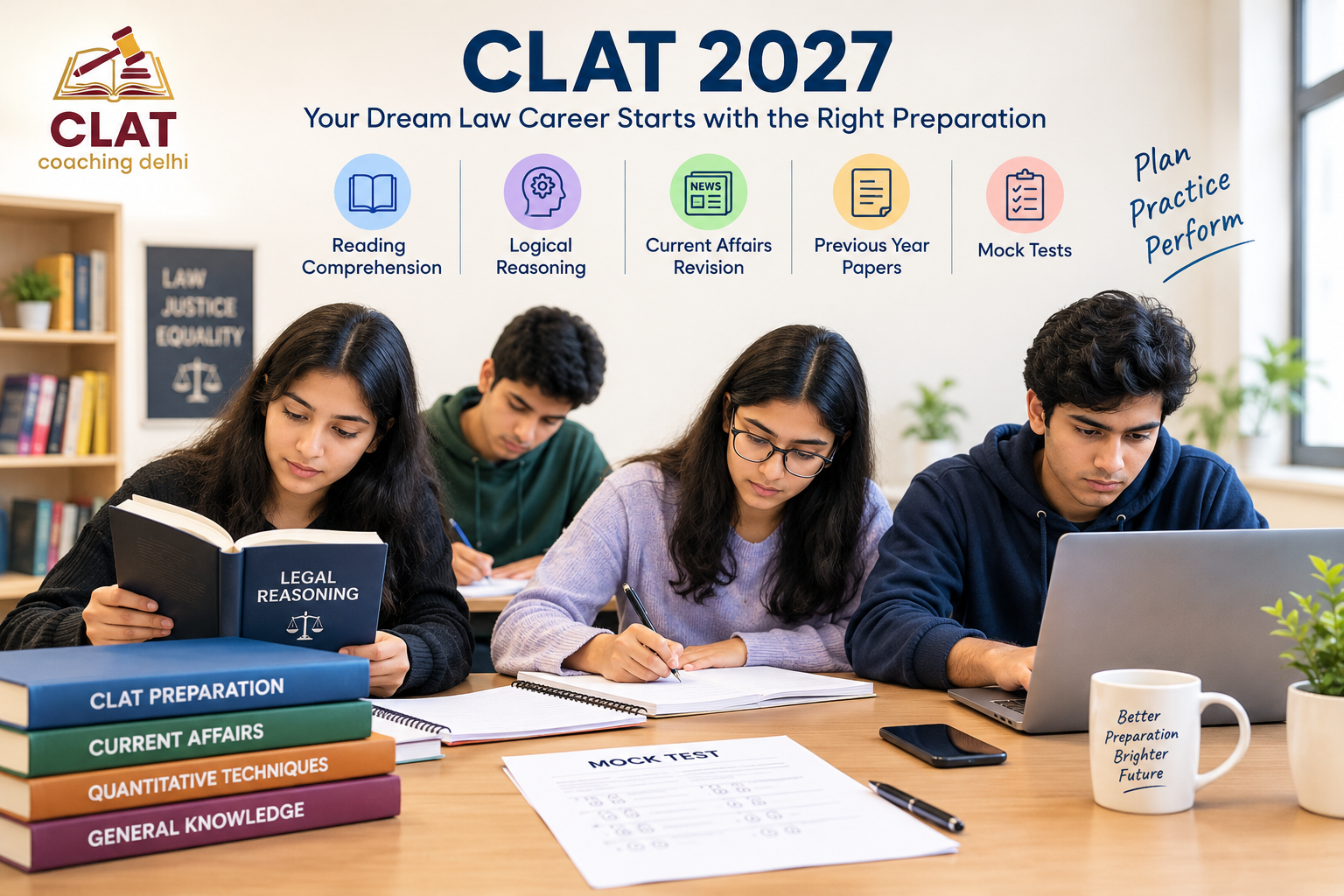
The CLAT syllabus is largely stable from year to year because it tests reading, reasoning and comprehension skills rather than a fixed topic list. The Consortium has confirmed the 2027 syllabus matches 2026, but a reform proposed for 2028 could change it. Always check the official notice.
Many Class 11 and 12 students ask whether last year's study material still works. Is CLAT syllabus same every year? The honest answer is that the core stays steady, but the official document can still change. This guide explains what remains fixed, what can shift, and how to plan without guessing or panicking.
Is CLAT Syllabus Same Every Year?
The short version: the skills tested in CLAT change very slowly, while the formal notices that describe the exam can change. Knowing the difference saves you from buying the wrong books or abandoning a good study routine because of a rumour. You can read more on our page on AILET 2027 Syllabus | NLU Delhi Sections & Weightage | Clat Coaching.
What the CLAT Syllabus Actually Means
The CLAT syllabus is not a list of chapters you finish before the exam. It is a description of the reading, reasoning and comprehension abilities the test measures. The Consortium of National Law Universities conducts CLAT, and the exam decides admission to 24 National Law Universities and some affiliated institutions.
Because the test is built around skills, the paper is tested through passages. You do not get a question that asks you to recall a definition from a textbook. You get a passage, then questions that check whether you understood it, can apply a principle to new facts, or can spot the flaw in an argument.
This is why the syllabus is steadier than a school curriculum. A school syllabus changes when textbooks are revised. A skill-based entrance syllabus changes only when the testing approach itself is reconsidered. A student who builds strong reading speed and reasoning habits in Class 11 is preparing for the same core demands that will appear in future papers.
What Stays the Same Every Year
For CLAT 2027, the exam has five sections with the following weightage: Legal Reasoning and Current Affairs and General Knowledge at 25 percent each, English Language and Logical Reasoning at 20 percent each, and Quantitative Techniques at 10 percent. These proportions are the anchor points you should expect to see repeated, so plan your time around them.
The format is equally consistent. All 120 questions are passage-based and are answered in 2 hours. Each correct answer earns plus 1, and each wrong answer loses minus 0.25. Because the marking scheme affects how you should guess, knowing it in advance matters as much as knowing the topics. Papers from 2024 to 2026 match this current 120-question pattern. Papers from 2020 to 2023 had 150 questions, and papers before 2020 followed a 200-question format.
For a section-by-section view of topics and weightage, the section-wise CLAT 2027 topics and weightage page is a useful reference to keep open while you plan.
What Can Change: The 2028 Reform Proposal
The Consortium has confirmed that the CLAT 2027 syllabus is unchanged from 2026. The exam is scheduled for 6 December 2026. Students preparing for this cycle can therefore use the current structure with confidence.
The position for CLAT 2028 is different. A reform has been proposed that could change the syllabus. A proposal is not a decision, and nothing in the approved information tells us its final shape. So the sensible response is not to rebuild your plan around rumours, but to keep watching for official updates and to keep training the skills that any reformed paper is likely to keep testing. If the reform is confirmed, your preparation will still rest on reading, reasoning and comprehension. Only the specific weightage or question handling might shift. Students who have spent a year on careful passage reading will adapt far more easily than students who memorised a topic list.
The Five Sections, With an Example for Each
Legal Reasoning is a passage-based section of roughly 28 to 32 questions. You read a legal principle, then apply it to a set of facts and decide which outcome the principle supports. No prior knowledge of law is needed. For example, a short principle might say that a contract requires a free agreement between competent parties. The facts then describe a situation where one party was pressured into signing. Your task is to decide whether the principle supports enforcing the agreement or not, using only what the passage says.
Logical Reasoning is a passage-based section of about 22 to 26 one-mark questions. A typical question gives a short argument, then asks you to identify its assumption, its conclusion or the inference that follows. Consider a generic argument: "Most people who finish the course pass the test. Ravi finished the course, so Ravi will pass." The skill being tested is noticing that the argument assumes Ravi belongs to the group of people who pass, which may not be stated. Practise this by writing the hidden step in your own words before you look at the options.
English Language, General Knowledge and Quantitative Techniques share a common approach. For English, a comprehension passage asks you to find the main idea and the tone. For Current Affairs and GK, a news passage about a recent event can be paired with the static background it relies on, such as how a particular institution works. For Quant, a short data passage tests whether you can read a table or chart and calculate using Class 10 maths. The key is that you are reading first and calculating second, not memorising formulas in isolation.
How to Check for Changes and Plan Around Them
Use the official Consortium website and the official notice as the final source before each exam cycle. Coaching blogs, including this one, explain the syllabus, but the bulletin decides what is tested. Check the official site at fixed points in the year, such as after each exam cycle ends and when the next bulletin is expected, and note the date you last checked.
When you practise, start with the 2024 to 2026 papers. They match the current 120-question pattern, so the timing and marking you train on will be the same as the exam you face. Once you are comfortable, use the 2020 to 2023 papers as extra practice, keeping in mind that their 150-question format differs. Our year-wise CLAT paper analysis helps you compare these sets. Older papers in the 200-question format are best used only for reading practice, not for judging how many questions to attempt.
If you are planning a longer runway, a two-year head start after Class 10 can give you more time to build reading stamina before the final year.
Who This Guide Is For and Not For
This guide suits Class 11 and 12 students and their parents who want a clear view of what is stable and what might change before buying books or joining a course. It is also useful for anyone who wants to understand why old study material may still be valuable.
Students who are starting now can follow a two-year Class 11 CLAT plan as a practical next step, since it builds the reading and reasoning habits this syllabus rewards. It is not a substitute for the official bulletin. It is also not the right resource for someone who only wants a last-minute list of topics to memorise, because the exam rewards understanding passages rather than recalling lists. For questions about who can sit the exam, the CLAT Coaching Delhi age limit guide is better reading.
Common Mistakes and How to Avoid Them
Mistake: treating the syllabus as a fixed chapter list. Students who try to memorise topics often struggle when a passage asks them to reason from unfamiliar facts. Fix this by practising skills through passages and timed sets every week.
Mistake: using pre-2020 papers with the 200-question format as the main guide. Those papers can make you misjudge pacing and question count. Fix this by starting with the 2024 to 2026 papers, which match the current pattern.
Mistake: ignoring official notices until late in the year. Students who check only when a deadline approaches may miss a change that affects their plan. Fix this by setting fixed check dates and keeping a short tracker with the date and the source of each update.
Frequently asked questions
Is the CLAT syllabus the same every year?
The skill base is steady, which is why the syllabus is described as skill-based rather than topic-based. The Consortium has confirmed that the CLAT 2027 syllabus is unchanged from 2026. The official notice remains the final source, so check it before each exam cycle.
Will the proposed CLAT 2028 reform change my preparation?
The reform is only proposed, so nothing has been finally decided. Keep building core reading, reasoning and comprehension skills, since these are the foundation of any version of the paper. Wait for the official decision before changing your plans in a major way.
Which previous year papers should I practise if the pattern changes?
Start with the 2024 to 2026 papers, because they match the current 120-question pattern. Use the 2020 to 2023 papers as extra practice, remembering that they had 150 questions. Use older papers in the 200-question format with caution, mainly for reading practice.

