


Fire Risk Assessment Services: UK Legal Requirements, Costs and Process
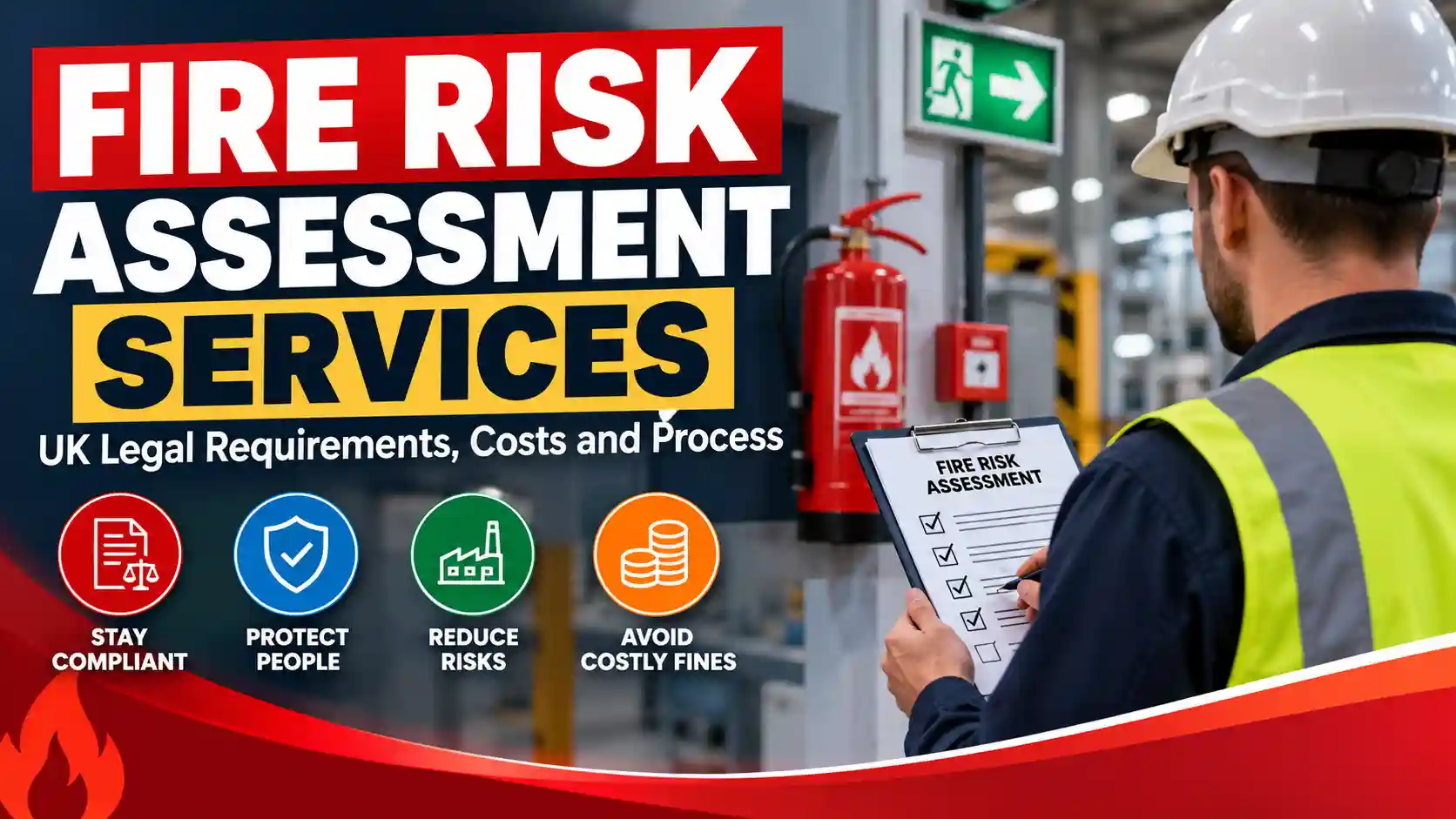
Fire risk assessment services help businesses identify fire hazards, protect employees and visitors, and meet their legal fire safety responsibilities. In England and Wales, the Regulatory Reform (Fire Safety) Order 2005 requires the responsible person for relevant premises to arrange a suitable and sufficient fire risk assessment, maintain appropriate precautions, and keep the assessment under review. Whether you manage a factory, corporate office, warehouse or small retail business, a professional assessment helps identify where fires could start, who might be harmed, and what action is needed.
What Are Fire Risk Assessment Services?
Fire risk assessment services involve systematically examining a building and its activities to identify fire hazards, evaluate risks to people, and recommend suitable prevention and protection measures. An assessor considers ignition sources, combustible materials, escape routes, fire detection, emergency lighting, people needing evacuation assistance, training and maintenance records. The findings should lead to a practical, prioritised action plan.
How Is an Assessment Different From an Inspection?
A fire safety inspection generally checks particular precautions or equipment. A fire risk assessment looks more broadly at how a fire could start, spread and affect occupants. For example, functioning extinguishers do not resolve unsafe storage of flammable materials or blocked escape routes.
Why Are Fire Risk Assessment Services Important?
A suitable assessment helps protect employees, contractors, visitors and customers; supports legal compliance; reduces the likelihood of business interruption; and improves emergency planning. It can also provide useful evidence of risk management for insurers and landlords. A report alone is not proof of compliance: appropriate precautions must be implemented and maintained.
Is a Fire Risk Assessment Legally Required in the UK?
Yes, fire risk assessments are required for most non-domestic premises. In England and Wales, the primary legislation is the Regulatory Reform (Fire Safety) Order 2005. Scotland and Northern Ireland have separate legal frameworks. The Fire Safety Act 2021 and changes introduced through Section 156 of the Building Safety Act 2022 also affect certain duties in England and Wales. Businesses operating in multiple UK nations should check the rules for each location.
Who Is the Responsible Person?
The responsible person can be an employer, occupier, business owner, commercial landlord or another party with control over relevant premises. Multiple responsible persons may have duties and must cooperate. In a rented office, the tenant may manage its occupied area while the landlord manages shared spaces, depending on actual control and legal duties.
Do Small Businesses Need a Written Assessment?
Yes. In England and Wales, changes effective from 1 October 2023 require responsible persons to record fire risk assessments in full regardless of employee count. A business with only two or three employees should not assume exemption.
What Does a Professional Assessment Include?
Typical areas include electrical hazards; alarm and detection systems; escape routes; fire doors and compartmentation; emergency lighting; extinguishers; storage of hazardous or combustible materials; occupancy and accessibility; staff training; emergency procedures; maintenance and previous corrective actions. An assessment does not automatically replace an EICR, specialist fire-door survey or other technical testing.
How Is a Fire Risk Assessment Carried Out?
Step 1: Identify fire hazards, including sources of ignition and fuel. Step 2: Identify people at risk, including employees, visitors, lone workers and those needing assistance. Step 3: Evaluate and reduce risks through suitable precautions. Step 4: Record findings, plan corrective action, prepare emergency arrangements and train staff. Step 5: Review the assessment and update it when circumstances change.
Example: Manufacturing Factory
A factory stores cardboard packaging near electrical machinery and an evacuation aisle. An assessor identifies the ignition and fuel combination and recommends moving the packaging, improving housekeeping, checking electrical maintenance and keeping the escape route clear. The factory assigns owners and deadlines for each corrective action.
Fire Risk Assessments for Factories and Warehouses
Factories may have hot work, machinery, combustible dust, flammable liquids and battery charging areas. Warehouses also need to consider high-density stock, racking, loading bays and changing layouts. Assessors should review industrial processes, storage practices, contractor arrangements and evacuation procedures for night shifts.
Fire Risk Assessments for Corporate Offices
Office assessments should consider electrical equipment, charging arrangements, kitchens, server rooms, fire alarms, emergency lighting, escape stairs, fire doors and evacuation arrangements for disabled occupants. Multi-tenant buildings require clear coordination between responsible parties.
Fire Risk Assessments for Small Businesses
Small shops, salons, cafés and workshops may have simpler layouts but still need suitable assessments. Common issues include stock blocking exits, unsafe storage, overloaded electrical sockets and insufficient staff instruction. The assessment should be proportionate to the real hazards.
How Much Do Fire Risk Assessment Services Cost?
There is no fixed UK-wide fee. Price depends on property size, layout, occupancy, industrial processes, hazardous materials, building complexity, location and reporting scope. Ask for a written quotation that specifies inspected areas, deliverables, exclusions and additional charges. A low-cost assessment is poor value if it overlooks important risks.
How Often Should an Assessment Be Reviewed?
Assessments must be reviewed regularly and when significant changes occur. In England and Wales, the Fire Safety Order does not set a universal annual renewal deadline. An annual review may be good practice for simple premises; complex or high-risk premises may need more frequent reviews. Triggers include alterations, new machinery, changed occupancy, increased combustible storage, incidents and changes to evacuation arrangements.
Can Business Owners Carry Out Their Own Assessment?
Sometimes. The responsible person may assess premises if they have the necessary knowledge and competence. Simple premises may be suitable for a competent owner using government guidance. Complex factories, large offices and premises with hazardous processes often require specialist help. Hiring an external assessor does not transfer the responsible person’s legal duties.
How Do You Choose a Competent Fire Risk Assessor?
Check qualifications, experience with similar premises, relevant professional registration or third-party certification, and the scope of the proposed work. Ask whether the report includes prioritised corrective actions and whether the provider can explain exclusions. BAFE SP205 certification can provide independent evidence of organisational competence for life safety fire risk assessment services.
What Happens If a Business Fails to Comply?
Fire and rescue authorities can take enforcement action in England and Wales. Serious breaches can lead to restrictions, prosecution, fines and in certain cases imprisonment. Beyond legal consequences, poor fire safety can cause injuries, property loss and prolonged interruption to operations.
Fire Risk Assessment Checklist
Confirm a current written assessment is available; exits remain clear; alarms and emergency lighting are maintained; fire equipment is suitable; electrical systems are appropriately maintained; combustible materials are safely stored; fire doors are maintained; staff receive instruction; evacuation plans account for people needing assistance; and outstanding actions are tracked. This checklist is not a substitute for a full assessment.
Frequently Asked Questions
Is a fire risk assessment mandatory for every business?
Most non-domestic premises require one, subject to the legislation applicable to their location and use.
How long does an assessment take?
A small simple site may take a few hours; complex industrial or multi-storey premises can take longer.
Do I need an assessment if I rent?
You may have duties as an employer or occupier, and the landlord may have separate responsibilities.
How often must it be renewed?
There is no universal annual renewal deadline under the Fire Safety Order in England and Wales. Review regularly and after significant changes.
What is included in the report?
A description of premises, hazards, people at risk, existing precautions, findings, recommendations and review arrangements.
Can I complete my own assessment?
Yes if competent; obtain specialist help where risks or building complexity exceed your expertise.
Is an assessment the same as an EICR?
No. An EICR concerns the electrical installation; a fire risk assessment considers wider fire risks.
Does it include PAT testing?
Not automatically. PAT testing is a separate risk-based electrical safety activity.
What if serious hazards are found?
Take appropriate corrective action, prioritising urgent risks and considering immediate protective measures.
Can a business be fined?
Yes. Serious offences can lead to substantial fines and in some cases imprisonment.
Do factories need specialist assessments?
Complex industrial processes may require an assessor with specific industrial fire safety expertise.
How do I verify competence?
Check qualifications, experience, registration and applicable third-party certification, including relevant BAFE schemes.
Book Professional Fire Risk Assessment Services in the UK
Fire Safety Risk Assessment (FSRA) provides fire safety services to businesses, commercial premises and landlords across the UK. Services include fire risk assessments, asbestos management, Legionella risk assessments, PAT testing and EICR inspections. Visit https://firesafetyriskassessment.co.uk/ to explore services and request further information.

