


What to Look for in an Automotive CRM Software Provider
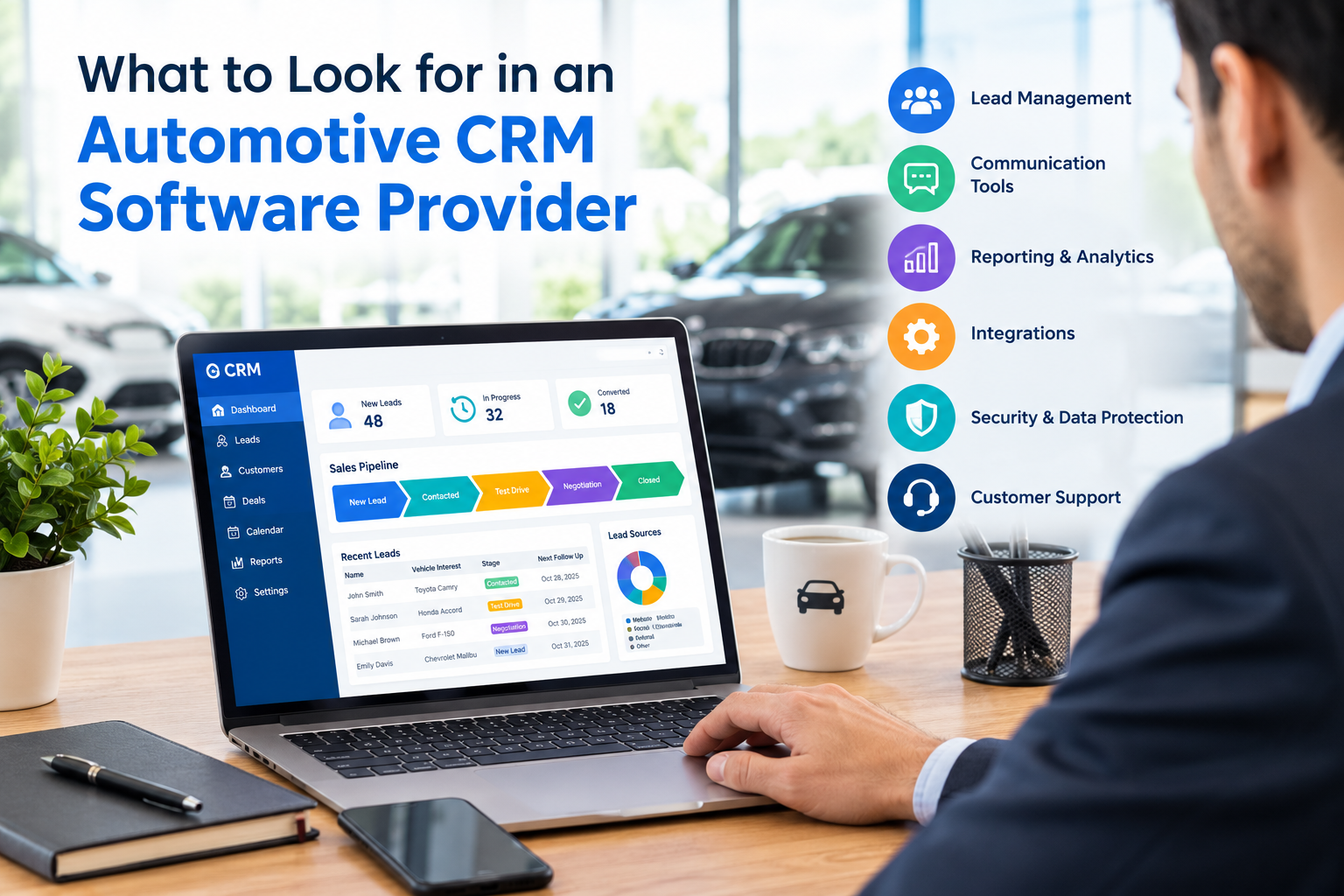
Choosing the right customer relationship management (CRM) solution is an important decision for modern car dealerships. As customer expectations increase and competition in the automotive industry continues to grow, dealerships need efficient ways to manage leads, communicate with potential buyers, organize sales activities, and build long-term customer relationships. An effective Automotive CRM Software Provider can help dealerships streamline these processes, improve team productivity, and make better use of customer information.
However, not every CRM platform offers the same features, integrations, or level of support. Some solutions focus primarily on lead management, while others provide broader capabilities for sales tracking, customer communication, reporting, and dealership operations. Understanding what to evaluate before choosing a provider can help dealership owners and managers select a solution that supports their business goals.
1. Understand Your Dealership's Requirements
Before comparing CRM providers, identify the main challenges your dealership wants to solve. For example, your sales team may struggle to follow up with online inquiries, track customer conversations, manage test-drive appointments, or monitor the progress of potential vehicle purchases.
A clear understanding of these challenges helps you determine which features are essential and which are optional.
Consider the following questions:
-
Do you receive leads from websites, social media, phone calls, and online advertising?
-
Does your sales team need a centralized customer database?
-
Do managers require visibility into sales activities and team performance?
-
Do you need automated reminders for follow-ups and appointments?
-
Will multiple branches or sales teams use the same CRM?
Documenting these requirements creates a practical checklist for comparing providers. It also reduces the risk of paying for features your dealership does not need.
2. Evaluate Lead Management Capabilities
Lead management is one of the most important functions of automotive CRM software. Dealerships often receive inquiries from multiple sources, and manually organizing these opportunities can lead to missed follow-ups and inconsistent communication.
A suitable provider should offer tools to capture, organize, assign, and track leads throughout the sales process.
Look for features such as:
-
Centralized lead management
-
Automatic lead assignment to sales representatives
-
Lead status tracking
-
Follow-up reminders and task scheduling
-
Lead source identification
-
Duplicate lead detection
-
Lead conversion reporting
For example, when a customer submits a website inquiry about a particular vehicle, the CRM should make it easy for the sales team to record the inquiry, assign responsibility, and schedule the next follow-up.
These capabilities help dealerships maintain an organized sales pipeline and reduce the likelihood of losing potential customers because of delayed responses.
3. Check Customer Communication Features
Effective communication plays a major role in the automotive sales process. Customers may contact a dealership through phone calls, emails, website forms, messaging applications, or social media.
An automotive CRM should help sales representatives maintain consistent communication across supported channels. Depending on the provider, features may include call logging, email history, messaging integrations, communication templates, and automated follow-up notifications.
A centralized communication history allows authorized team members to understand previous customer interactions before making contact. This reduces repetitive questions and helps representatives provide more relevant responses.
For dealerships that receive many inquiries, communication tools can also help managers monitor response times and identify opportunities to improve customer service.
When evaluating providers, confirm which communication channels are supported directly and which require third-party integrations or additional subscriptions.
4. Look for Sales Pipeline and Deal Tracking
A dealership needs more than a list of customer contacts. It also needs visibility into the progress of each sales opportunity.
A reliable Automotive CRM Software Provider should offer a clear sales pipeline that allows teams to monitor leads from the initial inquiry through qualification, vehicle selection, test-drive scheduling, negotiation, and deal closure.
The exact stages will vary depending on the dealership's sales process.
Useful pipeline features include:
-
Customizable sales stages
-
Deal status updates
-
Sales activity tracking
-
Test-drive and appointment scheduling
-
Expected sales reporting
-
Lost-lead tracking
-
Individual and team performance dashboards
These tools help managers identify opportunities that require attention and understand where potential buyers are dropping out of the sales process.
For instance, if several qualified leads remain inactive after a test drive, managers can review follow-up practices and determine whether additional training or process improvements are necessary.
5. Consider Integration With Existing Systems
Automotive dealerships frequently use multiple business applications, including dealership management systems, inventory platforms, accounting software, marketing tools, and website lead forms.
If these systems operate separately, employees may need to enter the same information multiple times. This increases administrative work and creates opportunities for data-entry errors.
Before choosing a provider, check whether its CRM integrates with the systems your dealership already uses.
Important integrations may include:
-
Website lead forms
-
Vehicle inventory systems
-
Dealership management systems (DMS)
-
Email and calendar applications
-
Marketing and advertising platforms
-
Telephony and call-tracking systems
-
Accounting or enterprise resource planning (ERP) software
Not every dealership requires every integration. The goal is to identify the connections that will make the biggest difference to daily operations.
Ask the provider whether integrations are native, available through an API, or dependent on third-party connectors. You should also clarify whether integration setup involves additional fees or technical support.
6. Review Reporting and Analytics
Data-driven decisions can help dealerships improve sales processes, allocate resources, and understand customer acquisition performance.
An automotive CRM should provide reports that turn daily sales activities into useful business insights. Instead of relying entirely on spreadsheets or manual updates, managers should be able to review performance through organized dashboards and reports.
Depending on the platform, useful metrics may include:
-
Number of incoming leads
-
Lead sources and campaign performance
-
Lead response times
-
Follow-up completion rates
-
Lead-to-sale conversion rates
-
Sales representative performance
-
Lost opportunities
-
Sales pipeline value
These reports can help managers identify patterns and determine which areas need improvement.
For example, if one lead source generates many inquiries but few completed sales, the dealership can investigate lead quality, response times, and the effectiveness of its sales process.
When comparing providers, check whether reports can be customized, exported, and filtered by date, team, branch, or lead source.
7. Prioritize Ease of Use and Team Adoption
Even a feature-rich CRM can deliver limited value if employees find it difficult to use. A complicated interface may discourage sales representatives from updating customer records or completing follow-up tasks.
This can result in incomplete information and unreliable reporting.
Look for a provider that offers a straightforward interface, logical navigation, customizable workflows, and accessible customer records. Sales representatives should be able to complete common tasks without unnecessary steps.
It is also useful to request a live demonstration or trial before making a decision. During the evaluation, ask your team to perform everyday activities, such as adding a lead, recording a call, scheduling an appointment, and updating a deal status.
Their feedback can help you determine whether the platform fits your actual workflow.
A user-friendly CRM, combined with appropriate training and clear internal processes, can improve adoption and help your dealership get more value from the system.
8. Examine Data Security and Access Controls
Automotive CRM platforms can store customer contact details, communication histories, sales records, and other business information. Protecting this information should therefore be a key consideration when selecting a provider.
Review the security measures offered by each vendor and determine whether they align with your dealership's requirements and applicable privacy obligations.
Important considerations include:
-
Role-based user permissions
-
Secure authentication options
-
Data encryption
-
Backup and recovery procedures
-
Audit logs and activity monitoring
-
Data retention and deletion policies
-
Procedures for exporting customer records
-
Information about data storage and processing
You should also ask how the provider handles service interruptions, security incidents, and account access when employees leave the organization.
A clear understanding of data ownership is particularly important. Your dealership should know how it can retrieve its information if it decides to change CRM providers in the future.
9. Compare Pricing and Total Cost of Ownership
Price is an important factor, but the lowest subscription fee does not necessarily represent the best value.
Different automotive CRM providers may use per-user pricing, tiered subscriptions, custom enterprise packages, or combinations of licensing and implementation fees.
When comparing costs, consider the complete financial commitment rather than focusing only on the advertised monthly price.
Potential expenses include:
-
Monthly or annual subscriptions
-
Initial implementation and configuration
-
Data migration
-
Employee training
-
Integration development
-
Additional user accounts
-
Premium support
-
Optional modules and upgrades
Ask each provider for a detailed quotation that explains what is included in the package and which services cost extra.
It is also useful to evaluate whether the software can scale as your dealership expands. A platform that meets your current requirements but becomes expensive or restrictive as your team grows may not be a sustainable long-term choice.
The best option is one that offers the right combination of functionality, reliability, support, and affordability.
10. Assess Customer Support and Training
Implementation is only the beginning of the CRM journey. Your team may need assistance with configuration, data migration, integrations, workflow adjustments, and ongoing technical issues.
A dependable Automotive CRM Software Provider should explain how it supports customers before and after implementation.
Before signing a contract, ask about:
-
Availability of technical support
-
Support channels, such as email, phone, or live chat
-
Response and resolution expectations
-
Onboarding assistance
-
Training sessions and learning resources
-
Software updates and maintenance
-
Access to documentation and troubleshooting guides
If your dealership operates across different locations or time zones, confirm that the provider's support hours suit your working schedule.
You should also ask whether training is available for new employees and whether the provider helps customers optimize their workflows after the initial setup.
Responsive support can reduce disruption and help your dealership use the software more effectively.
11. Check Scalability and Customization Options
A dealership's requirements may change as it adds employees, opens new branches, expands its inventory, or develops new sales channels.
Your CRM should be able to accommodate reasonable business growth without requiring a complete system replacement.
Look for flexible user management, configurable sales pipelines, customizable fields, workflow automation, and reporting options. If your business operates across several branches, check whether the system supports branch-level access and consolidated reporting.
Customization is also important because dealerships do not all follow the same sales process. A suitable platform should allow you to adapt relevant workflows while maintaining consistency across the organization.
However, extensive customization can increase implementation complexity and maintenance costs. Prioritize features that support genuine business needs rather than requesting changes simply because they are available.
12. Request a Product Demonstration Before Making a Decision
Reading feature lists and comparing pricing pages can help narrow your options, but a product demonstration provides a clearer understanding of how the software works in practice.
Prepare a list of real dealership scenarios and ask each provider to demonstrate how the platform handles them.
For example, you could ask the provider to show how a new online lead enters the CRM, how it is assigned to a sales representative, how follow-up reminders are created, and how managers track the opportunity until the deal is closed.
You should also test reporting, communication history, permissions, and any integrations that are essential to your operations.
Where possible, involve the people who will use the system every day. Their observations can reveal practical limitations that may not appear in a sales presentation.
Compare providers using the same checklist so that your final decision is based on consistent criteria rather than marketing claims alone.
Common Mistakes to Avoid When Selecting an Automotive CRM Provider
Even with a structured evaluation process, dealerships can make mistakes that reduce the value of their CRM investment.
Choosing software based only on price: An inexpensive platform may lack essential features or require costly add-ons.
Ignoring integration requirements: A CRM that cannot connect with important business systems may create additional manual work.
Overlooking employee training: Without proper onboarding, employees may use the software inconsistently or avoid important features.
Failing to define success metrics: Dealerships should establish measurable goals, such as improving lead response times or increasing follow-up completion rates.
Neglecting data ownership: Before committing, confirm that customer and sales records can be exported in a usable format.
Assuming every feature is included: Verify pricing, integration availability, support arrangements, and implementation requirements in writing.
Avoiding these mistakes can make the selection process more efficient and help ensure that the chosen platform supports the dealership's long-term objectives.
Conclusion
Selecting the right Automotive CRM Software Provider requires more than comparing feature lists or subscription prices. Dealerships should evaluate lead management, communication tools, sales pipeline tracking, reporting, integrations, security, usability, scalability, and ongoing support.
The most suitable solution will depend on the dealership's size, sales process, existing technology, budget, and future plans. By documenting business requirements, involving employees in the evaluation, and testing real-world workflows, dealership managers can make a more informed decision.
A well-matched automotive CRM can help centralize customer information, improve follow-up consistency, provide clearer sales visibility, and support stronger customer relationships. The objective is not simply to purchase new software, but to choose a platform that helps the dealership operate more efficiently and deliver a better customer experience.
Frequently Asked Questions
1. What is an Automotive CRM Software Provider?
An Automotive CRM Software Provider is a company that offers customer relationship management software designed for automotive businesses, including car dealerships. Its platform may help manage customer records, sales leads, communication, appointments, follow-ups, and sales reporting.
2. What features should an automotive CRM include?
Important features may include centralized lead management, customer databases, automated reminders, communication tracking, sales pipeline management, appointment scheduling, reporting dashboards, and integrations with dealership systems.
3. How can automotive CRM software help car dealerships?
Automotive CRM software can help dealerships organize customer information, respond to inquiries more consistently, track sales opportunities, monitor team activities, and identify areas for improvement through reporting and analytics.
4. How do I choose the right automotive CRM provider?
Start by identifying your dealership's requirements, then compare providers based on features, integrations, usability, pricing, security, scalability, customer support, and implementation services. Request a demonstration before making a final decision.
5. Is automotive CRM software suitable for small dealerships?
Yes. Small dealerships can benefit from CRM tools that centralize customer records, organize inquiries, schedule follow-ups, and track sales opportunities. The key is selecting a solution that fits the dealership's budget and operational complexity.
6. Can automotive CRM software integrate with dealership management systems?
Some automotive CRM platforms support integration with dealership management systems, inventory tools, websites, communication platforms, and other business applications. Availability depends on the specific products, integration methods, and subscription plans.
7. How much does automotive CRM software cost?
Pricing varies by provider, number of users, features, deployment model, integrations, and support requirements. Dealerships should request detailed quotations and compare total costs, including implementation, training, and optional services.
8. Why is customer support important when choosing a CRM provider?
Customer support helps dealerships resolve technical problems, configure workflows, onboard employees, and maintain effective software usage. Reliable assistance can reduce disruption and help the team get more value from its CRM investment.

